| L01 | Sdz18_17 | I weszli pięciu mężów, którzy szli wyszpiegować — ziemię; przyszli tam wzięli — rzeźbiony posąg — efod — terafim — odlany posąg; a kapłan stał przy wejściu bramy, a sześć setek mężów, przepasanych orężem wojennym. (Sdz18_17 tłum. AI) | |||||||||||||||||||||||||||
| L02 | Sdz18_17 | I weszli H5927 pięciu H2568 pięciu H2568 mężów H376 mężów H376 , którzy szli H1980 , którzy szli H1980 wyszpiegować H7270 wyszpiegować H7270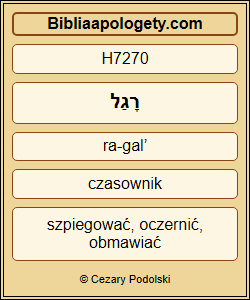 — ziemię H776 — ziemię H776 ; przyszli H935 ; przyszli H935 tam H8033 tam H8033 wzięli H3947 wzięli H3947 — rzeźbiony posąg H6456 — rzeźbiony posąg H6456 — efod H646 — efod H646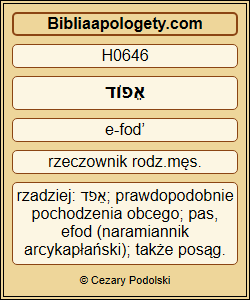 — terafim H8655 — terafim H8655 — odlany posąg H4541 — odlany posąg H4541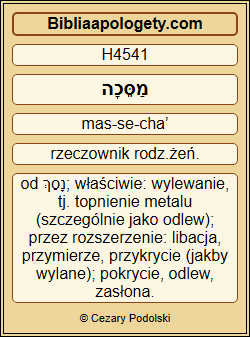 ; a kapłan H3548 ; a kapłan H3548 stał H5324 stał H5324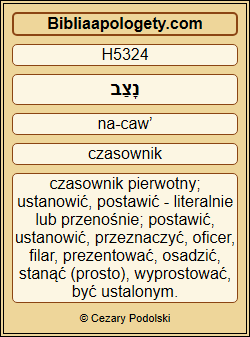 przy wejściu H6607 przy wejściu H6607 bramy H8179 bramy H8179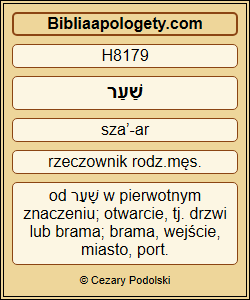 , a sześć H8337 , a sześć H8337 setek H3967 setek H3967 mężów H376, przepasanych H2296 mężów H376, przepasanych H2296 orężem H3627 orężem H3627 wojennym H4421 wojennym H4421 . (Sdz18_17 tłum. AI) . (Sdz18_17 tłum. AI) |
|||||||||||||||||||||||||||
| L03 | Sdz18_17 | pięciu owych mężów, którzy wywiadywali się o kraj, weszło do wnętrza, wzięło posążek rzeźbiony wraz z efodem i terafim oraz posążek ulany z metalu. A kapłan stał na progu u drzwi razem z owymi sześciuset mężami uzbrojonymi do boju. (Sdz18_17 BT_4) | |||||||||||||||||||||||||||
| L04 | Sdz18_17 | Pięciu H2568 owych mężów H376, którzy wywiadywali się H7270 o kraj H776, weszło H935 do wnętrza H1004 , wzięło H3947 posążek rzeźbiony H6459 , wzięło H3947 posążek rzeźbiony H6459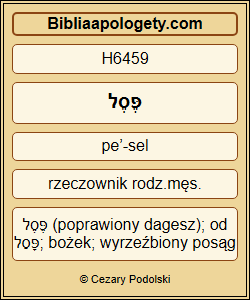 wraz z efodem H646 i terafim H8655 oraz posążek ulany z metalu H4541. A kapłan H3548 stał H5324 na progu H6607 u drzwi H8179 razem z owymi sześciuset H8337 H3967 mężami H376 uzbrojonymi H2296 do boju H4421. (Sdz18_17 BT_4) wraz z efodem H646 i terafim H8655 oraz posążek ulany z metalu H4541. A kapłan H3548 stał H5324 na progu H6607 u drzwi H8179 razem z owymi sześciuset H8337 H3967 mężami H376 uzbrojonymi H2296 do boju H4421. (Sdz18_17 BT_4) |
|||||||||||||||||||||||||||
| L05 | Sdz18_17 | wai•ja•'a•<Lu> | cha•<Me>•szet | ha•'a•na•<szim>, | ha•ho•le•<Chim> | le•rag•<Gel> | 'et- | ha•'a•<Rec> | <Ba>•'u | <szam>•ma, | la•ke•<Chu>, | 'et- | hap•<Pe>•sel | we•'<Et> | ha•'e•<Fod>, | we•'<Et> | hat•te•ra•<Fim> | we•'<Et> | ham•mas•se•<Cha>; | we•hak•ko•<Hen>, | nic•<caw> | <Pe>•tach | hasz•<sza>•'ar, | we•szesz- | me•'ot | ha•'<Isz>, | he•cha•<Gur> | ke•<Le> | ham•mil•cha•<Ma>. |
| L06 | Sdz18_17 | וַֽיַּעֲל֞וּ | חֲמֵ֣שֶׁת | הָאֲנָשִׁ֗ים | הַהֹלְכִים֮ | לְרַגֵּ֣ל | אֶת־ | הָאָרֶץ֒ | בָּ֣אוּ | שָׁ֔מָּה | לָקְח֗וּ | אֶת־ | הַפֶּ֙סֶל֙ | וְאֶת־ | הָ֣אֵפ֔וֹד | וְאֶת־ | הַתְּרָפִ֖ים | וְאֶת־ | הַמַּסֵּכָ֑ה | וְהַכֹּהֵ֗ן | נִצָּב֙ | פֶּ֣תַח | הַשַּׁ֔עַר | וְשֵׁשׁ־ | מֵא֣וֹת | הָאִ֔ישׁ | הֶחָג֖וּר | כְּלֵ֥י | הַמִּלְחָמָֽה׃ |
| L07 | Sdz18_17 | I weszli | pięciu | mężów, | którzy szli | wyszpiegować | — | ziemię; | przyszli | tam | wzięli | — | rzeźbiony posąg | — | efod | — | terafim | — | odlany posąg; | a kapłan | stał | przy wejściu | bramy, | a sześć | setek | mężów, | przepasanych | orężem | wojennym. |
| L08 | Sdz18_17 | וַֽ/יַּעֲל֞וּ | חֲמֵ֣שֶׁת | הָ/אֲנָשִׁ֗ים | הַ/הֹלְכִים֮ | לְ/רַגֵּ֣ל | אֶת־ | הָ/אָרֶץ֒ | בָּ֣אוּ | שָׁ֔מָּ/ה | לָקְח֗וּ | אֶת־ | הַ/פֶּ֙סֶל֙ | וְ/אֶת־ | הָ֣/אֵפ֔וֹד | וְ/אֶת־ | הַ/תְּרָפִ֖ים | וְ/אֶת־ | הַ/מַּסֵּכָ֑ה | וְ/הַ/כֹּהֵ֗ן | נִצָּב֙ | פֶּ֣תַח | הַ/שַּׁ֔עַר | וְ/שֵׁשׁ־ | מֵא֣וֹת | הָ/אִ֔ישׁ | הֶ/חָג֖וּר | כְּלֵ֥י | הַ/מִּלְחָמָֽה׃ |
| L09 | Sdz18_17 | HC/Vqw3mpSpój. + Czas. qal, imperf. konsekutywne, 3 os., m., lm. | HAcmscPrzym. liczebnik główny, m., lp., stan konstrukcyjny | HTd/NcmpaPartykuła rodzajnik określony + Rzecz. posp., m., lm., stan absolutny | HTd/VqrmpaPartykuła rodzajnik określony + Czas. qal, imiesłów czynny, m., lm., stan absolutny | HR/VpcPrzyim. + Czas. piel, bezok. konstrukcyjny | HToPartykuła znacznik dopełnienia bliższego | HTd/NcbsaPartykuła rodzajnik określony + Rzecz. posp., r. wspólny, lp., stan absolutny | HVqp3cpCzas. qal, perfectum, 3 os., r. wspólny, lm. | HD/SdPrzysł. + Sufiks he kierunkowe | HVqp3cpCzas. qal, perfectum, 3 os., r. wspólny, lm. | HToPartykuła znacznik dopełnienia bliższego | HTd/NcmsaPartykuła rodzajnik określony + Rzecz. posp., m., lp., stan absolutny | HC/ToSpój. + Partykuła znacznik dopełnienia bliższego | HTd/NcmsaPartykuła rodzajnik określony + Rzecz. posp., m., lp., stan absolutny | HC/ToSpój. + Partykuła znacznik dopełnienia bliższego | HTd/NcmpaPartykuła rodzajnik określony + Rzecz. posp., m., lm., stan absolutny | HC/ToSpój. + Partykuła znacznik dopełnienia bliższego | HTd/NcfsaPartykuła rodzajnik określony + Rzecz. posp., ż., lp., stan absolutny | HC/Td/NcmsaSpój. + Partykuła rodzajnik określony + Rzecz. posp., m., lp., stan absolutny | HVNrmsaCzas. nifal, imiesłów czynny, m., lp., stan absolutny | HNcmscRzecz. posp., m., lp., stan konstrukcyjny | HTd/NcmsaPartykuła rodzajnik określony + Rzecz. posp., m., lp., stan absolutny | HC/AcfsaSpój. + Przym. liczebnik główny, ż., lp., stan absolutny | HAcbpaPrzym. liczebnik główny, r. wspólny, lm., stan absolutny | HTd/NcmsaPartykuła rodzajnik określony + Rzecz. posp., m., lp., stan absolutny | HTd/VqsmsaPartykuła rodzajnik określony + Czas. qal, imiesłów bierny, m., lp., stan absolutny | HNcmpcRzecz. posp., m., lm., stan konstrukcyjny | HTd/NcfsaPartykuła rodzajnik określony + Rzecz. posp., ż., lp., stan absolutny |
| L10 | Sdz18_17 | wa|yya`álû | Hám뺚et | hä´ánäšîm | hahölkîm | lüraGGël | ´et- | hä´ärec | B亴û | šäºmmâ | läqHû | ´et- | haPPeºsel | wü´et- | h亴ëpôd | wü´et- | haTTüräpîm | wü´et- | hammassëkâ | wühaKKöhën | niccäb | PeºtaH | haššaº`ar | wüšëš- | më´ôt | hä´îš | heHägûr | Külê | hammilHämâ |
| L11 | Sdz18_17 | H5927 |
H2568 |
H0376 |
H1980 |
H7270 |
H0853 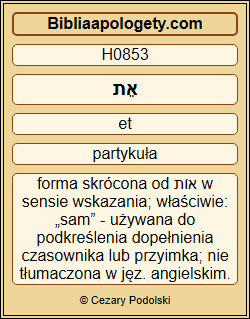 |
H0776 |
H0935 |
H8033 |
H3947 |
H0853 |
H6456 |
H0853 |
H0646 |
H0853 |
H8655 |
H0853 |
H4541 |
H3548 |
H5324 |
H6607 |
H8179 |
H8337 |
H3967 |
H0376 |
H2296 |
H3627 |
H4421 |
| L12 | Sdz18_17 | went up | And the five | men | that went | to spy out | the land | [and] came in | there | thither [and] took | carved image | and the ephod | and the teraphim | and the molten image | and the priest | stood | in the entering | of the gate | with the six | hundred | men | [that were] appointed | with weapons | of war | |||||
| L13 | Sdz18_17 | vai·ya·'a·Lu | cha·Me·shet | ha·'a·na·Shim, | ha·ho·le·Chim | le·rag·Gel | et- | ha·'a·Retz | Ba·'u | Sham·mah, | la·ke·Chu, | et- | hap·Pe·sel | ve·'Et | ha·'e·Fod, | ve·'Et | hat·te·ra·Fim | ve·'Et | ham·mas·se·Chah; | ve·hak·ko·Hen, | nitz·Tzav | Pe·tach | hash·Sha·'ar, | ve·shesh- | me·'ot | ha·'Ish, | he·cha·Gur | ke·Lei | ham·mil·cha·Mah. |
| L14 | Sdz18_17 | עָלָה | חָמֵשׁ | אִישׁ | הָלַךְ | רָגַל | אֵת | אֶרֶץ | בּוֹא | שָׁם | לָקַח | אֵת | פְּסִיל | אֵת | אֵפוֹד | אֵת | תְּרָפִים | אֵת | מַסֵּכָה | כֹּהֵן | נָצַב | פֶּתַח | שַׁעַר | שֵׁשׁ | מֵאָה | אִישׁ | חָגַר | כְּלִי | מִלְחָמָה |
| L15 | Sdz18_17 | 'a·(La) | cha·(Mesz) | ('Isz) | ha·(Lach) | ra·(Gal) | ('Et) | '(E)·rec | (Bo) | (Szam) | la·(Kach) | ('Et) | pe·(Sil) | ('Et) | e·(Fod) | ('Et) | te·ra·(Fim) | ('Et) | mas·se·(Cha) | ko·(Hen) | na·(Caw) | (Pe)·tach | (Sza)·'ar | (Szesz) | me·('A) | ('Isz) | cha·(Gar) | ke·(Li) | mil·cha·(Ma) |
| L16 | Sdz18_17 | ‘ālā(h) | ḥāmēš | ’îš | hālaḵ | rāg̱al | ’ēṯ | ’éreṣ | bô(’) | šām | lāqaḥ | ’ēṯ | pᵉsîl | ’ēṯ | ’ēp̱ôḏ | ’ēṯ | tᵉrāp̱îm | ’ēṯ | massēḵā(h) | kōhēn | nāṣaḇ | péṯaḥ | šá‘ar | šēš | mē’ā(h) | ’îš | ḥāg̱ar | kᵉlî | milḥāmā(h) |
| L17 | Sdz18_17 | ‘ālāh | ḥāmēš | ’îš | hālak | rāgal | ’ēt | ’ereṣ | bô’ | šām | lāqaḥ | ’ēt | pesîl | ’ēt | ’ēpôd | ’ēt | terāpîm | ’ēt | massēkāh | kōhēn | nāṣab | petaḥ | ša‘ar | šēš | mē’āh | ’îš | ḥāgar | kelî | milḥāmāh |
| L18 | Sdz18_17 | And the five men that went to spy out the land went up, [and] came in thither, [and] took the graven image, and the ephod, and the teraphim, and the molten image: and the priest stood in the entering of the gate with the six hundred men [that were] appointed with weapons of war. (Sdz18_17 KJV) | |||||||||||||||||||||||||||
| L19 | Sdz18_17 | 17 And the five <02568> men <0582> that went <01980> (08802) to spy out <07270> (08763) the land <0776> went up <05927> (08799), and came in <0935> (08804) thither, and took <03947> (08804) the graven image <06459>, and the ephod <0646>, and the teraphim <08655>, and the molten image <04541>: and the priest <03548> stood <05324> (08737) in the entering <06607> of the gate <08179> with the six <08337> hundred <03967> men <0376> that were appointed <02296> (08803) with weapons <03627> of war <04421>. (Sdz18_17 KJV) | |||||||||||||||||||||||||||
| L20 | Sdz18_17 | 306/883 | 155/342 | 675/2004 | 445/1542 | 19/26 | 5179/11047 | 1009/2502 | 748/2550 | 309/832 | 449/964 | 5180/11047 | 6/24 | 5181/11047 | 35/49 | 5182/11047 | 6/15 | 5183/11047 | 12/28 | 339/750 | 32/74 | 85/164 | 70/373 | 85/215 | 219/574 | 676/2004 | 11/44 | 106/325 | 62/319 |
| L21 | Sdz18_17 | Sdz18_17_1 | Sdz18_17_2 | Sdz18_17_3 | Sdz18_17_4 | Sdz18_17_5 | Sdz18_17_6 | Sdz18_17_7 | Sdz18_17_8 | Sdz18_17_9 | Sdz18_17_10 | Sdz18_17_11 | Sdz18_17_12 | Sdz18_17_13 | Sdz18_17_14 | Sdz18_17_15 | Sdz18_17_16 | Sdz18_17_17 | Sdz18_17_18 | Sdz18_17_19 | Sdz18_17_20 | Sdz18_17_21 | Sdz18_17_22 | Sdz18_17_23 | Sdz18_17_24 | Sdz18_17_25 | Sdz18_17_26 | Sdz18_17_27 | Sdz18_17_28 |