| L01 |
Pwt20_1 |
Gdy wyjdziesz na wojnę przeciw twoim wrogom i zobaczysz konia i rydwan, lud liczniejszy od ciebie, nie będziesz się bał ich, gdyż Jahwe, twój Bóg, z tobą, wyprowadzający cię z ziemi Egiptu. (Pwt20_1 tłum. AI) |
| L02 |
Pwt20_1 |
Gdy H3588 wyjdziesz H3318 wyjdziesz H3318 na wojnę H4421 na wojnę H4421 przeciw H5921 przeciw H5921 twoim wrogom H341 twoim wrogom H341 i zobaczysz H7200 i zobaczysz H7200 konia H5483 konia H5483 i rydwan H7393 i rydwan H7393 , lud H5971 , lud H5971 liczniejszy H7227 liczniejszy H7227 od ciebie H4480 od ciebie H4480 , nie H3808 , nie H3808 będziesz się bał H3372 będziesz się bał H3372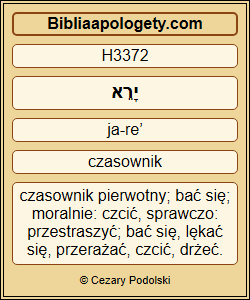 ich H1992 ich H1992 , gdyż H3588 Jahwe H3068 , gdyż H3588 Jahwe H3068 , twój Bóg H430 , twój Bóg H430 , z tobą H5973 , z tobą H5973 , wyprowadzający cię H5927 , wyprowadzający cię H5927 z ziemi H776 z ziemi H776 Egiptu H4714 Egiptu H4714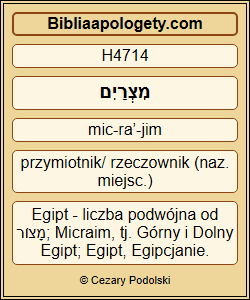 . (Pwt20_1 tłum. AI) . (Pwt20_1 tłum. AI) |
| L03 |
Pwt20_1 |
Jeśli się udasz na wojnę przeciw twemu wrogowi, a zauważysz, że koni, rydwanów i ludzi tam jest więcej niż u ciebie, nie lękaj się ich, gdyż z tobą jest Pan, Bóg twój, który cię wywiódł z ziemi egipskiej. (Pwt20_1 BT_4) |
| L04 |
Pwt20_1 |
Jeśli się udasz na wojnę H4421 przeciw twemu wrogowi H341, a zauważysz, że koni H5483, rydwanów H7393 i ludzi H5971 tam jest więcej H7227 niż u ciebie, nie lękaj się ich H3372, gdyż z tobą jest Pan H3068, Bóg H430 twój, który cię wywiódł H5927 z ziemi H776 egipskiej H4714. (Pwt20_1 BT_4) |
| L05 |
Pwt20_1 |
ki- |
te•<ce> |
lam•mil•cha•<Ma> |
'al- |
'o•je•<we>•cha, |
we•ra•'<I>•ta |
sus |
wa•<Re>•chew |
'am |
raw |
mi•me•<Cha>, |
lo |
ti•<Ra> |
me•<Hem>; |
ki- |
<jah>•weQere (czytaj): A·do·(Naj) |
'e•lo•<He>•cha |
'im•<Mach>, |
ham•ma•'al•<Cha> |
me•'<E>•rec |
mic•<Ra>•jim. |
| L06 |
Pwt20_1 |
כִּֽי־ |
תֵצֵ֨א |
לַמִּלְחָמָ֜ה |
עַל־ |
אֹיְבֶ֗יךָ |
וְֽרָאִ֜יתָ |
ס֤וּס |
וָרֶ֙כֶב֙ |
עַ֚ם |
רַ֣ב |
מִמְּךָ֔ |
לֹ֥א |
תִירָ֖א |
מֵהֶ֑ם |
כִּֽי־ |
יְהוָ֤ה |
אֱלֹהֶ֙יךָ֙ |
עִמָּ֔ךְ |
הַמַּֽעַלְךָ֖ |
מֵאֶ֥רֶץ |
מִצְרָֽיִם׃ |
| L07 |
Pwt20_1 |
Gdy |
wyjdziesz |
na wojnę |
przeciw |
twoim wrogom |
i zobaczysz |
konia |
i rydwan, |
lud |
liczniejszy |
od ciebie, |
nie |
będziesz się bał |
ich, |
gdyż |
Jahwe, |
twój Bóg, |
z tobą, |
wyprowadzający cię |
z ziemi |
Egiptu. |
| L08 |
Pwt20_1 |
כִּֽי־ |
תֵצֵ֨א |
לַ/מִּלְחָמָ֜ה |
עַל־ |
אֹיְבֶ֗י/ךָ |
וְֽ/רָאִ֜יתָ |
ס֤וּס |
וָ/רֶ֙כֶב֙ |
עַ֚ם |
רַ֣ב |
מִמְּ/ךָ֔ |
לֹ֥א |
תִירָ֖א |
מֵ/הֶ֑ם |
כִּֽי־ |
יְהוָ֤ה |
אֱלֹהֶ֙י/ךָ֙ |
עִמָּ֔/ךְ |
הַ/מַּֽעַלְ/ךָ֖ |
מֵ/אֶ֥רֶץ |
מִצְרָֽיִם׃ |
| L09 |
Pwt20_1 |
HCSpój. |
HVqi2msCzas. qal, imperfektum, 2 os., m., lp. |
HRd/NcfsaPrzyim. z rodzajnikiem + Rzecz. posp., ż., lp., stan absolutny |
HRPrzyim. |
HVqrmpc/Sp2msCzas. qal, imiesłów czynny, m., lm., stan konstrukcyjny + Sufiks zaimkowy, 2 os., m., lp. |
HC/Vqq2msSpój. + Czas. qal, perf. konsekutywne, 2 os., m., lp. |
HNcmsaRzecz. posp., m., lp., stan absolutny |
HC/NcmsaSpój. + Rzecz. posp., m., lp., stan absolutny |
HNcmsaRzecz. posp., m., lp., stan absolutny |
HAamsaPrzym. zwykły, m., lp., stan absolutny |
HR/Sp2msPrzyim. + Sufiks zaimkowy, 2 os., m., lp. |
HTnPartykuła przecząca |
HVqi2msCzas. qal, imperfektum, 2 os., m., lp. |
HR/Sp3mpPrzyim. + Sufiks zaimkowy, 3 os., m., lm. |
HCSpój. |
HNpRzecz. własny |
HNcmpc/Sp2msRzecz. posp., m., lm., stan konstrukcyjny + Sufiks zaimkowy, 2 os., m., lp. |
HR/Sp2fsPrzyim. + Sufiks zaimkowy, 2 os., ż., lp. |
HTd/Vhrmsc/Sp2msPartykuła rodzajnik określony + Czas. hifil, imiesłów czynny, m., lp., stan konstrukcyjny + Sufiks zaimkowy, 2 os., m., lp. |
HR/NcbscPrzyim. + Rzecz. posp., r. wspólny, lp., stan konstrukcyjny |
HNpRzecz. własny |
| L10 |
Pwt20_1 |
Kî|- |
tëcë´ |
lammilHämâ |
`al- |
´öybʺkä |
wü|rä´îºtä |
sûs |
wäreºkeb |
`am |
rab |
mimmükä |
lö´ |
tîrä´ |
mëhem |
Kî|- |
yhwh(´ädönäy) |
´élöhʺkä |
`immäk |
hamma|`alkä |
më´eºrec |
micräºyim |
| L11 |
Pwt20_1 |
H3588 |
H3318 |
H4421 |
H5921 |
H0341 |
H7200 |
H5483 |
H7393 |
H5971 |
H7227 |
H4480 |
H3808 |
H3372 |
H1992 |
H3588 |
H3068 |
H0430 |
H5973 |
H5927 |
H0776 |
H4714 |
| L12 |
Pwt20_1 |
When |
When thou goest out |
to battle |
against |
against thine enemies |
and seest |
horses |
and chariots |
[and] a people |
more |
than |
do |
than thou be not afraid |
like |
When |
of them for the LORD |
thy God |
with |
[is] with thee which brought thee up |
out of the land |
of Egypt |
| L13 |
Pwt20_1 |
ki- |
te·Tze |
lam·mil·cha·Mah |
al- |
'o·ye·Vei·cha, |
ve·ra·'I·ta |
sus |
va·Re·chev |
'am |
rav |
mi·me·Cha, |
lo |
ti·Ra |
me·Hem; |
ki- |
Yah·weh |
'e·lo·Hei·cha |
'im·Mach, |
ham·ma·'al·Cha |
me·'E·retz |
mitz·Ra·yim. |
| L14 |
Pwt20_1 |
כִּי |
יָצָא |
מִלְחָמָה |
עַל |
אֹיֵב |
רָאָה |
סוּס |
רֶכֶב |
עַם |
רַב |
מִן |
לֹא |
יָרֵא |
הֵם |
כִּי |
יְהֹוָה |
אֱלֹהִים |
עִם |
עָלָה |
אֶרֶץ |
מִצְרַיִם |
| L15 |
Pwt20_1 |
(Ki) |
ja·(Ca) |
mil·cha·(Ma) |
('Al) |
'o·(Jew) |
ra·('A) |
(Sus) |
(Re)·chew |
('Am) |
(Raw) |
(Min) |
(Lo) |
ja·(Re) |
(Hem) |
(Ki) |
(Jah)·we |
E·lo·(Him) |
('Im) |
'a·(La) |
'(E)·rec |
mic·(Ra)·jim |
| L16 |
Pwt20_1 |
kî |
jāṣā(’) |
milḥāmā(h) |
‘al |
’ōjēḇ |
rā’ā(h) |
sûs |
réḵeḇ |
‘am |
raḇ |
min |
lō(’) |
jārē(’) |
hēm |
kî |
JHWH |
’ᵉ̆lōhîm |
‘im |
‘ālā(h) |
’éreṣ |
miṣrájim |
| L17 |
Pwt20_1 |
kî |
jāṣā’ |
milḥāmāh |
‘al |
’ōjēb |
rā’āh |
sûs |
rekeb |
‘am |
rab |
min |
lō’ |
jārē’ |
hēm |
kî |
jhwh |
’ĕlōhîm |
‘im |
‘ālāh |
’ereṣ |
miṣrajim |
| L18 |
Pwt20_1 |
When thou goest out to battle against thine enemies, and seest horses, and chariots, [and] a people more than thou, be not afraid of them: for the LORD thy God [is] with thee, which brought thee up out of the land of Egypt. (Pwt20_1 KJV) |
| L19 |
Pwt20_1 |
1 When thou goest out <03318> (08799) to battle <04421> against thine enemies <0341> (08802), and seest <07200> (08804) horses <05483>, and chariots <07393>, and a people <05971> more <07227> than thou, be not afraid <03372> (08799) of them: for the LORD <03068> thy God <0430> is with thee, which brought thee up <05927> (08688) out of the land <0776> of Egypt <04714>. (Pwt20_1 KJV) |
| L20 |
Pwt20_1 |
914/4478 |
318/1060 |
28/319 |
1420/5759 |
32/280 |
367/1296 |
12/137 |
13/119 |
389/1866 |
58/462 |
376/1215 |
1145/5164 |
72/328 |
141/820 |
915/4478 |
1567/6220 |
695/2597 |
204/1043 |
192/883 |
778/2502 |
280/614 |
| L21 |
Pwt20_1 |
Pwt20_1_1 |
Pwt20_1_2 |
Pwt20_1_3 |
Pwt20_1_4 |
Pwt20_1_5 |
Pwt20_1_6 |
Pwt20_1_7 |
Pwt20_1_8 |
Pwt20_1_9 |
Pwt20_1_10 |
Pwt20_1_11 |
Pwt20_1_12 |
Pwt20_1_13 |
Pwt20_1_14 |
Pwt20_1_15 |
Pwt20_1_16 |
Pwt20_1_17 |
Pwt20_1_18 |
Pwt20_1_19 |
Pwt20_1_20 |
Pwt20_1_21 |
| |
| L01 |
Pwt20_2 |
I stanie się, gdy zbliżycie się do wojny, i zbliży się kapłan i przemówi do ludu. (Pwt20_2 tłum. AI) |
| L02 |
Pwt20_2 |
I stanie się H1961 , gdy zbliżycie się H7126 , gdy zbliżycie się H7126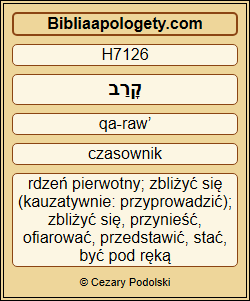 do H413 do H413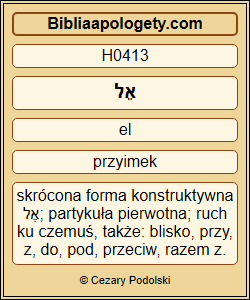 wojny H4421, i zbliży się H5066 wojny H4421, i zbliży się H5066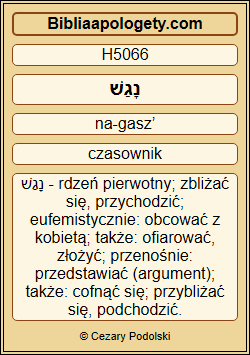 kapłan H3548 kapłan H3548 i przemówi H1696 i przemówi H1696 do H413 ludu H5971. (Pwt20_2 tłum. AI) do H413 ludu H5971. (Pwt20_2 tłum. AI) |
| L03 |
Pwt20_2 |
Gdy będziecie zaczynali walkę, wystąpi kapłan i przemówi do narodu, (Pwt20_2 BT_4) |
| L04 |
Pwt20_2 |
Gdy będziecie zaczynali H7126 walkę H4421, wystąpi kapłan H3548 i przemówi H1696 do narodu H5971, (Pwt20_2 BT_4) |
| L05 |
Pwt20_2 |
we•ha•<ja> |
ke•ka•ra•we•<Chem> |
'el- |
ham•mil•cha•<Ma>; |
we•nig•<Gasz> |
hak•ko•<Hen> |
we•dib•<Ber> |
'el- |
ha•'<Am>. |
| L06 |
Pwt20_2 |
וְהָיָ֕ה |
כְּקָֽרָבְכֶ֖ם |
אֶל־ |
הַמִּלְחָמָ֑ה |
וְנִגַּ֥שׁ |
הַכֹּהֵ֖ן |
וְדִבֶּ֥ר |
אֶל־ |
הָעָֽם׃ |
| L07 |
Pwt20_2 |
I stanie się, |
gdy zbliżycie się |
do |
wojny, |
i zbliży się |
kapłan |
i przemówi |
do |
ludu. |
| L08 |
Pwt20_2 |
וְ/הָיָ֕ה |
כְּ/קָֽרָבְ/כֶ֖ם |
אֶל־ |
הַ/מִּלְחָמָ֑ה |
וְ/נִגַּ֥שׁ |
הַ/כֹּהֵ֖ן |
וְ/דִבֶּ֥ר |
אֶל־ |
הָ/עָֽם׃ |
| L09 |
Pwt20_2 |
HC/Vqq3msSpój. + Czas. qal, perf. konsekutywne, 3 os., m., lp. |
HR/Vqc/Sp2mpPrzyim. + Czas. qal, bezok. konstrukcyjny + Sufiks zaimkowy, 2 os., m., lm. |
HRPrzyim. |
HTd/NcfsaPartykuła rodzajnik określony + Rzecz. posp., ż., lp., stan absolutny |
HC/VNq3msSpój. + Czas. nifal, perf. konsekutywne, 3 os., m., lp. |
HTd/NcmsaPartykuła rodzajnik określony + Rzecz. posp., m., lp., stan absolutny |
HC/Vpq3msSpój. + Czas. piel, perf. konsekutywne, 3 os., m., lp. |
HRPrzyim. |
HTd/NcmsaPartykuła rodzajnik określony + Rzecz. posp., m., lp., stan absolutny |
| L10 |
Pwt20_2 |
wühäyâ |
Küqo|robkem |
´el- |
hammilHämâ |
wüniGGaš |
haKKöhën |
wüdiBBer |
´el- |
hä`äm |
| L11 |
Pwt20_2 |
H1961 |
H7126 |
H0413 |
H4421 |
H5066 |
H3548 |
H1696 |
H0413 |
H5971 |
| L12 |
Pwt20_2 |
become |
And it shall be when ye are come nigh |
about |
unto the battle |
shall approach |
that the priest |
and speak |
to |
unto the people |
| L13 |
Pwt20_2 |
ve·ha·Yah |
ke·ka·ra·ve·Chem |
el- |
ham·mil·cha·Mah; |
ve·nig·Gash |
hak·ko·Hen |
ve·dib·Ber |
el- |
ha·'Am. |
| L14 |
Pwt20_2 |
הָיָה |
קָרַב |
אֵל |
מִלְחָמָה |
נָגַשׁ |
כֹּהֵן |
דָבַר |
אֵל |
עַם |
| L15 |
Pwt20_2 |
ha·(Ja) |
ka·(Raw) |
('El) |
mil·cha·(Ma) |
na·(Gasz) |
ko·(Hen) |
da·(War) |
('El) |
('Am) |
| L16 |
Pwt20_2 |
hājā(h) |
qāraḇ |
’ēl |
milḥāmā(h) |
nāg̱aš |
kōhēn |
ḏāḇar |
’ēl |
‘am |
| L17 |
Pwt20_2 |
hājāh |
qārab |
’ēl |
milḥāmāh |
nāgaš |
kōhēn |
dābar |
’ēl |
‘am |
| L18 |
Pwt20_2 |
And it shall be, when ye are come nigh unto the battle, that the priest shall approach and speak unto the people, (Pwt20_2 KJV) |
| L19 |
Pwt20_2 |
2 And it shall be, when ye are come nigh <07126> (08800) unto the battle <04421>, that the priest <03548> shall approach <05066> (08738) and speak <01696> (08765) unto the people <05971>, (Pwt20_2 KJV) |
| L20 |
Pwt20_2 |
947/3546 |
194/284 |
1587/5500 |
29/319 |
42/125 |
289/750 |
397/1142 |
1588/5500 |
390/1866 |
| L21 |
Pwt20_2 |
Pwt20_2_1 |
Pwt20_2_2 |
Pwt20_2_3 |
Pwt20_2_4 |
Pwt20_2_5 |
Pwt20_2_6 |
Pwt20_2_7 |
Pwt20_2_8 |
Pwt20_2_9 |
| |
| L01 |
Pwt20_3 |
I powie do nich: Słuchaj, Izraelu, wy zbliżacie się dzisiaj do wojny przeciw waszym wrogom; niech nie słabnie wasze serce, nie bójcie się i nie trwóżcie się i nie drżyjcie przed nimi. (Pwt20_3 tłum. AI) |
| L02 |
Pwt20_3 |
I powie H559 do nich H413: Słuchaj H8085 do nich H413: Słuchaj H8085 , Izraelu H3478 , Izraelu H3478 , wy H859 , wy H859 zbliżacie się H7131 zbliżacie się H7131 dzisiaj H3117 dzisiaj H3117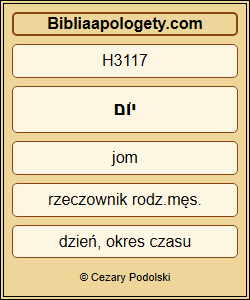 do wojny H4421 przeciw H5921 waszym wrogom H341; niech nie H408 do wojny H4421 przeciw H5921 waszym wrogom H341; niech nie H408 słabnie H7401 słabnie H7401 wasze serce H3824 wasze serce H3824 , nie H408 bójcie się H3372 i nie H408 trwóżcie się H2648 , nie H408 bójcie się H3372 i nie H408 trwóżcie się H2648 i nie H408 drżyjcie H6206 i nie H408 drżyjcie H6206 przed nimi H6440 przed nimi H6440 . (Pwt20_3 tłum. AI) . (Pwt20_3 tłum. AI) |
| L03 |
Pwt20_3 |
mówiąc mu: Słuchaj, Izraelu! Zaczynacie dzisiaj walkę przeciw wrogom waszym, niech trwoga przed nimi was nie ogarnia! Niech serce wam nie drży! Nie bójcie się, nie lękajcie się! (Pwt20_3 BT_4) |
| L04 |
Pwt20_3 |
mówiąc mu: Słuchaj H8085, Izraelu H3478! Zaczynacie dzisiaj H3117 walkę H4421 przeciw wrogom H341 waszym, niech trwoga H7401 przed nimi was nie ogarnia! Niech serce H3824 wam nie drży H3372! Nie bójcie się H3372, nie lękajcie się H6206! (Pwt20_3 BT_4) |
| L05 |
Pwt20_3 |
we•'a•<Mar> |
'a•le•<Hem> |
sze•<Ma>' |
jis•ra•'<El>, |
'at•<Tem> |
ke•re•<wim> |
hai•<jom> |
lam•mil•cha•<Ma> |
'al- |
'o•je•we•<Chem>; |
'al- |
je•<Rach> |
le•waw•<Chem>, |
'al- |
ti•re•'<U> |
we•'al- |
tach•pe•<Zu> |
we•'al- |
ta•'ar•<cu> |
mip•pe•ne•<Hem>. |
| L06 |
Pwt20_3 |
וְאָמַ֤ר |
אֲלֵהֶם֙ |
שְׁמַ֣ע |
יִשְׂרָאֵ֔ל |
אַתֶּ֨ם |
קְרֵבִ֥ים |
הַיּ֛וֹם |
לַמִּלְחָמָ֖ה |
עַל־ |
אֹיְבֵיכֶ֑ם |
אַל־ |
יֵרַ֣ךְ |
לְבַבְכֶ֗ם |
אַל־ |
תִּֽירְא֧וּ |
וְאַֽל־ |
תַּחְפְּז֛וּ |
וְאַל־ |
תַּֽעַרְצ֖וּ |
מִפְּנֵיהֶֽם׃ |
| L07 |
Pwt20_3 |
I powie |
do nich: |
Słuchaj, |
Izraelu, |
wy |
zbliżacie się |
dzisiaj |
do wojny |
przeciw |
waszym wrogom; |
niech nie |
słabnie |
wasze serce, |
nie |
bójcie się |
i nie |
trwóżcie się |
i nie |
drżyjcie |
przed nimi. |
| L08 |
Pwt20_3 |
וְ/אָמַ֤ר |
אֲלֵ/הֶם֙ |
שְׁמַ֣ע |
יִשְׂרָאֵ֔ל |
אַתֶּ֨ם |
קְרֵבִ֥ים |
הַ/יּ֛וֹם |
לַ/מִּלְחָמָ֖ה |
עַל־ |
אֹיְבֵי/כֶ֑ם |
אַל־ |
יֵרַ֣ךְ |
לְבַבְ/כֶ֗ם |
אַל־ |
תִּֽירְא֧וּ |
וְ/אַֽל־ |
תַּחְפְּז֛וּ |
וְ/אַל־ |
תַּֽעַרְצ֖וּ |
מִ/פְּנֵי/הֶֽם׃ |
| L09 |
Pwt20_3 |
HC/Vqq3msSpój. + Czas. qal, perf. konsekutywne, 3 os., m., lp. |
HR/Sp3mpPrzyim. + Sufiks zaimkowy, 3 os., m., lm. |
HVqv2msCzas. qal, imperatyw, 2 os., m., lp. |
HNpRzecz. własny |
HPp2mpZaimek osobowy, 2 os., m., lm. |
HAampaPrzym. zwykły, m., lm., stan absolutny |
HTd/NcmsaPartykuła rodzajnik określony + Rzecz. posp., m., lp., stan absolutny |
HRd/NcfsaPrzyim. z rodzajnikiem + Rzecz. posp., ż., lp., stan absolutny |
HRPrzyim. |
HVqrmpc/Sp2mpCzas. qal, imiesłów czynny, m., lm., stan konstrukcyjny + Sufiks zaimkowy, 2 os., m., lm. |
HTnPartykuła przecząca |
HVqj3msCzas. qal, jussyw, 3 os., m., lp. |
HNcmsc/Sp2mpRzecz. posp., m., lp., stan konstrukcyjny + Sufiks zaimkowy, 2 os., m., lm. |
HTnPartykuła przecząca |
HVqj2mpCzas. qal, jussyw, 2 os., m., lm. |
HC/TnSpój. + Partykuła przecząca |
HVqj2mpCzas. qal, jussyw, 2 os., m., lm. |
HC/TnSpój. + Partykuła przecząca |
HVqj2mpCzas. qal, jussyw, 2 os., m., lm. |
HR/Ncbpc/Sp3mpPrzyim. + Rzecz. posp., r. wspólny, lm., stan konstrukcyjny + Sufiks zaimkowy, 3 os., m., lm. |
| L10 |
Pwt20_3 |
wü´ämar |
´álëhem |
šüma` |
yiSrä´ël |
´aTTem |
qürëbîm |
hayyôm |
lammilHämâ |
`al- |
´öybêkem |
´al- |
yërak |
lübabkem |
´al- |
Tî|r´û |
wü´a|l- |
TaHPüzû |
wü´al- |
Ta|`arcû |
miPPünêhem |
| L11 |
Pwt20_3 |
H0559 |
H0413 |
H8085 |
H3478 |
H0859 |
H7131 |
H3117 |
H4421 |
H5921 |
H0341 |
H0408 |
H7401 |
H3824 |
H0408 |
H3372 |
H0408 |
H2648 |
H0408 |
H6206 |
H6440 |
| L12 |
Pwt20_3 |
And shall say |
to |
unto them Hear |
O Israel |
ye |
ye approach |
this day |
unto battle |
against |
against your enemies |
nay |
faint |
let not your hearts |
not |
fear |
not |
not and do not tremble |
not |
neither be ye terrified |
because |
| L13 |
Pwt20_3 |
ve·'a·Mar |
'a·le·Hem |
she·Ma' |
Yis·ra·'El, |
'at·Tem |
ke·re·Vim |
hai·Yom |
lam·mil·cha·Mah |
al- |
'o·ye·vei·Chem; |
al- |
ye·Rach |
le·vav·Chem, |
al- |
ti·re·'U |
ve·'al- |
tach·pe·Zu |
ve·'al- |
ta·'ar·Tzu |
mip·pe·nei·Hem. |
| L14 |
Pwt20_3 |
אָמַר |
אֵל |
שָׁמַע |
יִשְׂרָאֵל |
אַתָּה |
קָרֵב |
יוֹם |
מִלְחָמָה |
עַל |
אֹיֵב |
אַל |
רָכַךְ |
לֵבָב |
אַל |
יָרֵא |
אַל |
חָפַז |
אַל |
עָרַץ |
פָּנִים |
| L15 |
Pwt20_3 |
'a·(Mar) |
('El) |
sza·(Ma)' |
jis·ra·'(El) |
'at·(Ta) |
ka·(Rew) |
(Jom) |
mil·cha·(Ma) |
('Al) |
'o·(Jew) |
('Al) |
ra·(Chach) |
le·(Waw) |
('Al) |
ja·(Re) |
('Al) |
cha·(Faz) |
('Al) |
'a·(Rac) |
pa·(Nim) |
| L16 |
Pwt20_3 |
’āmar |
’ēl |
šāma‘ |
jiśrā’ēl |
’attā(h) |
qārēḇ |
jôm |
milḥāmā(h) |
‘al |
’ōjēḇ |
’al |
rāḵaḵ |
lēḇāḇ |
’al |
jārē(’) |
’al |
ḥāp̱az |
’al |
‘āraṣ |
pānîm |
| L17 |
Pwt20_3 |
’āmar |
’ēl |
šāma‘ |
jiśrā’ēl |
’attāh |
qārēb |
jôm |
milḥāmāh |
‘al |
’ōjēb |
’al |
rākak |
lēbāb |
’al |
jārē’ |
’al |
ḥāpaz |
’al |
‘āraṣ |
pānîm |
| L18 |
Pwt20_3 |
And shall say unto them, Hear, O Israel, ye approach this day unto battle against your enemies: let not your hearts faint, fear not, and do not tremble, neither be ye terrified because of them; (Pwt20_3 KJV) |
| L19 |
Pwt20_3 |
3 And shall say <0559> (08804) unto them, Hear <08085> (08798), O Israel <03478>, ye approach <07131> this day <03117> unto battle <04421> against your enemies <0341> (08802): let not your hearts <03824> faint <07401> (08735), fear <03372> (08799) not, and do not tremble <02648> (08799), neither be ye terrified <06206> (08799) because <06440> of them; (Pwt20_3 KJV) |
| L20 |
Pwt20_3 |
1301/5298 |
1589/5500 |
209/1154 |
540/2505 |
227/1080 |
3/8 |
603/2302 |
30/319 |
1421/5759 |
33/280 |
97/725 |
1/8 |
37/252 |
98/725 |
73/328 |
99/725 |
1/8 |
100/725 |
3/15 |
581/2127 |
| L21 |
Pwt20_3 |
Pwt20_3_1 |
Pwt20_3_2 |
Pwt20_3_3 |
Pwt20_3_4 |
Pwt20_3_5 |
Pwt20_3_6 |
Pwt20_3_7 |
Pwt20_3_8 |
Pwt20_3_9 |
Pwt20_3_10 |
Pwt20_3_11 |
Pwt20_3_12 |
Pwt20_3_13 |
Pwt20_3_14 |
Pwt20_3_15 |
Pwt20_3_16 |
Pwt20_3_17 |
Pwt20_3_18 |
Pwt20_3_19 |
Pwt20_3_20 |
| |
| L01 |
Pwt20_4 |
Gdyż Jahwe, wasz Bóg, idący z wami, aby walczyć dla was z waszymi wrogami, aby wybawić —. (Pwt20_4 tłum. AI) |
| L02 |
Pwt20_4 |
Gdyż H3588 Jahwe H3068, wasz Bóg H430, idący H1980 z wami H5973, aby walczyć H3898 z wami H5973, aby walczyć H3898 dla was z H5973 waszymi wrogami H341, aby wybawić H3467 dla was z H5973 waszymi wrogami H341, aby wybawić H3467 —. (Pwt20_4 tłum. AI) —. (Pwt20_4 tłum. AI) |
| L03 |
Pwt20_4 |
Gdyż z wami wyrusza Pan, Bóg wasz, by walczyć przeciw wrogom waszym i dać wam zwycięstwo. (Pwt20_4 BT_4) |
| L04 |
Pwt20_4 |
Gdyż z wami wyrusza Pan H3068, Bóg H430 wasz, by walczyć H3898 przeciw wrogom H341 waszym i dać wam zwycięstwo H3467. (Pwt20_4 BT_4) |
| L05 |
Pwt20_4 |
ki |
<jah>•weQere (czytaj): A·do·(Naj) |
'e•lo•he•<Chem>, |
ha•ho•<Lech> |
'im•ma•<Chem>; |
le•hil•la•<Chem> |
la•<Chem> |
'im- |
'o•je•we•<Chem> |
le•ho•<szi>•a' |
'et•<Chem>. |
| L06 |
Pwt20_4 |
כִּ֚י |
יְהוָ֣ה |
אֱלֹֽהֵיכֶ֔ם |
הַהֹלֵ֖ךְ |
עִמָּכֶ֑ם |
לְהִלָּחֵ֥ם |
לָכֶ֛ם |
עִם־ |
אֹיְבֵיכֶ֖ם |
לְהוֹשִׁ֥יעַ |
אֶתְכֶֽם׃ |
| L07 |
Pwt20_4 |
Gdyż |
Jahwe, |
wasz Bóg, |
idący |
z wami, |
aby walczyć |
dla was |
z |
waszymi wrogami, |
aby wybawić |
—. |
| L08 |
Pwt20_4 |
כִּ֚י |
יְהוָ֣ה |
אֱלֹֽהֵי/כֶ֔ם |
הַ/הֹלֵ֖ךְ |
עִמָּ/כֶ֑ם |
לְ/הִלָּחֵ֥ם |
לָ/כֶ֛ם |
עִם־ |
אֹיְבֵי/כֶ֖ם |
לְ/הוֹשִׁ֥יעַ |
אֶתְ/כֶֽם׃ |
| L09 |
Pwt20_4 |
HCSpój. |
HNpRzecz. własny |
HNcmpc/Sp2mpRzecz. posp., m., lm., stan konstrukcyjny + Sufiks zaimkowy, 2 os., m., lm. |
HTd/VqrmsaPartykuła rodzajnik określony + Czas. qal, imiesłów czynny, m., lp., stan absolutny |
HR/Sp2mpPrzyim. + Sufiks zaimkowy, 2 os., m., lm. |
HR/VNcPrzyim. + Czas. nifal, bezok. konstrukcyjny |
HR/Sp2mpPrzyim. + Sufiks zaimkowy, 2 os., m., lm. |
HRPrzyim. |
HVqrmpc/Sp2mpCzas. qal, imiesłów czynny, m., lm., stan konstrukcyjny + Sufiks zaimkowy, 2 os., m., lm. |
HR/VhcPrzyim. + Czas. hifil, bezok. konstrukcyjny |
HTo/Sp2mpPartykuła znacznik dopełnienia bliższego + Sufiks zaimkowy, 2 os., m., lm. |
| L10 |
Pwt20_4 |
Kî |
yhwh(´ädönäy) |
´élö|hêkem |
hahölëk |
`immäkem |
lühilläHëm |
läkem |
`im- |
´öybêkem |
lühôšîª` |
´etkem |
| L11 |
Pwt20_4 |
H3588 |
H3068 |
H0430 |
H1980 |
H5973 |
H3898 |
H0000  |
H5973 |
H0341 |
H3467 |
H0853 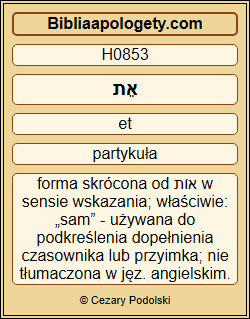 |
| L12 |
Pwt20_4 |
for |
For the LORD |
your God |
[is] he that goeth |
against |
with you to fight |
|
against |
for you against your enemies |
to save |
|
| L13 |
Pwt20_4 |
ki |
Yah·weh |
'e·lo·hei·Chem, |
ha·ho·Lech |
'im·ma·Chem; |
le·hil·la·Chem |
la·Chem |
im- |
'o·ye·vei·Chem |
le·ho·Shi·a' |
'et·Chem. |
| L14 |
Pwt20_4 |
כִּי |
יְהֹוָה |
אֱלֹהִים |
הָלַךְ |
עִם |
לָחַם |
|
עִם |
אֹיֵב |
יָשַׁע |
אֵת |
| L15 |
Pwt20_4 |
(Ki) |
(Jah)·we |
E·lo·(Him) |
ha·(Lach) |
('Im) |
la·(Cham) |
|
('Im) |
'o·(Jew) |
ja·(Sza') |
('Et) |
| L16 |
Pwt20_4 |
kî |
JHWH |
’ᵉ̆lōhîm |
hālaḵ |
‘im |
lāḥam |
|
‘im |
’ōjēḇ |
jāša‘ |
’ēṯ |
| L17 |
Pwt20_4 |
kî |
jhwh |
’ĕlōhîm |
hālak |
‘im |
lāḥam |
|
‘im |
’ōjēb |
jāša‘ |
’ēt |
| L18 |
Pwt20_4 |
For the LORD your God [is] he that goeth with you, to fight for you against your enemies, to save you. (Pwt20_4 KJV) |
| L19 |
Pwt20_4 |
4 For the LORD <03068> your God <0430> is he that goeth <01980> (08802) with you, to fight <03898> (08736) for you against your enemies <0341> (08802), to save <03467> (08687) you. (Pwt20_4 KJV) |
| L20 |
Pwt20_4 |
916/4478 |
1568/6220 |
696/2597 |
291/1542 |
205/1043 |
15/177 |
1662/6521 |
206/1043 |
34/280 |
4/206 |
3962/11047 |
| L21 |
Pwt20_4 |
Pwt20_4_1 |
Pwt20_4_2 |
Pwt20_4_3 |
Pwt20_4_4 |
Pwt20_4_5 |
Pwt20_4_6 |
Pwt20_4_7 |
Pwt20_4_8 |
Pwt20_4_9 |
Pwt20_4_10 |
Pwt20_4_11 |
| |
| L01 |
Pwt20_5 |
I przemówią urzędnicy do ludu, mówiąc: Kto jest człowiekiem, który zbudował dom nowy i nie poświęcił go, niech pójdzie i wróci do swego domu, aby nie umarł na wojnie, a człowiek inny poświęci go. (Pwt20_5 tłum. AI) |
| L02 |
Pwt20_5 |
I przemówią H1696 urzędnicy H7860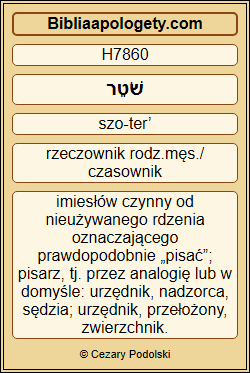 do H413 ludu H5971, mówiąc H559: Kto H4310 do H413 ludu H5971, mówiąc H559: Kto H4310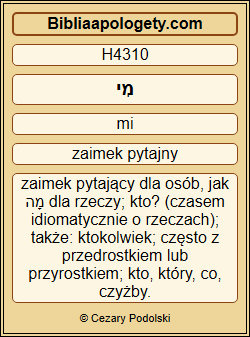 jest człowiekiem H376 jest człowiekiem H376 , który H834 , który H834 zbudował H1129 zbudował H1129 dom H1004 dom H1004 nowy H2319 nowy H2319 i nie H3808 poświęcił go H2596 i nie H3808 poświęcił go H2596 , niech pójdzie H1980 i wróci H7725 , niech pójdzie H1980 i wróci H7725 do swego domu H1004, aby nie H6435 do swego domu H1004, aby nie H6435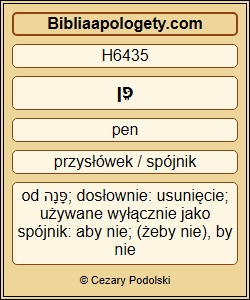 umarł H4191 umarł H4191 na wojnie H4421, a człowiek H376 inny H312 na wojnie H4421, a człowiek H376 inny H312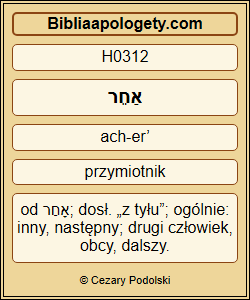 poświęci go H2596. (Pwt20_5 tłum. AI) poświęci go H2596. (Pwt20_5 tłum. AI) |
| L03 |
Pwt20_5 |
Zwierzchnicy niech powiedzą następnie narodowi: Kto z was zbudował nowy dom, a jeszcze go nie poświęcił, niech idzie i wraca do swego domu, bo mógłby zginąć na wojnie, i kto inny by go poświęcił. (Pwt20_5 BT_4) |
| L04 |
Pwt20_5 |
Zwierzchnicy H7860 niech powiedzą H1696 następnie narodowi H5971: Kto z was H376 zbudował H1129 nowy H2319 dom H1004, a jeszcze go nie poświęcił H2596, niech idzie H1980 i wraca H7725 do swego domu H1004, bo mógłby zginąć H4191 na wojnie H4421, i kto inny H312 by go poświęcił H2596. (Pwt20_5 BT_4) |
| L05 |
Pwt20_5 |
we•dib•be•<Ru> |
hasz•szo•te•<Rim> |
'el- |
ha•'<Am> |
le•<Mor> |
mi- |
ha•'<Isz> |
'a•<szer> |
ba•<Na> |
wa•jit- |
cha•<Dasz> |
we•<Lo> |
cha•na•<Cho>, |
je•<Lech> |
we•ja•<szo> |
le•we•<To>; |
pen- |
ja•<Mut> |
bam•mil•cha•<Ma>, |
we•'<Isz> |
'a•<Cher> |
jach•ne•<Chen>•nu. |
| L06 |
Pwt20_5 |
וְדִבְּר֣וּ |
הַשֹּֽׁטְרִים֮ |
אֶל־ |
הָעָ֣ם |
לֵאמֹר֒ |
מִֽי־ |
הָאִ֞ישׁ |
אֲשֶׁ֨ר |
בָּנָ֤ה |
בַֽיִת־ |
חָדָשׁ֙ |
וְלֹ֣א |
חֲנָכ֔וֹ |
יֵלֵ֖ךְ |
וְיָשֹׁ֣ב |
לְבֵית֑וֹ |
פֶּן־ |
יָמוּת֙ |
בַּמִּלְחָמָ֔ה |
וְאִ֥ישׁ |
אַחֵ֖ר |
יַחְנְכֶֽנּוּ׃ |
| L07 |
Pwt20_5 |
I przemówią |
urzędnicy |
do |
ludu, |
mówiąc: |
Kto |
jest człowiekiem, |
który |
zbudował |
dom |
nowy |
i nie |
poświęcił go, |
niech pójdzie |
i wróci |
do swego domu, |
aby nie |
umarł |
na wojnie, |
a człowiek |
inny |
poświęci go. |
| L08 |
Pwt20_5 |
וְ/דִבְּר֣וּ |
הַ/שֹּֽׁטְרִים֮ |
אֶל־ |
הָ/עָ֣ם |
לֵ/אמֹר֒ |
מִֽי־ |
הָ/אִ֞ישׁ |
אֲשֶׁ֨ר |
בָּנָ֤ה |
בַֽיִת־ |
חָדָשׁ֙ |
וְ/לֹ֣א |
חֲנָכ֔/וֹ |
יֵלֵ֖ךְ |
וְ/יָשֹׁ֣ב |
לְ/בֵית֑/וֹ |
פֶּן־ |
יָמוּת֙ |
בַּ/מִּלְחָמָ֔ה |
וְ/אִ֥ישׁ |
אַחֵ֖ר |
יַחְנְכֶֽ/נּוּ׃ |
| L09 |
Pwt20_5 |
HC/Vpq3cpSpój. + Czas. piel, perf. konsekutywne, 3 os., r. wspólny, lm. |
HTd/VqrmpaPartykuła rodzajnik określony + Czas. qal, imiesłów czynny, m., lm., stan absolutny |
HRPrzyim. |
HTd/NcmsaPartykuła rodzajnik określony + Rzecz. posp., m., lp., stan absolutny |
HR/VqcPrzyim. + Czas. qal, bezok. konstrukcyjny |
HTiPartykuła pytajna |
HTd/NcmsaPartykuła rodzajnik określony + Rzecz. posp., m., lp., stan absolutny |
HTrPartykuła względna |
HVqp3msCzas. qal, perfectum, 3 os., m., lp. |
HNcmsaRzecz. posp., m., lp., stan absolutny |
HAamsaPrzym. zwykły, m., lp., stan absolutny |
HC/TnSpój. + Partykuła przecząca |
HVqp3ms/Sp3msCzas. qal, perfectum, 3 os., m., lp. + Sufiks zaimkowy, 3 os., m., lp. |
HVqi3msCzas. qal, imperfektum, 3 os., m., lp. |
HC/Vqi3msSpój. + Czas. qal, imperfektum, 3 os., m., lp. |
HR/Ncmsc/Sp3msPrzyim. + Rzecz. posp., m., lp., stan konstrukcyjny + Sufiks zaimkowy, 3 os., m., lp. |
HCSpój. |
HVqi3msCzas. qal, imperfektum, 3 os., m., lp. |
HRd/NcfsaPrzyim. z rodzajnikiem + Rzecz. posp., ż., lp., stan absolutny |
HC/NcmsaSpój. + Rzecz. posp., m., lp., stan absolutny |
HAamsaPrzym. zwykły, m., lp., stan absolutny |
HVqi3ms/Sp3msCzas. qal, imperfektum, 3 os., m., lp. + Sufiks zaimkowy, 3 os., m., lp. |
| L10 |
Pwt20_5 |
wüdiBBürû |
haššö|†rîm |
´el- |
hä`äm |
lë´mör |
mî|- |
hä´îš |
´ášer |
Bänâ |
ba|yit- |
Hädäš |
wülö´ |
Hánäkô |
yëlëk |
wüyäšöb |
lübêtô |
Pen- |
yämût |
BammilHämâ |
wü´îš |
´aHër |
yaHnükeºnnû |
| L11 |
Pwt20_5 |
H1696 |
H7860 |
H0413 |
H5971 |
H0559 |
H4310 |
H0376 |
H0834 |
H1129 |
H1004 |
H2319 |
H3808 |
H2596 |
H1980 |
H7725 |
H1004 |
H6435 |
H4191 |
H4421 |
H0376 |
H0312 |
H2596 |
| L12 |
Pwt20_5 |
shall speak |
And the officers |
to |
unto the people |
saying |
Who |
What man |
that |
[is there] that hath built |
house |
a new |
not |
and hath not dedicated |
depart |
and return |
to his house |
otherwise |
lest he die |
in the battle |
man |
and another |
dedicate |
| L13 |
Pwt20_5 |
ve·dib·be·Ru |
hash·sho·te·Rim |
el- |
ha·'Am |
le·Mor |
mi- |
ha·'Ish |
'a·Sher |
ba·Nah |
va·yit- |
cha·Dash |
ve·Lo |
cha·na·Cho, |
ye·Lech |
ve·ya·Sho |
le·vei·To; |
pen- |
ya·Mut |
bam·mil·cha·Mah, |
ve·'Ish |
'a·Cher |
yach·ne·Chen·nu. |
| L14 |
Pwt20_5 |
דָבַר |
שֹׁטֵר |
אֵל |
עַם |
אָמַר |
מִי |
אִישׁ |
אֲשֶׁר |
בָּנָה |
בַּיִת |
חָדָשׁ |
לֹא |
חָנַךְ |
הָלַךְ |
שׁוּב |
בַּיִת |
פֵּן |
מוּת |
מִלְחָמָה |
אִישׁ |
אַחֵר |
חָנַךְ |
| L15 |
Pwt20_5 |
da·(War) |
szo·(Ter) |
('El) |
('Am) |
'a·(Mar) |
(Mi) |
('Isz) |
'a·(Szer) |
ba·(Na) |
(Ba)·jit |
cha·(Dasz) |
(Lo) |
cha·(Nach) |
ha·(Lach) |
(Szuw) |
(Ba)·jit |
(Pen) |
(Mut) |
mil·cha·(Ma) |
('Isz) |
'a·(Cher) |
cha·(Nach) |
| L16 |
Pwt20_5 |
ḏāḇar |
šōṭēr |
’ēl |
‘am |
’āmar |
mî |
’îš |
’ᵃ̆šer |
bānā(h) |
bájiṯ |
ḥāḏāš |
lō(’) |
ḥānaḵ |
hālaḵ |
šûḇ |
bájiṯ |
pēn |
mûṯ |
milḥāmā(h) |
’îš |
’aḥēr |
ḥānaḵ |
| L17 |
Pwt20_5 |
dābar |
šōṭēr |
’ēl |
‘am |
’āmar |
mî |
’îš |
’ăšer |
bānāh |
bajit |
ḥādāš |
lō’ |
ḥānak |
hālak |
šûb |
bajit |
pēn |
mût |
milḥāmāh |
’îš |
’aḥēr |
ḥānak |
| L18 |
Pwt20_5 |
And the officers shall speak unto the people, saying, What man [is there] that hath built a new house, and hath not dedicated it? let him go and return to his house, lest he die in the battle, and another man dedicate it. (Pwt20_5 KJV) |
| L19 |
Pwt20_5 |
5 And the officers <07860> (08802) shall speak <01696> (08765) unto the people <05971>, saying <0559> (08800), What man <0376> is there that hath built <01129> (08804) a new <02319> house <01004>, and hath not dedicated <02596> (08804) it? let him go <03212> (08799) and return <07725> (08799) to his house <01004>, lest he die <04191> (08799) in the battle <04421>, and another <0312> man <0376> dedicate <02596> (08799) it. (Pwt20_5 KJV) |
| L20 |
Pwt20_5 |
398/1142 |
9/25 |
1590/5500 |
391/1866 |
1302/5298 |
46/422 |
452/2004 |
1704/5499 |
35/374 |
301/2052 |
5/53 |
1146/5164 |
1/5 |
292/1542 |
156/1041 |
302/2052 |
54/133 |
280/836 |
31/319 |
453/2004 |
40/166 |
2/5 |
| L21 |
Pwt20_5 |
Pwt20_5_1 |
Pwt20_5_2 |
Pwt20_5_3 |
Pwt20_5_4 |
Pwt20_5_5 |
Pwt20_5_6 |
Pwt20_5_7 |
Pwt20_5_8 |
Pwt20_5_9 |
Pwt20_5_10 |
Pwt20_5_11 |
Pwt20_5_12 |
Pwt20_5_13 |
Pwt20_5_14 |
Pwt20_5_15 |
Pwt20_5_16 |
Pwt20_5_17 |
Pwt20_5_18 |
Pwt20_5_19 |
Pwt20_5_20 |
Pwt20_5_21 |
Pwt20_5_22 |
| |
| L01 |
Pwt20_6 |
A kto jest człowiekiem, który zasadził winnicę i nie użył jej, niech pójdzie i wróci do swego domu, aby nie umarł na wojnie, a człowiek inny użyje jej. (Pwt20_6 tłum. AI) |
| L02 |
Pwt20_6 |
A kto H4310 jest człowiekiem H376, który H834 zasadził H5193 winnicę H3754 winnicę H3754 i nie H3808 użył jej H2490 i nie H3808 użył jej H2490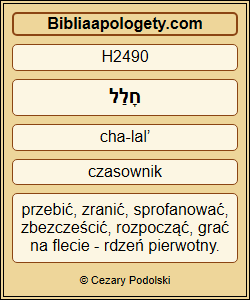 , niech pójdzie H1980 i wróci H7725 do swego domu H1004, aby nie H6435 umarł H4191 na wojnie H4421, a człowiek H376 inny H312 użyje jej H2490. (Pwt20_6 tłum. AI) , niech pójdzie H1980 i wróci H7725 do swego domu H1004, aby nie H6435 umarł H4191 na wojnie H4421, a człowiek H376 inny H312 użyje jej H2490. (Pwt20_6 tłum. AI) |
| L03 |
Pwt20_6 |
Kto z was zasadził winnicę, a nie zebrał jej owoców, niech wraca do domu, bo mógłby zginąć na wojnie, a kto inny by zebrał jej owoce. (Pwt20_6 BT_4) |
| L04 |
Pwt20_6 |
Kto z was H376 zasadził H5193 winnicę H3754, a nie zebrał H2490 jej owoców, niech wraca H7725 do domu H1004, bo mógłby zginąć H4191 na wojnie H4421, a kto inny H312 by zebrał H2490 jej owoce. (Pwt20_6 BT_4) |
| L05 |
Pwt20_6 |
u•mi- |
ha•'<Isz> |
'a•<szer>- |
na•<Ta>' |
ke•rem |
we•<Lo> |
chil•le•<Lo>, |
je•<Lech> |
we•ja•<szo> |
le•we•<To>; |
pen- |
ja•<Mut> |
bam•mil•cha•<Ma>, |
we•'<Isz> |
'a•<Cher> |
je•chal•le•<Len>•nu. |
| L06 |
Pwt20_6 |
וּמִֽי־ |
הָאִ֞ישׁ |
אֲשֶׁר־ |
נָטַ֥ע |
כֶּ֙רֶם֙ |
וְלֹ֣א |
חִלְּל֔וֹ |
יֵלֵ֖ךְ |
וְיָשֹׁ֣ב |
לְבֵית֑וֹ |
פֶּן־ |
יָמוּת֙ |
בַּמִּלְחָמָ֔ה |
וְאִ֥ישׁ |
אַחֵ֖ר |
יְחַלְּלֶֽנּוּ׃ |
| L07 |
Pwt20_6 |
A kto |
jest człowiekiem, |
który |
zasadził |
winnicę |
i nie |
użył jej, |
niech pójdzie |
i wróci |
do swego domu, |
aby nie |
umarł |
na wojnie, |
a człowiek |
inny |
użyje jej. |
| L08 |
Pwt20_6 |
וּ/מִֽי־ |
הָ/אִ֞ישׁ |
אֲשֶׁר־ |
נָטַ֥ע |
כֶּ֙רֶם֙ |
וְ/לֹ֣א |
חִלְּל֔/וֹ |
יֵלֵ֖ךְ |
וְ/יָשֹׁ֣ב |
לְ/בֵית֑/וֹ |
פֶּן־ |
יָמוּת֙ |
בַּ/מִּלְחָמָ֔ה |
וְ/אִ֥ישׁ |
אַחֵ֖ר |
יְחַלְּלֶֽ/נּוּ׃ |
| L09 |
Pwt20_6 |
HC/TiSpój. + Partykuła pytajna |
HTd/NcmsaPartykuła rodzajnik określony + Rzecz. posp., m., lp., stan absolutny |
HTrPartykuła względna |
HVqp3msCzas. qal, perfectum, 3 os., m., lp. |
HNcbsaRzecz. posp., r. wspólny, lp., stan absolutny |
HC/TnSpój. + Partykuła przecząca |
HVpp3ms/Sp3msCzas. piel, perfectum, 3 os., m., lp. + Sufiks zaimkowy, 3 os., m., lp. |
HVqi3msCzas. qal, imperfektum, 3 os., m., lp. |
HC/Vqi3msSpój. + Czas. qal, imperfektum, 3 os., m., lp. |
HR/Ncmsc/Sp3msPrzyim. + Rzecz. posp., m., lp., stan konstrukcyjny + Sufiks zaimkowy, 3 os., m., lp. |
HCSpój. |
HVqi3msCzas. qal, imperfektum, 3 os., m., lp. |
HRd/NcfsaPrzyim. z rodzajnikiem + Rzecz. posp., ż., lp., stan absolutny |
HC/NcmsaSpój. + Rzecz. posp., m., lp., stan absolutny |
HAamsaPrzym. zwykły, m., lp., stan absolutny |
HVpi3ms/Sp3msCzas. piel, imperfektum, 3 os., m., lp. + Sufiks zaimkowy, 3 os., m., lp. |
| L10 |
Pwt20_6 |
ûmî|- |
hä´îš |
´ášer- |
nä†a` |
Keºrem |
wülö´ |
Hillülô |
yëlëk |
wüyäšöb |
lübêtô |
Pen- |
yämût |
BammilHämâ |
wü´îš |
´aHër |
yüHallüleºnnû |
| L11 |
Pwt20_6 |
H4310 |
H0376 |
H0834 |
H5193 |
H3754 |
H3808 |
H2490 |
H1980 |
H7725 |
H1004 |
H6435 |
H4191 |
H4421 |
H0376 |
H0312 |
H2490 |
| L12 |
Pwt20_6 |
Who |
And what man |
that |
[is he] that hath planted |
a vineyard |
not |
and hath not [yet] eaten |
along |
and return |
unto his house |
otherwise |
lest he die |
in the battle |
man |
and another |
eat |
| L13 |
Pwt20_6 |
u·mi- |
ha·'Ish |
a·Sher- |
na·Ta' |
ke·rem |
ve·Lo |
chil·le·Lo, |
ye·Lech |
ve·ya·Sho |
le·vei·To; |
pen- |
ya·Mut |
bam·mil·cha·Mah, |
ve·'Ish |
'a·Cher |
ye·chal·le·Len·nu. |
| L14 |
Pwt20_6 |
מִי |
אִישׁ |
אֲשֶׁר |
נָטַע |
כֶּרֶם |
לֹא |
חָלַל |
הָלַךְ |
שׁוּב |
בַּיִת |
פֵּן |
מוּת |
מִלְחָמָה |
אִישׁ |
אַחֵר |
חָלַל |
| L15 |
Pwt20_6 |
(Mi) |
('Isz) |
'a·(Szer) |
na·(Ta)' |
(Ke)·rem |
(Lo) |
cha·(Lal) |
ha·(Lach) |
(Szuw) |
(Ba)·jit |
(Pen) |
(Mut) |
mil·cha·(Ma) |
('Isz) |
'a·(Cher) |
cha·(Lal) |
| L16 |
Pwt20_6 |
mî |
’îš |
’ᵃ̆šer |
nāṭa‘ |
kérem |
lō(’) |
ḥālal |
hālaḵ |
šûḇ |
bájiṯ |
pēn |
mûṯ |
milḥāmā(h) |
’îš |
’aḥēr |
ḥālal |
| L17 |
Pwt20_6 |
mî |
’îš |
’ăšer |
nāṭa‘ |
kerem |
lō’ |
ḥālal |
hālak |
šûb |
bajit |
pēn |
mût |
milḥāmāh |
’îš |
’aḥēr |
ḥālal |
| L18 |
Pwt20_6 |
And what man [is he] that hath planted a vineyard, and hath not [yet] eaten of it? let him [also] go and return unto his house, lest he die in the battle, and another man eat of it. (Pwt20_6 KJV) |
| L19 |
Pwt20_6 |
6 And what man <0376> is he that hath planted <05193> (08804) a vineyard <03754>, and hath not yet] eaten <02490> (08765) of it? let him also go <03212> (08799) and return <07725> (08799) unto his house <01004>, lest he die <04191> (08799) in the battle <04421>, and another <0312> man <0376> eat <02490> (08762) of it. (Pwt20_6 KJV) |
| L20 |
Pwt20_6 |
47/422 |
454/2004 |
1705/5499 |
9/57 |
14/93 |
1147/5164 |
39/142 |
293/1542 |
157/1041 |
303/2052 |
55/133 |
281/836 |
32/319 |
455/2004 |
41/166 |
40/142 |
| L21 |
Pwt20_6 |
Pwt20_6_1 |
Pwt20_6_2 |
Pwt20_6_3 |
Pwt20_6_4 |
Pwt20_6_5 |
Pwt20_6_6 |
Pwt20_6_7 |
Pwt20_6_8 |
Pwt20_6_9 |
Pwt20_6_10 |
Pwt20_6_11 |
Pwt20_6_12 |
Pwt20_6_13 |
Pwt20_6_14 |
Pwt20_6_15 |
Pwt20_6_16 |
| |
| L01 |
Pwt20_7 |
A kto jest człowiekiem, który zaręczył się z kobietą i nie wziął jej, niech pójdzie i wróci do swego domu, aby nie umarł na wojnie, a człowiek inny weźmie ją. (Pwt20_7 tłum. AI) |
| L02 |
Pwt20_7 |
A kto H4310 jest człowiekiem H376, który H834 zaręczył się H781 z kobietą H802 z kobietą H802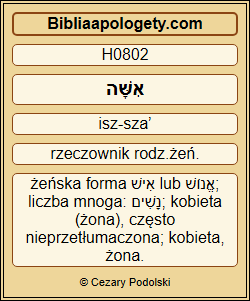 i nie H3808 wziął jej H3947 i nie H3808 wziął jej H3947 , niech pójdzie H1980 i wróci H7725 do swego domu H1004, aby nie H6435 umarł H4191 na wojnie H4421, a człowiek H376 inny H312 weźmie ją H3947. (Pwt20_7 tłum. AI) , niech pójdzie H1980 i wróci H7725 do swego domu H1004, aby nie H6435 umarł H4191 na wojnie H4421, a człowiek H376 inny H312 weźmie ją H3947. (Pwt20_7 tłum. AI) |
| L03 |
Pwt20_7 |
Kto żonę poślubił, a jeszcze jej nie sprowadził do siebie, niech wraca do domu, bo mógłby zginąć na wojnie, a kto inny by ją sprowadził do siebie. (Pwt20_7 BT_4) |
| L04 |
Pwt20_7 |
Kto H376 żonę H802 poślubił H781, a jeszcze jej nie sprowadził H3947 do siebie, niech wraca H7725 do domu H1004, bo mógłby zginąć H4191 na wojnie H4421, a kto inny H312 by ją sprowadził H3947 do siebie. (Pwt20_7 BT_4) |
| L05 |
Pwt20_7 |
u•mi- |
ha•'<Isz> |
'a•<szer>- |
'e•<Ras> |
'isz•<sza> |
we•<Lo> |
le•ka•<Cha>, |
je•<Lech> |
we•ja•<szo> |
le•we•<To>; |
pen- |
ja•<Mut> |
bam•mil•cha•<Ma>, |
we•'<Isz> |
'a•<Cher> |
jik•ka•<Chen>•na. |
| L06 |
Pwt20_7 |
וּמִֽי־ |
הָאִ֞ישׁ |
אֲשֶׁר־ |
אֵרַ֤שׂ |
אִשָּׁה֙ |
וְלֹ֣א |
לְקָחָ֔הּ |
יֵלֵ֖ךְ |
וְיָשֹׁ֣ב |
לְבֵית֑וֹ |
פֶּן־ |
יָמוּת֙ |
בַּמִּלְחָמָ֔ה |
וְאִ֥ישׁ |
אַחֵ֖ר |
יִקָּחֶֽנָּה׃ |
| L07 |
Pwt20_7 |
A kto |
jest człowiekiem, |
który |
zaręczył się |
z kobietą |
i nie |
wziął jej, |
niech pójdzie |
i wróci |
do swego domu, |
aby nie |
umarł |
na wojnie, |
a człowiek |
inny |
weźmie ją. |
| L08 |
Pwt20_7 |
וּ/מִֽי־ |
הָ/אִ֞ישׁ |
אֲשֶׁר־ |
אֵרַ֤שׂ |
אִשָּׁה֙ |
וְ/לֹ֣א |
לְקָחָ֔/הּ |
יֵלֵ֖ךְ |
וְ/יָשֹׁ֣ב |
לְ/בֵית֑/וֹ |
פֶּן־ |
יָמוּת֙ |
בַּ/מִּלְחָמָ֔ה |
וְ/אִ֥ישׁ |
אַחֵ֖ר |
יִקָּחֶֽ/נָּה׃ |
| L09 |
Pwt20_7 |
HC/TiSpój. + Partykuła pytajna |
HTd/NcmsaPartykuła rodzajnik określony + Rzecz. posp., m., lp., stan absolutny |
HTrPartykuła względna |
HVpp3msCzas. piel, perfectum, 3 os., m., lp. |
HNcfsaRzecz. posp., ż., lp., stan absolutny |
HC/TnSpój. + Partykuła przecząca |
HVqp3ms/Sp3fsCzas. qal, perfectum, 3 os., m., lp. + Sufiks zaimkowy, 3 os., ż., lp. |
HVqi3msCzas. qal, imperfektum, 3 os., m., lp. |
HC/Vqi3msSpój. + Czas. qal, imperfektum, 3 os., m., lp. |
HR/Ncmsc/Sp3msPrzyim. + Rzecz. posp., m., lp., stan konstrukcyjny + Sufiks zaimkowy, 3 os., m., lp. |
HCSpój. |
HVqi3msCzas. qal, imperfektum, 3 os., m., lp. |
HRd/NcfsaPrzyim. z rodzajnikiem + Rzecz. posp., ż., lp., stan absolutny |
HC/NcmsaSpój. + Rzecz. posp., m., lp., stan absolutny |
HAamsaPrzym. zwykły, m., lp., stan absolutny |
HVqi3ms/Sp3fsCzas. qal, imperfektum, 3 os., m., lp. + Sufiks zaimkowy, 3 os., ż., lp. |
| L10 |
Pwt20_7 |
ûmî|- |
hä´îš |
´ášer- |
´ëraS |
´iššâ |
wülö´ |
lüqäHäh |
yëlëk |
wüyäšöb |
lübêtô |
Pen- |
yämût |
BammilHämâ |
wü´îš |
´aHër |
yiqqäHeºnnâ |
| L11 |
Pwt20_7 |
H4310 |
H0376 |
H0834 |
H0781 |
H0802 |
H3808 |
H3947 |
H1980 |
H7725 |
H1004 |
H6435 |
H4191 |
H4421 |
H0376 |
H0312 |
H3947 |
| L12 |
Pwt20_7 |
and who |
And what man |
is |
[is there] that hath betrothed |
a wife |
not |
and hath not taken |
depart |
and return |
unto his house |
otherwise |
lest he die |
in the battle |
man |
and another |
take |
| L13 |
Pwt20_7 |
u·mi- |
ha·'Ish |
a·Sher- |
'e·Ras |
'ish·Shah |
ve·Lo |
le·ka·Chah, |
ye·Lech |
ve·ya·Sho |
le·vei·To; |
pen- |
ya·Mut |
bam·mil·cha·Mah, |
ve·'Ish |
'a·Cher |
yik·ka·Chen·nah. |
| L14 |
Pwt20_7 |
מִי |
אִישׁ |
אֲשֶׁר |
אָרַשׂ |
אִשָּׁה |
לֹא |
לָקַח |
הָלַךְ |
שׁוּב |
בַּיִת |
פֵּן |
מוּת |
מִלְחָמָה |
אִישׁ |
אַחֵר |
לָקַח |
| L15 |
Pwt20_7 |
(Mi) |
('Isz) |
'a·(Szer) |
'a·(Ras) |
'isz·(Sza) |
(Lo) |
la·(Kach) |
ha·(Lach) |
(Szuw) |
(Ba)·jit |
(Pen) |
(Mut) |
mil·cha·(Ma) |
('Isz) |
'a·(Cher) |
la·(Kach) |
| L16 |
Pwt20_7 |
mî |
’îš |
’ᵃ̆šer |
’āraś |
’iššā(h) |
lō(’) |
lāqaḥ |
hālaḵ |
šûḇ |
bájiṯ |
pēn |
mûṯ |
milḥāmā(h) |
’îš |
’aḥēr |
lāqaḥ |
| L17 |
Pwt20_7 |
mî |
’îš |
’ăšer |
’āraś |
’iššāh |
lō’ |
lāqaḥ |
hālak |
šûb |
bajit |
pēn |
mût |
milḥāmāh |
’îš |
’aḥēr |
lāqaḥ |
| L18 |
Pwt20_7 |
And what man [is there] that hath betrothed a wife, and hath not taken her? let him go and return unto his house, lest he die in the battle, and another man take her. (Pwt20_7 KJV) |
| L19 |
Pwt20_7 |
7 And what man <0376> is there that hath betrothed <0781> (08765) a wife <0802>, and hath not taken <03947> (08804) her? let him go <03212> (08799) and return <07725> (08799) unto his house <01004>, lest he die <04191> (08799) in the battle <04421>, and another <0312> man <0376> take <03947> (08799) her. (Pwt20_7 KJV) |
| L20 |
Pwt20_7 |
48/422 |
456/2004 |
1706/5499 |
2/11 |
276/781 |
1148/5164 |
365/964 |
294/1542 |
158/1041 |
304/2052 |
56/133 |
282/836 |
33/319 |
457/2004 |
42/166 |
366/964 |
| L21 |
Pwt20_7 |
Pwt20_7_1 |
Pwt20_7_2 |
Pwt20_7_3 |
Pwt20_7_4 |
Pwt20_7_5 |
Pwt20_7_6 |
Pwt20_7_7 |
Pwt20_7_8 |
Pwt20_7_9 |
Pwt20_7_10 |
Pwt20_7_11 |
Pwt20_7_12 |
Pwt20_7_13 |
Pwt20_7_14 |
Pwt20_7_15 |
Pwt20_7_16 |
| |
| L01 |
Pwt20_8 |
I będą dalej urzędnicy mówić do ludu, i powiedzą: Kto jest człowiekiem bojącym się i miękkiego serca, niech pójdzie i wróci do swego domu, i nie stopnieje — serce jego braci jak jego serce. (Pwt20_8 tłum. AI) |
| L02 |
Pwt20_8 |
I będą dalej H3254 urzędnicy H7860 mówić H1696 do H413 ludu H5971, i powiedzą H559: Kto H4310 jest człowiekiem H376 bojącym się H3373 urzędnicy H7860 mówić H1696 do H413 ludu H5971, i powiedzą H559: Kto H4310 jest człowiekiem H376 bojącym się H3373 i miękkiego H7390 i miękkiego H7390 serca H3824, niech pójdzie H1980 i wróci H7725 do swego domu H1004, i nie H3808 stopnieje H4549 serca H3824, niech pójdzie H1980 i wróci H7725 do swego domu H1004, i nie H3808 stopnieje H4549 — serce H3824 jego braci H251 — serce H3824 jego braci H251 jak jego serce H3824. (Pwt20_8 tłum. AI) jak jego serce H3824. (Pwt20_8 tłum. AI) |
| L03 |
Pwt20_8 |
Niech jeszcze zwierzchnicy powiedzą do narodu: Kto się lęka, czyje serce drży, niech wraca do domu, by nie struchlało serce jego braci, jak jego. (Pwt20_8 BT_4) |
| L04 |
Pwt20_8 |
Niech jeszcze zwierzchnicy H7860 powiedzą H1696 do narodu H5971: Kto H376 się lęka H3373, czyje serce H3824 drży H7390, niech wraca H7725 do domu H1004, by nie struchlało H4549 serce H3824 jego braci H251, jak jego. (Pwt20_8 BT_4) |
| L05 |
Pwt20_8 |
we•ja•se•<Fu> |
hasz•szo•te•<Rim> |
le•dab•<Ber> |
'el- |
ha•'<Am> |
we•'a•me•<Ru>, |
mi- |
ha•'<Isz> |
hai•ja•<Re> |
we•<Rach> |
hal•le•<waw>, |
je•<Lech> |
we•ja•<szo> |
le•we•<To>; |
we•<Lo> |
jim•<Mas> |
'et- |
le•<waw> |
'e•<Chaw> |
kil•wa•<wo>. |
| L06 |
Pwt20_8 |
וְיָסְפ֣וּ |
הַשֹּׁטְרִים֮ |
לְדַבֵּ֣ר |
אֶל־ |
הָעָם֒ |
וְאָמְר֗וּ |
מִי־ |
הָאִ֤ישׁ |
הַיָּרֵא֙ |
וְרַ֣ךְ |
הַלֵּבָ֔ב |
יֵלֵ֖ךְ |
וְיָשֹׁ֣ב |
לְבֵית֑וֹ |
וְלֹ֥א |
יִמַּ֛ס |
אֶת־ |
לְבַ֥ב |
אֶחָ֖יו |
כִּלְבָבֽוֹ׃ |
| L07 |
Pwt20_8 |
I będą dalej |
urzędnicy |
mówić |
do |
ludu, |
i powiedzą: |
Kto |
jest człowiekiem |
bojącym się |
i miękkiego |
serca, |
niech pójdzie |
i wróci |
do swego domu, |
i nie |
stopnieje |
— |
serce |
jego braci |
jak jego serce. |
| L08 |
Pwt20_8 |
וְ/יָסְפ֣וּ |
הַ/שֹּׁטְרִים֮ |
לְ/דַבֵּ֣ר |
אֶל־ |
הָ/עָם֒ |
וְ/אָמְר֗וּ |
מִי־ |
הָ/אִ֤ישׁ |
הַ/יָּרֵא֙ |
וְ/רַ֣ךְ |
הַ/לֵּבָ֔ב |
יֵלֵ֖ךְ |
וְ/יָשֹׁ֣ב |
לְ/בֵית֑/וֹ |
וְ/לֹ֥א |
יִמַּ֛ס |
אֶת־ |
לְבַ֥ב |
אֶחָ֖י/ו |
כִּ/לְבָבֽ/וֹ׃ |
| L09 |
Pwt20_8 |
HC/Vqq3cpSpój. + Czas. qal, perf. konsekutywne, 3 os., r. wspólny, lm. |
HTd/VqrmpaPartykuła rodzajnik określony + Czas. qal, imiesłów czynny, m., lm., stan absolutny |
HR/VpcPrzyim. + Czas. piel, bezok. konstrukcyjny |
HRPrzyim. |
HTd/NcmsaPartykuła rodzajnik określony + Rzecz. posp., m., lp., stan absolutny |
HC/Vqq3cpSpój. + Czas. qal, perf. konsekutywne, 3 os., r. wspólny, lm. |
HTiPartykuła pytajna |
HTd/NcmsaPartykuła rodzajnik określony + Rzecz. posp., m., lp., stan absolutny |
HTd/AamsaPartykuła rodzajnik określony + Przym. zwykły, m., lp., stan absolutny |
HC/AamscSpój. + Przym. zwykły, m., lp., stan konstrukcyjny |
HTd/NcmsaPartykuła rodzajnik określony + Rzecz. posp., m., lp., stan absolutny |
HVqi3msCzas. qal, imperfektum, 3 os., m., lp. |
HC/Vqi3msSpój. + Czas. qal, imperfektum, 3 os., m., lp. |
HR/Ncmsc/Sp3msPrzyim. + Rzecz. posp., m., lp., stan konstrukcyjny + Sufiks zaimkowy, 3 os., m., lp. |
HC/TnSpój. + Partykuła przecząca |
HVNi3msCzas. nifal, imperfektum, 3 os., m., lp. |
HToPartykuła znacznik dopełnienia bliższego |
HNcmscRzecz. posp., m., lp., stan konstrukcyjny |
HNcmpc/Sp3msRzecz. posp., m., lm., stan konstrukcyjny + Sufiks zaimkowy, 3 os., m., lp. |
HR/Ncmsc/Sp3msPrzyim. + Rzecz. posp., m., lp., stan konstrukcyjny + Sufiks zaimkowy, 3 os., m., lp. |
| L10 |
Pwt20_8 |
wüyäspû |
haššö†rîm |
lüdaBBër |
´el- |
hä`äm |
wü´ämrû |
mî- |
hä´îš |
hayyärë´ |
würak |
hallëbäb |
yëlëk |
wüyäšöb |
lübêtô |
wülö´ |
yimmas |
´et- |
lübab |
´eHäyw |
Kilbäbô |
| L11 |
Pwt20_8 |
H3254 |
H7860 |
H1696 |
H0413 |
H5971 |
H0559 |
H4310 |
H0376 |
H3373 |
H7390 |
H3824 |
H1980 |
H7725 |
H1004 |
H3808 |
H4549 |
H0853 |
H3824 |
H0251 |
H3824 |
| L12 |
Pwt20_8 |
further |
And the officers |
shall speak |
to |
unto the people |
and they shall say |
Who |
What man |
[is there that is] fearful |
faint |
heart |
along |
and return |
unto his house |
not |
faint |
|
as well as his heart |
lest his brethren's |
hearts |
| L13 |
Pwt20_8 |
ve·ya·se·Fu |
hash·sho·te·Rim |
le·dab·Ber |
el- |
ha·'Am |
ve·'a·me·Ru, |
mi- |
ha·'Ish |
hai·ya·Re |
ve·Rach |
hal·le·Vav, |
ye·Lech |
ve·ya·Sho |
le·vei·To; |
ve·Lo |
yim·Mas |
et- |
le·Vav |
'e·Chav |
kil·va·Vo. |
| L14 |
Pwt20_8 |
יָסַף |
שֹׁטֵר |
דָבַר |
אֵל |
עַם |
אָמַר |
מִי |
אִישׁ |
יָרֵא |
רַךְ |
לֵבָב |
הָלַךְ |
שׁוּב |
בַּיִת |
לֹא |
מָסַס |
אֵת |
לֵבָב |
אָח |
לֵבָב |
| L15 |
Pwt20_8 |
ja·(Saf) |
szo·(Ter) |
da·(War) |
('El) |
('Am) |
'a·(Mar) |
(Mi) |
('Isz) |
ja·(Re) |
(RaCh) |
le·(Waw) |
ha·(Lach) |
(Szuw) |
(Ba)·jit |
(Lo) |
ma·(Sas) |
('Et) |
le·(Waw) |
'(Ach) |
le·(Waw) |
| L16 |
Pwt20_8 |
jāsap̱ |
šōṭēr |
ḏāḇar |
’ēl |
‘am |
’āmar |
mî |
’îš |
jārē(’) |
raḵ |
lēḇāḇ |
hālaḵ |
šûḇ |
bájiṯ |
lō(’) |
māsas |
’ēṯ |
lēḇāḇ |
’āḥ |
lēḇāḇ |
| L17 |
Pwt20_8 |
jāsap |
šōṭēr |
dābar |
’ēl |
‘am |
’āmar |
mî |
’îš |
jārē’ |
rak |
lēbāb |
hālak |
šûb |
bajit |
lō’ |
māsas |
’ēt |
lēbāb |
’āḥ |
lēbāb |
| L18 |
Pwt20_8 |
And the officers shall speak further unto the people, and they shall say, What man [is there that is] fearful and fainthearted? let him go and return unto his house, lest his brethren's heart faint as well as his heart. (Pwt20_8 KJV) |
| L19 |
Pwt20_8 |
8 And the officers <07860> (08802) shall speak <01696> (08763) further <03254> (08804) unto the people <05971>, and they shall say <0559> (08804), What man <0376> is there that is fearful <03373> and fainthearted <07390> <03824>? let him go <03212> (08799) and return <07725> (08799) unto his house <01004>, lest his brethren's <0251> heart <03824> faint <04549> (08735) as well as his heart <03824>. (Pwt20_8 KJV) |
| L20 |
Pwt20_8 |
55/210 |
10/25 |
399/1142 |
1591/5500 |
392/1866 |
1303/5298 |
49/422 |
458/2004 |
5/55 |
4/16 |
38/252 |
295/1542 |
159/1041 |
305/2052 |
1149/5164 |
3/21 |
3963/11047 |
39/252 |
263/630 |
40/252 |
| L21 |
Pwt20_8 |
Pwt20_8_1 |
Pwt20_8_2 |
Pwt20_8_3 |
Pwt20_8_4 |
Pwt20_8_5 |
Pwt20_8_6 |
Pwt20_8_7 |
Pwt20_8_8 |
Pwt20_8_9 |
Pwt20_8_10 |
Pwt20_8_11 |
Pwt20_8_12 |
Pwt20_8_13 |
Pwt20_8_14 |
Pwt20_8_15 |
Pwt20_8_16 |
Pwt20_8_17 |
Pwt20_8_18 |
Pwt20_8_19 |
Pwt20_8_20 |
| |
| L01 |
Pwt20_9 |
I stanie się, gdy skończą urzędnicy mówić do ludu, i ustanowią dowódców wojsk na czele ludu. (Pwt20_9 tłum. AI) |
| L02 |
Pwt20_9 |
I stanie się H1961, gdy skończą H3615 urzędnicy H7860 mówić H1696 do H413 ludu H5971, i ustanowią H6485 urzędnicy H7860 mówić H1696 do H413 ludu H5971, i ustanowią H6485 dowódców H8269 dowódców H8269 wojsk H6635 wojsk H6635 na czele H7218 na czele H7218 ludu H5971. (Pwt20_9 tłum. AI) ludu H5971. (Pwt20_9 tłum. AI) |
| L03 |
Pwt20_9 |
Gdy zwierzchnicy skończą mówić do ludu, na czele narodu staną wodzowie. (Pwt20_9 BT_4) |
| L04 |
Pwt20_9 |
Gdy zwierzchnicy H7860 skończą H3615 mówić H1696 do ludu H5971, na czele narodu H5971 staną wodzowie H8269. (Pwt20_9 BT_4) |
| L05 |
Pwt20_9 |
we•ha•<ja> |
ke•chal•<Lot> |
hasz•szo•te•<Rim> |
le•dab•<Ber> |
'el- |
ha•'<Am>; |
u•<Fa>•ke•<Du> |
sa•<Re> |
ce•wa•'ot |
be•<Rosz> |
ha•'<Am>. |
sa•<Mek> |
| L06 |
Pwt20_9 |
וְהָיָ֛ה |
כְּכַלֹּ֥ת |
הַשֹּׁטְרִ֖ים |
לְדַבֵּ֣ר |
אֶל־ |
הָעָ֑ם |
וּפָ֥קְד֛וּ |
שָׂרֵ֥י |
צְבָא֖וֹת |
בְּרֹ֥אשׁ |
הָעָֽם׃ |
ס |
| L07 |
Pwt20_9 |
I stanie się, |
gdy skończą |
urzędnicy |
mówić |
do |
ludu, |
i ustanowią |
dowódców |
wojsk |
na czele |
ludu. |
§ |
| L08 |
Pwt20_9 |
וְ/הָיָ֛ה |
כְּ/כַלֹּ֥ת |
הַ/שֹּׁטְרִ֖ים |
לְ/דַבֵּ֣ר |
אֶל־ |
הָ/עָ֑ם |
וּ/פָ֥קְד֛וּ |
שָׂרֵ֥י |
צְבָא֖וֹת |
בְּ/רֹ֥אשׁ |
הָ/עָֽם׃ |
ס |
| L09 |
Pwt20_9 |
HC/Vqq3msSpój. + Czas. qal, perf. konsekutywne, 3 os., m., lp. |
HR/VpcPrzyim. + Czas. piel, bezok. konstrukcyjny |
HTd/VqrmpaPartykuła rodzajnik określony + Czas. qal, imiesłów czynny, m., lm., stan absolutny |
HR/VpcPrzyim. + Czas. piel, bezok. konstrukcyjny |
HRPrzyim. |
HTd/NcmsaPartykuła rodzajnik określony + Rzecz. posp., m., lp., stan absolutny |
HC/Vqq3cpSpój. + Czas. qal, perf. konsekutywne, 3 os., r. wspólny, lm. |
HNcmpcRzecz. posp., m., lm., stan konstrukcyjny |
HNcbpaRzecz. posp., r. wspólny, lm., stan absolutny |
HR/NcmscPrzyim. + Rzecz. posp., m., lp., stan konstrukcyjny |
HTd/NcmsaPartykuła rodzajnik określony + Rzecz. posp., m., lp., stan absolutny |
MARK-SZnacznik podziału: setuma (akapit zamknięty) |
| L10 |
Pwt20_9 |
wühäyâ |
Kükallöt |
haššö†rîm |
lüdaBBër |
´el- |
hä`äm |
ûpäºqdû |
Särê |
cübä´ôt |
Bürö´š |
hä`äm |
s |
| L11 |
Pwt20_9 |
H1961 |
H3615 |
H7860 |
H1696 |
H0413 |
H5971 |
H6485 |
H8269 |
H6635 |
H7218 |
H5971 |
|
| L12 |
Pwt20_9 |
become |
have made an end |
And it shall be when the officers |
of speaking |
to |
unto the people |
that they shall make |
captains |
of the armies |
to lead |
the people |
|
| L13 |
Pwt20_9 |
ve·ha·Yah |
ke·chal·Lot |
hash·sho·te·Rim |
le·dab·Ber |
el- |
ha·'Am; |
u·Fa·ke·Du |
sa·Rei |
tze·va·'ot |
be·Rosh |
ha·'Am. |
sa·Mek |
| L14 |
Pwt20_9 |
הָיָה |
כָּלָה |
שֹׁטֵר |
דָבַר |
אֵל |
עַם |
פָּקַד |
שַׂר |
צָבָא |
רֹאשׁ |
עַם |
|
| L15 |
Pwt20_9 |
ha·(Ja) |
ka·(La) |
szo·(Ter) |
da·(War) |
('El) |
('Am) |
pa·(Kad) |
(Sar) |
ca·(Wa) |
(Rosz) |
('Am) |
|
| L16 |
Pwt20_9 |
hājā(h) |
kālā(h) |
šōṭēr |
ḏāḇar |
’ēl |
‘am |
pāqaḏ |
śar |
ṣāḇā(’) |
rō(’)š |
‘am |
|
| L17 |
Pwt20_9 |
hājāh |
kālāh |
šōṭēr |
dābar |
’ēl |
‘am |
pāqad |
śar |
ṣābā’ |
rō’š |
‘am |
|
| L18 |
Pwt20_9 |
And it shall be, when the officers have made an end of speaking unto the people, that they shall make captains of the armies to lead the people. (Pwt20_9 KJV) |
| L19 |
Pwt20_9 |
9 And it shall be, when the officers <07860> (08802) have made an end <03615> (08763) of speaking <01696> (08763) unto the people <05971>, that they shall make <06485> (08804) captains <08269> of the armies <06635> to lead <07218> the people <05971>. (Pwt20_9 KJV) |
| L20 |
Pwt20_9 |
948/3546 |
41/204 |
11/25 |
400/1142 |
1592/5500 |
393/1866 |
134/301 |
57/421 |
89/484 |
133/598 |
394/1866 |
|
| L21 |
Pwt20_9 |
Pwt20_9_1 |
Pwt20_9_2 |
Pwt20_9_3 |
Pwt20_9_4 |
Pwt20_9_5 |
Pwt20_9_6 |
Pwt20_9_7 |
Pwt20_9_8 |
Pwt20_9_9 |
Pwt20_9_10 |
Pwt20_9_11 |
Pwt20_9_12 |
| |
| L01 |
Pwt20_10 |
Gdy zbliżysz się do miasta, aby walczyć przeciw niemu, i zawołasz do niego o pokój. (Pwt20_10 tłum. AI) |
| L02 |
Pwt20_10 |
Gdy H3588 zbliżysz się H7126 do H413 miasta H5892 , aby walczyć H3898 przeciw niemu H5921, i zawołasz H7121 , aby walczyć H3898 przeciw niemu H5921, i zawołasz H7121 do niego H413 o pokój H7965 do niego H413 o pokój H7965 . (Pwt20_10 tłum. AI) . (Pwt20_10 tłum. AI) |
| L03 |
Pwt20_10 |
Jeśli podejdziesz pod miasto, by z nim prowadzić wojnę, najpierw ofiarujesz mu pokój, (Pwt20_10 BT_4) |
| L04 |
Pwt20_10 |
Jeśli podejdziesz H7126 pod miasto H5892, by z nim prowadzić wojnę H3898, [najpierw] ofiarujesz H7121 mu pokój H7965, (Pwt20_10 BT_4) |
| L05 |
Pwt20_10 |
ki- |
tik•<Raw> |
'el- |
'<Ir>, |
le•hil•la•<Chem> |
'a•<Le>•ha; |
we•ka•<Ra>•ta |
'e•<Le>•ha |
le•sza•<Lom>. |
| L06 |
Pwt20_10 |
כִּֽי־ |
תִקְרַ֣ב |
אֶל־ |
עִ֔יר |
לְהִלָּחֵ֖ם |
עָלֶ֑יהָ |
וְקָרָ֥אתָ |
אֵלֶ֖יהָ |
לְשָׁלֽוֹם׃ |
| L07 |
Pwt20_10 |
Gdy |
zbliżysz się |
do |
miasta, |
aby walczyć |
przeciw niemu, |
i zawołasz |
do niego |
o pokój. |
| L08 |
Pwt20_10 |
כִּֽי־ |
תִקְרַ֣ב |
אֶל־ |
עִ֔יר |
לְ/הִלָּחֵ֖ם |
עָלֶ֑י/הָ |
וְ/קָרָ֥אתָ |
אֵלֶ֖י/הָ |
לְ/שָׁלֽוֹם׃ |
| L09 |
Pwt20_10 |
HCSpój. |
HVqi2msCzas. qal, imperfektum, 2 os., m., lp. |
HRPrzyim. |
HNcfsaRzecz. posp., ż., lp., stan absolutny |
HR/VNcPrzyim. + Czas. nifal, bezok. konstrukcyjny |
HR/Sp3fsPrzyim. + Sufiks zaimkowy, 3 os., ż., lp. |
HC/Vqq2msSpój. + Czas. qal, perf. konsekutywne, 2 os., m., lp. |
HR/Sp3fsPrzyim. + Sufiks zaimkowy, 3 os., ż., lp. |
HR/NcmsaPrzyim. + Rzecz. posp., m., lp., stan absolutny |
| L10 |
Pwt20_10 |
Kî|- |
tiqrab |
´el- |
`îr |
lühilläHëm |
`älʺhä |
wüqär亴tä |
´ëlʺhä |
lüšälôm |
| L11 |
Pwt20_10 |
H3588 |
H7126 |
H0413 |
H5892 |
H3898 |
H5921 |
H7121 |
H0413 |
H7965 |
| L12 |
Pwt20_10 |
When |
When thou comest nigh |
about |
unto a city |
to fight |
against |
against it then proclaim |
of |
peace |
| L13 |
Pwt20_10 |
ki- |
tik·Rav |
el- |
'Ir, |
le·hil·la·Chem |
'a·Lei·ha; |
ve·ka·Ra·ta |
'e·Lei·ha |
le·sha·Lom. |
| L14 |
Pwt20_10 |
כִּי |
קָרַב |
אֵל |
עִיר |
לָחַם |
עַל |
קָרָא |
אֵל |
שָׁלוֹם |
| L15 |
Pwt20_10 |
(Ki) |
ka·(Raw) |
('El) |
('Ir) |
la·(Cham) |
('Al) |
ka·(Ra) |
('El) |
sza·(Lom) |
| L16 |
Pwt20_10 |
kî |
qāraḇ |
’ēl |
‘îr |
lāḥam |
‘al |
qārā(’) |
’ēl |
šālôm |
| L17 |
Pwt20_10 |
kî |
qārab |
’ēl |
‘îr |
lāḥam |
‘al |
qārā’ |
’ēl |
šālôm |
| L18 |
Pwt20_10 |
When thou comest nigh unto a city to fight against it, then proclaim peace unto it. (Pwt20_10 KJV) |
| L19 |
Pwt20_10 |
10 When thou comest nigh <07126> (08799) unto a city <05892> to fight <03898> (08736) against it, then proclaim <07121> (08804) peace <07965> unto it. (Pwt20_10 KJV) |
| L20 |
Pwt20_10 |
917/4478 |
195/284 |
1593/5500 |
148/1093 |
16/177 |
1422/5759 |
181/731 |
1594/5500 |
23/237 |
| L21 |
Pwt20_10 |
Pwt20_10_1 |
Pwt20_10_2 |
Pwt20_10_3 |
Pwt20_10_4 |
Pwt20_10_5 |
Pwt20_10_6 |
Pwt20_10_7 |
Pwt20_10_8 |
Pwt20_10_9 |
| |
| L01 |
Pwt20_11 |
I stanie się, jeśli pokojem odpowie ci i otworzy tobie, to będzie cały lud, znajdujący się w nim, będą dla ciebie do pracy przymusowej i będą ci służyć. (Pwt20_11 tłum. AI) |
| L02 |
Pwt20_11 |
I stanie się H1961, jeśli H518 pokojem H7965 odpowie ci H6030 pokojem H7965 odpowie ci H6030 i otworzy H6605 i otworzy H6605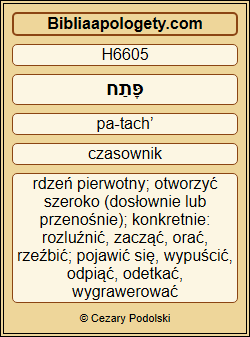 tobie, to będzie H1961 cały H3605 tobie, to będzie H1961 cały H3605 lud H5971, znajdujący się H4672 lud H5971, znajdujący się H4672 w nim, będą H1961 dla ciebie do pracy przymusowej H4522 w nim, będą H1961 dla ciebie do pracy przymusowej H4522 i będą ci służyć H5647 i będą ci służyć H5647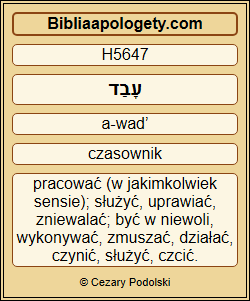 . (Pwt20_11 tłum. AI) . (Pwt20_11 tłum. AI) |
| L03 |
Pwt20_11 |
a ono ci odpowie pokojowo i bramy ci otworzy, niech cały lud, który się w nim znajduje, zejdzie do rzędu robotników pracujących przymusowo, i będą ci służyli. (Pwt20_11 BT_4) |
| L04 |
Pwt20_11 |
a ono ci odpowie H6030 pokojowo H7965 i bramy H6605 ci otworzy, niech cały lud H5971, który się w nim znajduje H4672, zejdzie do rzędu robotników pracujących przymusowo H4522, i będą ci służyli H5647. (Pwt20_11 BT_4) |
| L05 |
Pwt20_11 |
we•ha•<ja> |
'im- |
sza•<Lom> |
ta•'an•<Cha>, |
u•fa•te•<Cha> |
<Lach>; |
we•ha•<ja> |
kol- |
ha•'<Am> |
han•nim•ca- |
<wa>, |
jih•<ju> |
le•<Cha> |
la•<Mas> |
wa•'a•wa•<Du>•cha. |
| L06 |
Pwt20_11 |
וְהָיָה֙ |
אִם־ |
שָׁל֣וֹם |
תַּֽעַנְךָ֔ |
וּפָתְחָ֖ה |
לָ֑ךְ |
וְהָיָ֞ה |
כָּל־ |
הָעָ֣ם |
הַנִּמְצָא־ |
בָ֗הּ |
יִהְי֥וּ |
לְךָ֛ |
לָמַ֖ס |
וַעֲבָדֽוּךָ׃ |
| L07 |
Pwt20_11 |
I stanie się, |
jeśli |
pokojem |
odpowie ci |
i otworzy |
tobie, |
to będzie |
cały |
lud, |
znajdujący się |
w nim, |
będą |
dla ciebie |
do pracy przymusowej |
i będą ci służyć. |
| L08 |
Pwt20_11 |
וְ/הָיָה֙ |
אִם־ |
שָׁל֣וֹם |
תַּֽעַנְ/ךָ֔ |
וּ/פָתְחָ֖ה |
לָ֑/ךְ |
וְ/הָיָ֞ה |
כָּל־ |
הָ/עָ֣ם |
הַ/נִּמְצָא־ |
בָ֗/הּ |
יִהְי֥וּ |
לְ/ךָ֛ |
לָ/מַ֖ס |
וַ/עֲבָדֽוּ/ךָ׃ |
| L09 |
Pwt20_11 |
HC/Vqq3msSpój. + Czas. qal, perf. konsekutywne, 3 os., m., lp. |
HCSpój. |
HNcmsaRzecz. posp., m., lp., stan absolutny |
HVqi3fs/Sp2msCzas. qal, imperfektum, 3 os., ż., lp. + Sufiks zaimkowy, 2 os., m., lp. |
HC/Vqq3fsSpój. + Czas. qal, perf. konsekutywne, 3 os., ż., lp. |
HR/Sp2fsPrzyim. + Sufiks zaimkowy, 2 os., ż., lp. |
HC/Vqq3msSpój. + Czas. qal, perf. konsekutywne, 3 os., m., lp. |
HNcmscRzecz. posp., m., lp., stan konstrukcyjny |
HTd/NcmsaPartykuła rodzajnik określony + Rzecz. posp., m., lp., stan absolutny |
HTd/VNrmsaPartykuła rodzajnik określony + Czas. nifal, imiesłów czynny, m., lp., stan absolutny |
HR/Sp3fsPrzyim. + Sufiks zaimkowy, 3 os., ż., lp. |
HVqi3mpCzas. qal, imperfektum, 3 os., m., lm. |
HR/Sp2msPrzyim. + Sufiks zaimkowy, 2 os., m., lp. |
HR/NcmsaPrzyim. + Rzecz. posp., m., lp., stan absolutny |
HC/Vqq3cp/Sp2msSpój. + Czas. qal, perf. konsekutywne, 3 os., r. wspólny, lm. + Sufiks zaimkowy, 2 os., m., lp. |
| L10 |
Pwt20_11 |
wühäyâ |
´im- |
šälôm |
Ta|`ankä |
ûpätHâ |
läk |
wühäyâ |
Kol- |
hä`äm |
hannimcä´- |
bäh |
yihyû |
lükä |
lämas |
wa`ábädûºkä |
| L11 |
Pwt20_11 |
H1961 |
H0518 |
H7965 |
H6030 |
H6605 |
H0000 |
H1961 |
H3605 |
H5971 |
H4672 |
H0000 |
H1961 |
H0000 |
H4522 |
H5647 |
| L12 |
Pwt20_11 |
shall become |
If |
of peace |
And it shall be if it make thee answer |
and open |
|
shall become |
all |
unto thee then it shall be [that] all the people |
[that is] found |
|
shall become |
|
therein shall be tributaries |
unto thee and they shall serve |
| L13 |
Pwt20_11 |
ve·ha·Yah |
im- |
sha·Lom |
ta·'an·Cha, |
u·fa·te·Chah |
Lach; |
ve·ha·Yah |
kol- |
ha·'Am |
han·nim·tza- |
Vah, |
yih·Yu |
le·Cha |
la·Mas |
va·'a·va·Du·cha. |
| L14 |
Pwt20_11 |
הָיָה |
אִם |
שָׁלוֹם |
עָנָה |
פָּתַח |
|
הָיָה |
כֹּל |
עַם |
מָצָא |
|
הָיָה |
|
מַס |
עָבַד |
| L15 |
Pwt20_11 |
ha·(Ja) |
'(Im) |
sza·(Lom) |
'a·(Na) |
pa·(Tach) |
|
ha·(Ja) |
(Kol) |
('Am) |
ma·(Ca) |
|
ha·(Ja) |
|
(Mas) |
'a·(Wad) |
| L16 |
Pwt20_11 |
hājā(h) |
’im |
šālôm |
‘ānā(h) |
pāṯaḥ |
|
hājā(h) |
kōl |
‘am |
māṣā(’) |
|
hājā(h) |
|
mas |
‘āḇaḏ |
| L17 |
Pwt20_11 |
hājāh |
’im |
šālôm |
‘ānāh |
pātaḥ |
|
hājāh |
kōl |
‘am |
māṣā’ |
|
hājāh |
|
mas |
‘ābad |
| L18 |
Pwt20_11 |
And it shall be, if it make thee answer of peace, and open unto thee, then it shall be, [that] all the people [that is] found therein shall be tributaries unto thee, and they shall serve thee. (Pwt20_11 KJV) |
| L19 |
Pwt20_11 |
11 And it shall be, if it make thee answer <06030> (08799) of peace <07965>, and open <06605> (08804) unto thee, then it shall be, that all the people <05971> that is found <04672> (08737) therein shall be tributaries <04522> unto thee, and they shall serve <05647> (08804) thee. (Pwt20_11 KJV) |
| L20 |
Pwt20_11 |
949/3546 |
311/1068 |
24/237 |
42/329 |
25/144 |
1663/6521 |
950/3546 |
1451/5415 |
395/1866 |
103/453 |
1664/6521 |
951/3546 |
1665/6521 |
3/23 |
101/288 |
| L21 |
Pwt20_11 |
Pwt20_11_1 |
Pwt20_11_2 |
Pwt20_11_3 |
Pwt20_11_4 |
Pwt20_11_5 |
Pwt20_11_6 |
Pwt20_11_7 |
Pwt20_11_8 |
Pwt20_11_9 |
Pwt20_11_10 |
Pwt20_11_11 |
Pwt20_11_12 |
Pwt20_11_13 |
Pwt20_11_14 |
Pwt20_11_15 |
| |
| L01 |
Pwt20_12 |
A jeśli nie zawrze pokoju z tobą i uczyni z tobą wojnę, i będziesz oblegał ją. (Pwt20_12 tłum. AI) |
| L02 |
Pwt20_12 |
A jeśli H518 nie H3808 zawrze pokoju H7999 z tobą H5973 i uczyni H6213 z tobą H5973 i uczyni H6213 z tobą H5973 wojnę H4421, i będziesz oblegał H6696 z tobą H5973 wojnę H4421, i będziesz oblegał H6696 ją H5921. (Pwt20_12 tłum. AI) ją H5921. (Pwt20_12 tłum. AI) |
| L03 |
Pwt20_12 |
Jeśli ci nie odpowie pokojowo i zacznie z tobą wojować, oblegniesz je. (Pwt20_12 BT_4) |
| L04 |
Pwt20_12 |
Jeśli ci nie odpowie pokojowo H7999 i zacznie z tobą wojować H4421, oblegniesz je H6696. (Pwt20_12 BT_4) |
| L05 |
Pwt20_12 |
we•'im- |
lo |
tasz•<Lim> |
'im•<Mach>, |
we•'a•se•<Ta> |
'im•me•<Cha> |
mil•cha•<Ma>; |
we•car•<Ta> |
'a•<Le>•ha. |
| L06 |
Pwt20_12 |
וְאִם־ |
לֹ֤א |
תַשְׁלִים֙ |
עִמָּ֔ךְ |
וְעָשְׂתָ֥ה |
עִמְּךָ֖ |
מִלְחָמָ֑ה |
וְצַרְתָּ֖ |
עָלֶֽיהָ׃ |
| L07 |
Pwt20_12 |
A jeśli |
nie |
zawrze pokoju |
z tobą |
i uczyni |
z tobą |
wojnę, |
i będziesz oblegał |
ją. |
| L08 |
Pwt20_12 |
וְ/אִם־ |
לֹ֤א |
תַשְׁלִים֙ |
עִמָּ֔/ךְ |
וְ/עָשְׂתָ֥ה |
עִמְּ/ךָ֖ |
מִלְחָמָ֑ה |
וְ/צַרְתָּ֖ |
עָלֶֽי/הָ׃ |
| L09 |
Pwt20_12 |
HC/CSpój. + Spój. |
HTnPartykuła przecząca |
HVhi3fsCzas. hifil, imperfektum, 3 os., ż., lp. |
HR/Sp2fsPrzyim. + Sufiks zaimkowy, 2 os., ż., lp. |
HC/Vqq3fsSpój. + Czas. qal, perf. konsekutywne, 3 os., ż., lp. |
HR/Sp2msPrzyim. + Sufiks zaimkowy, 2 os., m., lp. |
HNcfsaRzecz. posp., ż., lp., stan absolutny |
HC/Vqq2msSpój. + Czas. qal, perf. konsekutywne, 2 os., m., lp. |
HR/Sp3fsPrzyim. + Sufiks zaimkowy, 3 os., ż., lp. |
| L10 |
Pwt20_12 |
wü´im- |
lö´ |
tašlîm |
`immäk |
wü`äStâ |
`immükä |
milHämâ |
wücarTä |
`älʺhä |
| L11 |
Pwt20_12 |
H0518 |
H3808 |
H7999 |
H5973 |
H6213 |
H5973 |
H4421 |
H6696 |
H5921 |
| L12 |
Pwt20_12 |
if |
does not |
And if it will make no peace |
against |
with thee but will make |
against |
war |
against thee then thou shalt besiege |
and |
| L13 |
Pwt20_12 |
ve·'im- |
lo |
tash·Lim |
'im·Mach, |
ve·'a·se·Tah |
'im·me·Cha |
mil·cha·Mah; |
ve·tzar·Ta |
'a·Lei·ha. |
| L14 |
Pwt20_12 |
אִם |
לֹא |
שָׁלַם |
עִם |
עָשָׂה |
עִם |
מִלְחָמָה |
צוּר |
עַל |
| L15 |
Pwt20_12 |
'(Im) |
(Lo) |
sza·(Lam) |
('Im) |
a·(Sa) |
('Im) |
mil·cha·(Ma) |
(Cur) |
('Al) |
| L16 |
Pwt20_12 |
’im |
lō(’) |
šālam |
‘im |
‘āśā(h) |
‘im |
milḥāmā(h) |
ṣûr |
‘al |
| L17 |
Pwt20_12 |
’im |
lō’ |
šālam |
‘im |
‘āśāh |
‘im |
milḥāmāh |
ṣûr |
‘al |
| L18 |
Pwt20_12 |
And if it will make no peace with thee, but will make war against thee, then thou shalt besiege it: (Pwt20_12 KJV) |
| L19 |
Pwt20_12 |
12 And if it will make no peace <07999> (08686) with thee, but will make <06213> (08804) war <04421> against thee, then thou shalt besiege <06696> (08804) it: (Pwt20_12 KJV) |
| L20 |
Pwt20_12 |
312/1068 |
1150/5164 |
26/116 |
207/1043 |
801/2617 |
208/1043 |
34/319 |
4/36 |
1423/5759 |
| L21 |
Pwt20_12 |
Pwt20_12_1 |
Pwt20_12_2 |
Pwt20_12_3 |
Pwt20_12_4 |
Pwt20_12_5 |
Pwt20_12_6 |
Pwt20_12_7 |
Pwt20_12_8 |
Pwt20_12_9 |
| |
| L01 |
Pwt20_13 |
I wyda ją Jahwe, twój Bóg, w twoją rękę, i uderzysz — wszystkich jej mężczyzn ostrzem miecza. (Pwt20_13 tłum. AI) |
| L02 |
Pwt20_13 |
I wyda ją H5414 Jahwe H3068, twój Bóg H430, w twoją rękę H3027 Jahwe H3068, twój Bóg H430, w twoją rękę H3027 , i uderzysz H5221 , i uderzysz H5221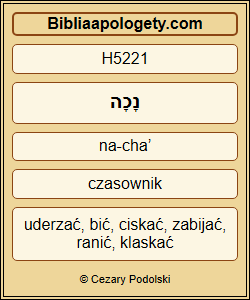 — wszystkich H3605 jej mężczyzn H2138 — wszystkich H3605 jej mężczyzn H2138 ostrzem H6310 ostrzem H6310 miecza H2719 miecza H2719 . (Pwt20_13 tłum. AI) . (Pwt20_13 tłum. AI) |
| L03 |
Pwt20_13 |
Skoro ci je Pan, Bóg twój, odda w ręce - wszystkich mężczyzn wytniesz ostrzem miecza. (Pwt20_13 BT_4) |
| L04 |
Pwt20_13 |
Skoro ci je Pan H3068, Bóg H430 twój, odda H5414 w ręce H3027 – wszystkich mężczyzn H2138 wytniesz H5221 ostrzem H6310 miecza H2719. (Pwt20_13 BT_4) |
| L05 |
Pwt20_13 |
u•ne•ta•<Na> |
<jah>•weQere (czytaj): A·do·(Naj) |
'e•lo•<He>•cha |
be•ja•<De>•cha; |
we•hik•ki•<Ta> |
'et- |
kol- |
ze•chu•<Ra> |
le•fi- |
<Cha>•rew. |
| L06 |
Pwt20_13 |
וּנְתָנָ֛הּ |
יְהוָ֥ה |
אֱלֹהֶ֖יךָ |
בְּיָדֶ֑ךָ |
וְהִכִּיתָ֥ |
אֶת־ |
כָּל־ |
זְכוּרָ֖הּ |
לְפִי־ |
חָֽרֶב׃ |
| L07 |
Pwt20_13 |
I wyda ją |
Jahwe, |
twój Bóg, |
w twoją rękę, |
i uderzysz |
— |
wszystkich |
jej mężczyzn |
ostrzem |
miecza. |
| L08 |
Pwt20_13 |
וּ/נְתָנָ֛/הּ |
יְהוָ֥ה |
אֱלֹהֶ֖י/ךָ |
בְּ/יָדֶ֑/ךָ |
וְ/הִכִּיתָ֥ |
אֶת־ |
כָּל־ |
זְכוּרָ֖/הּ |
לְ/פִי־ |
חָֽרֶב׃ |
| L09 |
Pwt20_13 |
HC/Vqq3ms/Sp3fsSpój. + Czas. qal, perf. konsekutywne, 3 os., m., lp. + Sufiks zaimkowy, 3 os., ż., lp. |
HNpRzecz. własny |
HNcmpc/Sp2msRzecz. posp., m., lm., stan konstrukcyjny + Sufiks zaimkowy, 2 os., m., lp. |
HR/Ncbsc/Sp2msPrzyim. + Rzecz. posp., r. wspólny, lp., stan konstrukcyjny + Sufiks zaimkowy, 2 os., m., lp. |
HC/Vhq2msSpój. + Czas. hifil, perf. konsekutywne, 2 os., m., lp. |
HToPartykuła znacznik dopełnienia bliższego |
HNcmscRzecz. posp., m., lp., stan konstrukcyjny |
HNcmsc/Sp3fsRzecz. posp., m., lp., stan konstrukcyjny + Sufiks zaimkowy, 3 os., ż., lp. |
HR/NcmscPrzyim. + Rzecz. posp., m., lp., stan konstrukcyjny |
HNcfsaRzecz. posp., ż., lp., stan absolutny |
| L10 |
Pwt20_13 |
ûnütänäh |
yhwh(´ädönäy) |
´élöhʺkä |
Büyädeºkä |
wühiKKîtä |
´et- |
Kol- |
zükûräh |
lüpî- |
Häºreb |
| L11 |
Pwt20_13 |
H5414 |
H3068 |
H0430 |
H3027 |
H5221 |
H0853 |
H3605 |
H2138 |
H6310 |
H2719 |
| L12 |
Pwt20_13 |
hath delivered |
And when the LORD |
thy God |
it into thine hands |
thou shalt smite |
|
all |
every male |
thereof with the edge |
of the sword |
| L13 |
Pwt20_13 |
u·ne·ta·Nah |
Yah·weh |
'e·lo·Hei·cha |
be·ya·De·cha; |
ve·hik·ki·Ta |
et- |
kol- |
ze·chu·Rah |
le·fi- |
Cha·rev. |
| L14 |
Pwt20_13 |
נָתַן |
יְהֹוָה |
אֱלֹהִים |
יָד |
נָכָה |
אֵת |
כֹּל |
זָכוּר |
פֶּה |
חֶרֶב |
| L15 |
Pwt20_13 |
na·(Tan) |
(Jah)·we |
E·lo·(Him) |
(Jad) |
na·(Cha) |
('Et) |
(Kol) |
za·(Chur) |
(Pe) |
(Che)·rew |
| L16 |
Pwt20_13 |
nāṯan |
JHWH |
’ᵉ̆lōhîm |
jāḏ |
nāḵā(h) |
’ēṯ |
kōl |
zāḵûr |
pe(h) |
ḥéreḇ |
| L17 |
Pwt20_13 |
nātan |
jhwh |
’ĕlōhîm |
jād |
nākāh |
’ēt |
kōl |
zākûr |
peh |
ḥereb |
| L18 |
Pwt20_13 |
And when the LORD thy God hath delivered it into thine hands, thou shalt smite every male thereof with the edge of the sword: (Pwt20_13 KJV) |
| L19 |
Pwt20_13 |
13 And when the LORD <03068> thy God <0430> hath delivered <05414> (08804) it into thine hands <03027>, thou shalt smite <05221> (08689) every male <02138> thereof with the edge <06310> of the sword <02719>: (Pwt20_13 KJV) |
| L20 |
Pwt20_13 |
584/2007 |
1569/6220 |
697/2597 |
349/1608 |
86/500 |
3964/11047 |
1452/5415 |
4/4 |
116/497 |
33/412 |
| L21 |
Pwt20_13 |
Pwt20_13_1 |
Pwt20_13_2 |
Pwt20_13_3 |
Pwt20_13_4 |
Pwt20_13_5 |
Pwt20_13_6 |
Pwt20_13_7 |
Pwt20_13_8 |
Pwt20_13_9 |
Pwt20_13_10 |
| |
| L01 |
Pwt20_14 |
Tylko kobiety i dzieci, i bydło, i wszystko, które będzie w mieście cały jej łup zabierzesz sobie i będziesz jadł — łup twoich wrogów, który dał Jahwe, twój Bóg, tobie. (Pwt20_14 tłum. AI) |
| L02 |
Pwt20_14 |
Tylko H7535 kobiety H802 i dzieci H2945 kobiety H802 i dzieci H2945 , i bydło H929 , i bydło H929 , i wszystko H3605, które H834 będzie H1961 w mieście H5892 cały H3605 jej łup H7998 , i wszystko H3605, które H834 będzie H1961 w mieście H5892 cały H3605 jej łup H7998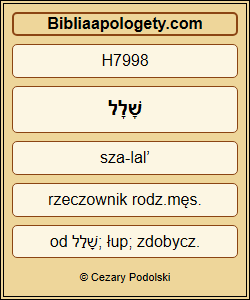 zabierzesz H962 zabierzesz H962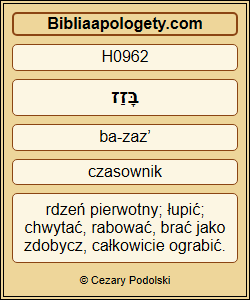 sobie i będziesz jadł H398 sobie i będziesz jadł H398 — łup H7998 twoich wrogów H341, który H834 dał H5414 Jahwe H3068, twój Bóg H430, tobie. (Pwt20_14 tłum. AI) — łup H7998 twoich wrogów H341, który H834 dał H5414 Jahwe H3068, twój Bóg H430, tobie. (Pwt20_14 tłum. AI) |
| L03 |
Pwt20_14 |
Tylko kobiety, dzieci, trzody i wszystko, co jest w mieście, cały łup zabierzesz i będziesz korzystał z łupu twoich wrogów, których ci dał Pan, Bóg twój. (Pwt20_14 BT_4) |
| L04 |
Pwt20_14 |
Tylko kobiety H802, dzieci H2945, trzody H929 i wszystko H3605, co jest w mieście H5892, cały łup H7998 zabierzesz H962 i będziesz korzystał H398 z łupu H7998 twoich wrogów H341, których ci dał H5414 Pan H3068, Bóg H430 twój. (Pwt20_14 BT_4) |
| L05 |
Pwt20_14 |
rak |
<Han>•na•szim |
we•hat•<Taf> |
we•hab•be•he•<Ma> |
we•<Chol> |
'a•<szer> |
jih•<je> |
wa•'<Ir> |
kol- |
sze•la•<La> |
ta•<woz> |
<Lach>; |
we•'a•chal•<Ta> |
'et- |
sze•<Lal> |
'o•je•<we>•cha, |
'a•<szer> |
na•<Tan> |
<jah>•weQere (czytaj): A·do·(Naj) |
'e•lo•<He>•cha |
<Lach>. |
| L06 |
Pwt20_14 |
רַ֣ק |
הַ֠נָּשִׁים |
וְהַטַּ֨ף |
וְהַבְּהֵמָ֜ה |
וְכֹל֩ |
אֲשֶׁ֨ר |
יִהְיֶ֥ה |
בָעִ֛יר |
כָּל־ |
שְׁלָלָ֖הּ |
תָּבֹ֣ז |
לָ֑ךְ |
וְאָֽכַלְתָּ֙ |
אֶת־ |
שְׁלַ֣ל |
אֹיְבֶ֔יךָ |
אֲשֶׁ֥ר |
נָתַ֛ן |
יְהוָ֥ה |
אֱלֹהֶ֖יךָ |
לָֽךְ׃ |
| L07 |
Pwt20_14 |
Tylko |
kobiety |
i dzieci, |
i bydło, |
i wszystko, |
które |
będzie |
w mieście |
cały |
jej łup |
zabierzesz |
sobie |
i będziesz jadł |
— |
łup |
twoich wrogów, |
który |
dał |
Jahwe, |
twój Bóg, |
tobie. |
| L08 |
Pwt20_14 |
רַ֣ק |
הַ֠/נָּשִׁים |
וְ/הַ/טַּ֨ף |
וְ/הַ/בְּהֵמָ֜ה |
וְ/כֹל֩ |
אֲשֶׁ֨ר |
יִהְיֶ֥ה |
בָ/עִ֛יר |
כָּל־ |
שְׁלָלָ֖/הּ |
תָּבֹ֣ז |
לָ֑/ךְ |
וְ/אָֽכַלְתָּ֙ |
אֶת־ |
שְׁלַ֣ל |
אֹיְבֶ֔י/ךָ |
אֲשֶׁ֥ר |
נָתַ֛ן |
יְהוָ֥ה |
אֱלֹהֶ֖י/ךָ |
לָֽ/ךְ׃ |
| L09 |
Pwt20_14 |
HTaPartykuła twierdząca |
HTd/NcfpaPartykuła rodzajnik określony + Rzecz. posp., ż., lm., stan absolutny |
HC/Td/NcmsaSpój. + Partykuła rodzajnik określony + Rzecz. posp., m., lp., stan absolutny |
HC/Td/NcfsaSpój. + Partykuła rodzajnik określony + Rzecz. posp., ż., lp., stan absolutny |
HC/NcmsaSpój. + Rzecz. posp., m., lp., stan absolutny |
HTrPartykuła względna |
HVqi3msCzas. qal, imperfektum, 3 os., m., lp. |
HRd/NcfsaPrzyim. z rodzajnikiem + Rzecz. posp., ż., lp., stan absolutny |
HNcmscRzecz. posp., m., lp., stan konstrukcyjny |
HNcmsc/Sp3fsRzecz. posp., m., lp., stan konstrukcyjny + Sufiks zaimkowy, 3 os., ż., lp. |
HVqi2msCzas. qal, imperfektum, 2 os., m., lp. |
HR/Sp2fsPrzyim. + Sufiks zaimkowy, 2 os., ż., lp. |
HC/Vqq2msSpój. + Czas. qal, perf. konsekutywne, 2 os., m., lp. |
HToPartykuła znacznik dopełnienia bliższego |
HNcmscRzecz. posp., m., lp., stan konstrukcyjny |
HVqrmpc/Sp2msCzas. qal, imiesłów czynny, m., lm., stan konstrukcyjny + Sufiks zaimkowy, 2 os., m., lp. |
HTrPartykuła względna |
HVqp3msCzas. qal, perfectum, 3 os., m., lp. |
HNpRzecz. własny |
HNcmpc/Sp2msRzecz. posp., m., lm., stan konstrukcyjny + Sufiks zaimkowy, 2 os., m., lp. |
HR/Sp2fsPrzyim. + Sufiks zaimkowy, 2 os., ż., lp. |
| L10 |
Pwt20_14 |
raq |
hannäšîm |
wüha††ap |
wühaBBühëmâ |
wüköl |
´ášer |
yihyè |
bä`îr |
Kol- |
šüläläh |
Täböz |
läk |
wü´ä|kalTä |
´et- |
šülal |
´öybʺkä |
´ášer |
nätan |
yhwh(´ädönäy) |
´élöhʺkä |
läk |
| L11 |
Pwt20_14 |
H7535 |
H0802 |
H2945 |
H0929 |
H3605 |
H0834 |
H1961 |
H5892 |
H3605 |
H7998 |
H0962 |
H0000 |
H0398 |
H0853 |
H7998 |
H0341 |
H0834 |
H5414 |
H3068 |
H0430 |
H0000 |
| L12 |
Pwt20_14 |
but |
But the women |
and the little ones |
and the cattle |
and all |
which |
is in |
and all that is in the city |
all |
[even] all the spoil |
thereof shalt thou take |
|
unto thyself and thou shalt eat |
|
the spoil |
of thine enemies |
which |
hath given |
which the LORD |
thy God |
|
| L13 |
Pwt20_14 |
rak |
Han·na·shim |
ve·hat·Taf |
ve·hab·be·he·Mah |
ve·Chol |
'a·Sher |
yih·Yeh |
va·'Ir |
kol- |
she·la·Lah |
ta·Voz |
Lach; |
ve·'a·chal·Ta |
et- |
she·Lal |
'o·ye·Vei·cha, |
'a·Sher |
na·Tan |
Yah·weh |
'e·lo·Hei·cha |
Lach. |
| L14 |
Pwt20_14 |
רַק |
אִשָּׁה |
טַף |
בְּהֵמָה |
כֹּל |
אֲשֶׁר |
הָיָה |
עִיר |
כֹּל |
שָׁלָל |
בָּזַז |
|
אָכַל |
אֵת |
שָׁלָל |
אֹיֵב |
אֲשֶׁר |
נָתַן |
יְהֹוָה |
אֱלֹהִים |
|
| L15 |
Pwt20_14 |
(Rak) |
'isz·(Sza) |
(Taf) |
be·he·(Ma) |
(Kol) |
'a·(Szer) |
ha·(Ja) |
('Ir) |
(Kol) |
sza·(Lal) |
ba·(Zaz) |
|
a·(Chal) |
('Et) |
sza·(Lal) |
'o·(Jew) |
'a·(Szer) |
na·(Tan) |
(Jah)·we |
E·lo·(Him) |
|
| L16 |
Pwt20_14 |
raq |
’iššā(h) |
ṭap̱ |
bᵉhēmā(h) |
kōl |
’ᵃ̆šer |
hājā(h) |
‘îr |
kōl |
šālāl |
bāzaz |
|
’āḵal |
’ēṯ |
šālāl |
’ōjēḇ |
’ᵃ̆šer |
nāṯan |
JHWH |
’ᵉ̆lōhîm |
|
| L17 |
Pwt20_14 |
raq |
’iššāh |
ṭap |
behēmāh |
kōl |
’ăšer |
hājāh |
‘îr |
kōl |
šālāl |
bāzaz |
|
’ākal |
’ēt |
šālāl |
’ōjēb |
’ăšer |
nātan |
jhwh |
’ĕlōhîm |
|
| L18 |
Pwt20_14 |
But the women, and the little ones, and the cattle, and all that is in the city, [even] all the spoil thereof, shalt thou take unto thyself; and thou shalt eat the spoil of thine enemies, which the LORD thy God hath given thee. (Pwt20_14 KJV) |
| L19 |
Pwt20_14 |
14 But the women <0802>, and the little ones <02945>, and the cattle <0929>, and all that is in the city <05892>, even all the spoil <07998> thereof, shalt thou take <0962> (08799) unto thyself; and thou shalt eat <0398> (08804) the spoil <07998> of thine enemies <0341> (08802), which the LORD <03068> thy God <0430> hath given <05414> (08804) thee. (Pwt20_14 KJV) |
| L20 |
Pwt20_14 |
36/109 |
277/781 |
26/42 |
96/190 |
1453/5415 |
1707/5499 |
952/3546 |
149/1093 |
1454/5415 |
9/72 |
8/43 |
1666/6521 |
307/806 |
3965/11047 |
10/72 |
35/280 |
1708/5499 |
585/2007 |
1570/6220 |
698/2597 |
1667/6521 |
| L21 |
Pwt20_14 |
Pwt20_14_1 |
Pwt20_14_2 |
Pwt20_14_3 |
Pwt20_14_4 |
Pwt20_14_5 |
Pwt20_14_6 |
Pwt20_14_7 |
Pwt20_14_8 |
Pwt20_14_9 |
Pwt20_14_10 |
Pwt20_14_11 |
Pwt20_14_12 |
Pwt20_14_13 |
Pwt20_14_14 |
Pwt20_14_15 |
Pwt20_14_16 |
Pwt20_14_17 |
Pwt20_14_18 |
Pwt20_14_19 |
Pwt20_14_20 |
Pwt20_14_21 |
| |
| L01 |
Pwt20_15 |
Tak uczynisz ze wszystkimi miastami dalekimi od ciebie bardzo, które nie z miast narodów tych one [są]. (Pwt20_15 tłum. AI) |
| L02 |
Pwt20_15 |
Tak H3651 uczynisz H6213 ze wszystkimi H3605 miastami H5892 dalekimi H7350 uczynisz H6213 ze wszystkimi H3605 miastami H5892 dalekimi H7350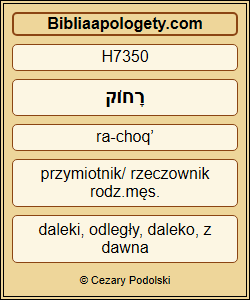 od ciebie H4480 bardzo H3966 od ciebie H4480 bardzo H3966 , które H834 nie H3808 z miast H5892 narodów H1471 , które H834 nie H3808 z miast H5892 narodów H1471 tych H428 tych H428 one [są] H2007 one [są] H2007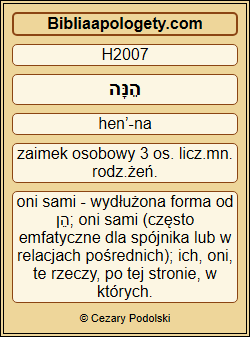 . (Pwt20_15 tłum. AI) . (Pwt20_15 tłum. AI) |
| L03 |
Pwt20_15 |
Tak postąpisz ze wszystkimi miastami daleko od ciebie położonymi, nie będącymi własnością pobliskich narodów. (Pwt20_15 BT_4) |
| L04 |
Pwt20_15 |
Tak postąpisz H6213 ze wszystkimi H3605 miastami H5892 daleko H7350 od ciebie położonymi, nie będącymi H3808 własnością miast H5892 tych H428 narodów H1471. (Pwt20_15 BT_4) |
| L05 |
Pwt20_15 |
ken |
ta•'a•<Se> |
le•chol |
he•'a•<Rim>, |
ha•re•cho•<Kot> |
mi•me•<Cha> |
me•'<Od>; |
'a•<szer> |
lo- |
me•'a•<Re> |
hag•go•jim- |
ha•'<El>•le |
<Hen>•na. |
| L06 |
Pwt20_15 |
כֵּ֤ן |
תַּעֲשֶׂה֙ |
לְכָל־ |
הֶ֣עָרִ֔ים |
הָרְחֹקֹ֥ת |
מִמְּךָ֖ |
מְאֹ֑ד |
אֲשֶׁ֛ר |
לֹא־ |
מֵעָרֵ֥י |
הַגּֽוֹיִם־ |
הָאֵ֖לֶּה |
הֵֽנָּה׃ |
| L07 |
Pwt20_15 |
Tak |
uczynisz |
ze wszystkimi |
miastami |
dalekimi |
od ciebie |
bardzo, |
które |
nie |
z miast |
narodów |
tych |
one [są]. |
| L08 |
Pwt20_15 |
כֵּ֤ן |
תַּעֲשֶׂה֙ |
לְ/כָל־ |
הֶ֣/עָרִ֔ים |
הָ/רְחֹקֹ֥ת |
מִמְּ/ךָ֖ |
מְאֹ֑ד |
אֲשֶׁ֛ר |
לֹא־ |
מֵ/עָרֵ֥י |
הַ/גּֽוֹיִם־ |
הָ/אֵ֖לֶּה |
הֵֽנָּה׃ |
| L09 |
Pwt20_15 |
HTmPartykuła wskazująca |
HVqi2msCzas. qal, imperfektum, 2 os., m., lp. |
HR/NcmscPrzyim. + Rzecz. posp., m., lp., stan konstrukcyjny |
HTd/NcfpaPartykuła rodzajnik określony + Rzecz. posp., ż., lm., stan absolutny |
HTd/AafpaPartykuła rodzajnik określony + Przym. zwykły, ż., lm., stan absolutny |
HR/Sp2msPrzyim. + Sufiks zaimkowy, 2 os., m., lp. |
HDPrzysł. |
HTrPartykuła względna |
HTnPartykuła przecząca |
HR/NcfpcPrzyim. + Rzecz. posp., ż., lm., stan konstrukcyjny |
HTd/NcmpaPartykuła rodzajnik określony + Rzecz. posp., m., lm., stan absolutny |
HTd/PdxcpPartykuła rodzajnik określony + Zaimek wskazujący, os. ?, r. wspólny, lm. |
HPp3fpZaimek osobowy, 3 os., ż., lm. |
| L10 |
Pwt20_15 |
Kën |
Ta`áSè |
lükol- |
heº`ärîm |
härüHöqöt |
mimmükä |
mü´öd |
´ášer |
lö´- |
më`ärê |
haGGô|yim- |
hä´ëºllè |
hëºnnâ |
| L11 |
Pwt20_15 |
H3651 |
H6213 |
H3605 |
H5892 |
H7350 |
H4480 |
H3966 |
H0834 |
H3808 |
H5892 |
H1471 |
H0428 |
H2007 |
| L12 |
Pwt20_15 |
Thus |
Thus shalt thou do |
to all |
unto all the cities |
far off |
that |
[which are] very |
which |
are not |
[are] not of the cities |
of these nations |
of these |
from thee which |
| L13 |
Pwt20_15 |
ken |
ta·'a·Seh |
le·chol |
he·'a·Rim, |
ha·re·cho·Kot |
mi·me·Cha |
me·'Od; |
'a·Sher |
lo- |
me·'a·Rei |
hag·go·yim- |
ha·'El·leh |
Hen·nah. |
| L14 |
Pwt20_15 |
כֵּן |
עָשָׂה |
כֹּל |
עִיר |
רָחוֹק |
מִן |
מְאֹד |
אֲשֶׁר |
לֹא |
עִיר |
גּוֹי |
אֵלֶּה |
הֵנָּה |
| L15 |
Pwt20_15 |
(Ken) |
a·(Sa) |
(Kol) |
('Ir) |
ra·(Chok) |
(Min) |
me·'(Od) |
'a·(Szer) |
(Lo) |
('Ir) |
(Goj) |
'(El)·le |
(Hen)·na |
| L16 |
Pwt20_15 |
kēn |
‘āśā(h) |
kōl |
‘îr |
rāḥôq |
min |
mᵉ’ōḏ |
’ᵃ̆šer |
lō(’) |
‘îr |
gôj |
’ḗlle(h) |
hḗnnā(h) |
| L17 |
Pwt20_15 |
kēn |
‘āśāh |
kōl |
‘îr |
rāḥôq |
min |
me’ōd |
’ăšer |
lō’ |
‘îr |
gôj |
’ēlleh |
hēnnāh |
| L18 |
Pwt20_15 |
Thus shalt thou do unto all the cities [which are] very far off from thee, which [are] not of the cities of these nations. (Pwt20_15 KJV) |
| L19 |
Pwt20_15 |
15 Thus shalt thou do <06213> (08799) unto all the cities <05892> which are very <03966> far off <07350> from thee, which <02007> are not of the cities <05892> of these nations <01471>. (Pwt20_15 KJV) |
| L20 |
Pwt20_15 |
174/767 |
802/2617 |
1455/5415 |
150/1093 |
9/85 |
377/1215 |
72/300 |
1709/5499 |
1151/5164 |
151/1093 |
72/555 |
244/745 |
17/48 |
| L21 |
Pwt20_15 |
Pwt20_15_1 |
Pwt20_15_2 |
Pwt20_15_3 |
Pwt20_15_4 |
Pwt20_15_5 |
Pwt20_15_6 |
Pwt20_15_7 |
Pwt20_15_8 |
Pwt20_15_9 |
Pwt20_15_10 |
Pwt20_15_11 |
Pwt20_15_12 |
Pwt20_15_13 |
| |
| L01 |
Pwt20_16 |
Tylko z miast ludów tych, które Jahwe, twój Bóg, daje tobie jako dziedzictwo, nie pozostawisz przy życiu żadnej duszy. (Pwt20_16 tłum. AI) |
| L02 |
Pwt20_16 |
Tylko H7535 z miast H5892 ludów H5971 tych H428, które H834 Jahwe H3068, twój Bóg H430, daje H5414 tobie jako dziedzictwo H5159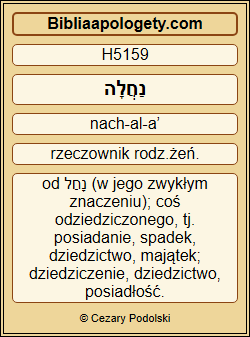 , nie H3808 pozostawisz przy życiu H2421 , nie H3808 pozostawisz przy życiu H2421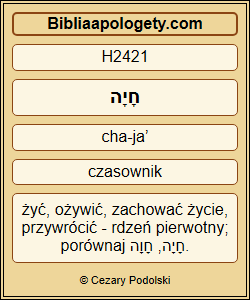 żadnej H3605 duszy H5397 żadnej H3605 duszy H5397 . (Pwt20_16 tłum. AI) . (Pwt20_16 tłum. AI) |
| L03 |
Pwt20_16 |
Tylko w miastach należących do narodów, które ci daje Pan, twój Bóg, jako dziedzictwo, niczego nie zostawisz przy życiu. (Pwt20_16 BT_4) |
| L04 |
Pwt20_16 |
Tylko H7535 w miastach H5892 należących do narodów H5971, które ci daje H5414 Pan H3068, twój Bóg H430, jako dziedzictwo H5159, niczego H3605 żyjącego H5397 nie zostawisz przy życiu H2421. (Pwt20_16 BT_4) |
| L05 |
Pwt20_16 |
<Rak>, |
me•'a•<Re> |
ha•'am•<Mim> |
ha•'<El>•le, |
'a•<szer> |
<jah>•weQere (czytaj): A·do·(Naj) |
'e•lo•<He>•cha, |
no•<Ten> |
le•<Cha> |
na•cha•<La>; |
lo |
te•chai•<je> |
kol- |
ne•sza•<Ma>. |
| L06 |
Pwt20_16 |
רַ֗ק |
מֵעָרֵ֤י |
הָֽעַמִּים֙ |
הָאֵ֔לֶּה |
אֲשֶׁר֙ |
יְהוָ֣ה |
אֱלֹהֶ֔יךָ |
נֹתֵ֥ן |
לְךָ֖ |
נַחֲלָ֑ה |
לֹ֥א |
תְחַיֶּ֖ה |
כָּל־ |
נְשָׁמָֽה׃ |
| L07 |
Pwt20_16 |
Tylko |
z miast |
ludów |
tych, |
które |
Jahwe, |
twój Bóg, |
daje |
tobie |
jako dziedzictwo, |
nie |
pozostawisz przy życiu |
żadnej |
duszy. |
| L08 |
Pwt20_16 |
רַ֗ק |
מֵ/עָרֵ֤י |
הָֽ/עַמִּים֙ |
הָ/אֵ֔לֶּה |
אֲשֶׁר֙ |
יְהוָ֣ה |
אֱלֹהֶ֔י/ךָ |
נֹתֵ֥ן |
לְ/ךָ֖ |
נַחֲלָ֑ה |
לֹ֥א |
תְחַיֶּ֖ה |
כָּל־ |
נְשָׁמָֽה׃ |
| L09 |
Pwt20_16 |
HTaPartykuła twierdząca |
HR/NcfpcPrzyim. + Rzecz. posp., ż., lm., stan konstrukcyjny |
HTd/NcmpaPartykuła rodzajnik określony + Rzecz. posp., m., lm., stan absolutny |
HTd/PdxcpPartykuła rodzajnik określony + Zaimek wskazujący, os. ?, r. wspólny, lm. |
HTrPartykuła względna |
HNpRzecz. własny |
HNcmpc/Sp2msRzecz. posp., m., lm., stan konstrukcyjny + Sufiks zaimkowy, 2 os., m., lp. |
HVqrmsaCzas. qal, imiesłów czynny, m., lp., stan absolutny |
HR/Sp2msPrzyim. + Sufiks zaimkowy, 2 os., m., lp. |
HNcfsaRzecz. posp., ż., lp., stan absolutny |
HTnPartykuła przecząca |
HVpi2msCzas. piel, imperfektum, 2 os., m., lp. |
HNcmscRzecz. posp., m., lp., stan konstrukcyjny |
HNcfsaRzecz. posp., ż., lp., stan absolutny |
| L10 |
Pwt20_16 |
raq |
më`ärê |
hä|`ammîm |
hä´ëºllè |
´ášer |
yhwh(´ädönäy) |
´élöhʺkä |
nötën |
lükä |
naHálâ |
lö´ |
tüHayyè |
Kol- |
nüšämâ |
| L11 |
Pwt20_16 |
H7535 |
H5892 |
H5971 |
H0428 |
H0834 |
H3068 |
H0430 |
H5414 |
H0000 |
H5159 |
H3808 |
H2421 |
H3605 |
H5397 |
| L12 |
Pwt20_16 |
in |
But of the cities |
of these people |
of these |
that |
which the LORD |
thy God |
doth give |
|
thee [for] an inheritance |
shall not |
thou shalt save alive |
anything |
nothing that breatheth |
| L13 |
Pwt20_16 |
Rak, |
me·'a·Rei |
ha·'am·Mim |
ha·'El·leh, |
'a·Sher |
Yah·weh |
'e·lo·Hei·cha, |
no·Ten |
le·Cha |
na·cha·Lah; |
lo |
te·chai·Yeh |
kol- |
ne·sha·Mah. |
| L14 |
Pwt20_16 |
רַק |
עִיר |
עַם |
אֵלֶּה |
אֲשֶׁר |
יְהֹוָה |
אֱלֹהִים |
נָתַן |
|
נַחֲלָה |
לֹא |
חָיָה |
כֹּל |
נְשָׁמָה |
| L15 |
Pwt20_16 |
(Rak) |
('Ir) |
('Am) |
'(El)·le |
'a·(Szer) |
(Jah)·we |
E·lo·(Him) |
na·(Tan) |
|
na·cha·(La) |
(Lo) |
cha·(Ja) |
(Kol) |
ne·sza·(Ma) |
| L16 |
Pwt20_16 |
raq |
‘îr |
‘am |
’ḗlle(h) |
’ᵃ̆šer |
JHWH |
’ᵉ̆lōhîm |
nāṯan |
|
naḥᵃ̆lā(h) |
lō(’) |
ḥājā(h) |
kōl |
nᵉšāmā(h) |
| L17 |
Pwt20_16 |
raq |
‘îr |
‘am |
’ēlleh |
’ăšer |
jhwh |
’ĕlōhîm |
nātan |
|
naḥălāh |
lō’ |
ḥājāh |
kōl |
nešāmāh |
| L18 |
Pwt20_16 |
But of the cities of these people, which the LORD thy God doth give thee [for] an inheritance, thou shalt save alive nothing that breatheth: (Pwt20_16 KJV) |
| L19 |
Pwt20_16 |
16 But of the cities <05892> of these people <05971>, which the LORD <03068> thy God <0430> doth give <05414> (08802) thee for an inheritance <05159>, thou shalt save alive <02421> (08762) nothing that breatheth <05397>: (Pwt20_16 KJV) |
| L20 |
Pwt20_16 |
37/109 |
152/1093 |
396/1866 |
245/745 |
1710/5499 |
1571/6220 |
699/2597 |
586/2007 |
1668/6521 |
68/223 |
1152/5164 |
79/260 |
1456/5415 |
3/23 |
| L21 |
Pwt20_16 |
Pwt20_16_1 |
Pwt20_16_2 |
Pwt20_16_3 |
Pwt20_16_4 |
Pwt20_16_5 |
Pwt20_16_6 |
Pwt20_16_7 |
Pwt20_16_8 |
Pwt20_16_9 |
Pwt20_16_10 |
Pwt20_16_11 |
Pwt20_16_12 |
Pwt20_16_13 |
Pwt20_16_14 |
| |
| L01 |
Pwt20_17 |
Gdyż obkładając klątwą obłożysz ich klątwą: Chetytę i Amorytę, Kananejczyka i Peryzzytę, Chiwwitę i Jebusytę, jak nakazał ci Jahwe, twój Bóg,. (Pwt20_17 tłum. AI) |
| L02 |
Pwt20_17 |
Gdyż H3588 obkładając klątwą H2763 obłożysz ich klątwą H2763: Chetytę H2850 obłożysz ich klątwą H2763: Chetytę H2850 i Amorytę H567 i Amorytę H567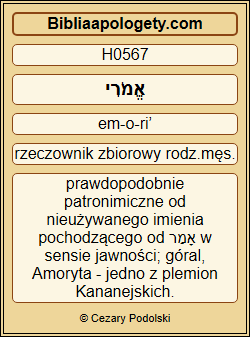 , Kananejczyka H3669 , Kananejczyka H3669 i Peryzzytę H6522 i Peryzzytę H6522 , Chiwwitę H2340 , Chiwwitę H2340 i Jebusytę H2983 i Jebusytę H2983 , jak H834 nakazał ci H6680 , jak H834 nakazał ci H6680 Jahwe H3068, twój Bóg H430,. (Pwt20_17 tłum. AI) Jahwe H3068, twój Bóg H430,. (Pwt20_17 tłum. AI) |
| L03 |
Pwt20_17 |
Gdyż klątwą obłożysz Chetytę, Amorytę, Kananejczyka, Peryzzytę, Chiwwitę i Jebusytę, jak ci rozkazał Pan, Bóg twój, (Pwt20_17 BT_4) |
| L04 |
Pwt20_17 |
Gdyż klątwą obłożysz H2763 Chetytę H2850, Amorytę H567, Kananejczyka H3669, Peryzzytę H6522, Chiwwitę H2340 i Jebusytę H2983, jak H834 ci rozkazał H6680 Pan H3068, Bóg H430 twój, (Pwt20_17 BT_4) |
| L05 |
Pwt20_17 |
ki- |
ha•cha•<Rem> |
ta•cha•ri•<Mem>, |
ha•chit•<Ti> |
we•ha•'e•mo•<Ri> |
hak•ke•na•'a•<Ni> |
we•hap•pe•riz•<Zi>, |
ha•chiw•<wi> |
we•haj•wu•<Si>; |
ka•'a•<szer> |
ciw•we•<Cha> |
<jah>•weQere (czytaj): A·do·(Naj) |
'e•lo•<He>•cha. |
| L06 |
Pwt20_17 |
כִּֽי־ |
הַחֲרֵ֣ם |
תַּחֲרִימֵ֗ם |
הַחִתִּ֤י |
וְהָאֱמֹרִי֙ |
הַכְּנַעֲנִ֣י |
וְהַפְּרִזִּ֔י |
הַחִוִּ֖י |
וְהַיְבוּסִ֑י |
כַּאֲשֶׁ֥ר |
צִוְּךָ֖ |
יְהוָ֥ה |
אֱלֹהֶֽיךָ׃ |
| L07 |
Pwt20_17 |
Gdyż |
obkładając klątwą |
obłożysz ich klątwą: |
Chetytę |
i Amorytę, |
Kananejczyka |
i Peryzzytę, |
Chiwwitę |
i Jebusytę, |
jak |
nakazał ci |
Jahwe, |
twój Bóg, |
| L08 |
Pwt20_17 |
כִּֽי־ |
הַחֲרֵ֣ם |
תַּחֲרִימֵ֗/ם |
הַ/חִתִּ֤י |
וְ/הָ/אֱמֹרִי֙ |
הַ/כְּנַעֲנִ֣י |
וְ/הַ/פְּרִזִּ֔י |
הַ/חִוִּ֖י |
וְ/הַ/יְבוּסִ֑י |
כַּ/אֲשֶׁ֥ר |
צִוְּ/ךָ֖ |
יְהוָ֥ה |
אֱלֹהֶֽי/ךָ׃ |
| L09 |
Pwt20_17 |
HCSpój. |
HVhaCzas. hifil, bezok. absolutny |
HVhi2ms/Sp3mpCzas. hifil, imperfektum, 2 os., m., lp. + Sufiks zaimkowy, 3 os., m., lm. |
HTd/NgmsaPartykuła rodzajnik określony + Rzecz. gentilicium, m., lp., stan absolutny |
HC/Td/NgmsaSpój. + Partykuła rodzajnik określony + Rzecz. gentilicium, m., lp., stan absolutny |
HTd/NgmsaPartykuła rodzajnik określony + Rzecz. gentilicium, m., lp., stan absolutny |
HC/Td/NgmsaSpój. + Partykuła rodzajnik określony + Rzecz. gentilicium, m., lp., stan absolutny |
HTd/NgmsaPartykuła rodzajnik określony + Rzecz. gentilicium, m., lp., stan absolutny |
HC/Td/NgmsaSpój. + Partykuła rodzajnik określony + Rzecz. gentilicium, m., lp., stan absolutny |
HR/TrPrzyim. + Partykuła względna |
HVpp3ms/Sp2msCzas. piel, perfectum, 3 os., m., lp. + Sufiks zaimkowy, 2 os., m., lp. |
HNpRzecz. własny |
HNcmpc/Sp2msRzecz. posp., m., lm., stan konstrukcyjny + Sufiks zaimkowy, 2 os., m., lp. |
| L10 |
Pwt20_17 |
Kî|- |
haHárëm |
TaHárîmëm |
haHiTTî |
wühä´émörî |
haKKüna`ánî |
wühaPPürizzî |
haHiwwî |
wühayübûsî |
Ka´ášer |
ciwwükä |
yhwh(´ädönäy) |
´élöhʺkä |
| L11 |
Pwt20_17 |
H3588 |
H2763 |
H2763 |
H2850 |
H0567 |
H3669 |
H6522 |
H2340 |
H2983 |
H0834 |
H6680 |
H3068 |
H0430 |
| L12 |
Pwt20_17 |
for |
But thou shalt utterly |
destroy |
them [namely] the Hittites |
and the Amorites |
the Canaanites |
and the Perizzites |
the Hivites |
and the Jebusites |
after |
hath commanded |
as the LORD |
thy God |
| L13 |
Pwt20_17 |
ki- |
ha·cha·Rem |
ta·cha·ri·Mem, |
ha·chit·Ti |
ve·ha·'e·mo·Ri |
hak·ke·na·'a·Ni |
ve·hap·pe·riz·Zi, |
ha·chiv·Vi |
ve·hay·vu·Si; |
ka·'a·Sher |
tziv·ve·Cha |
Yah·weh |
'e·lo·Hei·cha. |
| L14 |
Pwt20_17 |
כִּי |
חָרַם |
חָרַם |
חִתִּי |
אֱמֹרִי |
כְּנַעַנִי |
פְּרִזִּי |
חִוִּי |
יְבוּסִי |
אֲשֶׁר |
צָוָה |
יְהֹוָה |
אֱלֹהִים |
| L15 |
Pwt20_17 |
(Ki) |
cha·(Ram) |
cha·(Ram) |
chit·(Ti) |
'e·mo·(Ri) |
ke·na·'a·(Ni) |
pe·riz·(Zi) |
chiw·(Wi) |
je·wu·(Si) |
'a·(Szer) |
ca·(Wa) |
(Jah)·we |
E·lo·(Him) |
| L16 |
Pwt20_17 |
kî |
ḥāram |
ḥāram |
ḥittî |
’ᵉ̆mōrî |
kᵉna‘anî |
pᵉrizzî |
ḥiwwî |
jᵉḇûsî |
’ᵃ̆šer |
ṣāwā(h) |
JHWH |
’ᵉ̆lōhîm |
| L17 |
Pwt20_17 |
kî |
ḥāram |
ḥāram |
ḥittî |
’ĕmōrî |
kena‘anî |
perizzî |
ḥiwwî |
jebûsî |
’ăšer |
ṣāwāh |
jhwh |
’ĕlōhîm |
| L18 |
Pwt20_17 |
But thou shalt utterly destroy them; [namely], the Hittites, and the Amorites, the Canaanites, and the Perizzites, the Hivites, and the Jebusites; as the LORD thy God hath commanded thee: (Pwt20_17 KJV) |
| L19 |
Pwt20_17 |
17 But thou shalt utterly <02763> (08687) destroy <02763> (08686) them; namely, the Hittites <02850>, and the Amorites <0567>, the Canaanites <03669>, and the Perizzites <06522>, the Hivites <02340>, and the Jebusites <02983>; as the LORD <03068> thy God <0430> hath commanded <06680> (08765) thee: (Pwt20_17 KJV) |
| L20 |
Pwt20_17 |
918/4478 |
13/52 |
14/52 |
19/48 |
39/87 |
31/74 |
10/23 |
12/25 |
11/41 |
1711/5499 |
221/491 |
1572/6220 |
700/2597 |
| L21 |
Pwt20_17 |
Pwt20_17_1 |
Pwt20_17_2 |
Pwt20_17_3 |
Pwt20_17_4 |
Pwt20_17_5 |
Pwt20_17_6 |
Pwt20_17_7 |
Pwt20_17_8 |
Pwt20_17_9 |
Pwt20_17_10 |
Pwt20_17_11 |
Pwt20_17_12 |
Pwt20_17_13 |
| |
| L01 |
Pwt20_18 |
Aby które nie nauczą — czynić według wszystkich ich obrzydliwości, które czynili dla swoich bogów, i zgrzeszycie przeciw Jahwe, waszemu Bogu. (Pwt20_18 tłum. AI) |
| L02 |
Pwt20_18 |
Aby H4616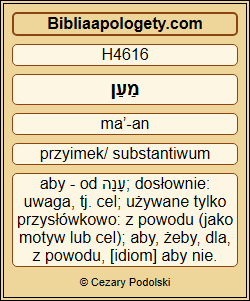 które H834 nie H3808 nauczą H3925 które H834 nie H3808 nauczą H3925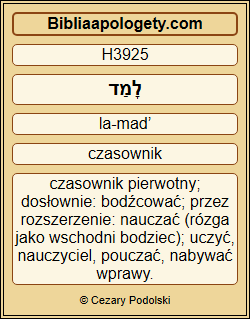 — czynić H6213 według wszystkich H3605 ich obrzydliwości H8441 — czynić H6213 według wszystkich H3605 ich obrzydliwości H8441 , które H834 czynili H6213 dla swoich bogów H430, i zgrzeszycie H2398 , które H834 czynili H6213 dla swoich bogów H430, i zgrzeszycie H2398 przeciw Jahwe H3068, waszemu Bogu H430. (Pwt20_18 tłum. AI) przeciw Jahwe H3068, waszemu Bogu H430. (Pwt20_18 tłum. AI) |
| L03 |
Pwt20_18 |
abyście się nie nauczyli czynić wszystkich obrzydliwości, które oni czynią ku czci bogów swoich, i byście nie grzeszyli przeciw Panu, waszemu Bogu. (Pwt20_18 BT_4) |
| L04 |
Pwt20_18 |
abyście się nie nauczyli H3925 czynić H6213 wszystkich H3605 obrzydliwości H8441, które oni czynią H6213 ku czci bogów H430 swoich, i byście nie grzeszyli H2398 przeciw Panu H3068, waszemu Bogu H430. (Pwt20_18 BT_4) |
| L05 |
Pwt20_18 |
le•<Ma>•'an, |
'a•<szer> |
lo- |
je•lam•me•<Du> |
'et•<Chem> |
la•'a•<Sot>, |
ke•<Chol> |
to•'a•wo•<Tam>, |
'a•<szer> |
'a•<Su> |
le•lo•he•<Hem>; |
wa•cha•ta•<Tem> |
la·(Jah)·weQere (czytaj): la·do·(Naj) |
'e•lo•he•<Chem>. |
sa•<Mek> |
| L06 |
Pwt20_18 |
לְמַ֗עַן |
אֲשֶׁ֨ר |
לֹֽא־ |
יְלַמְּד֤וּ |
אֶתְכֶם֙ |
לַעֲשׂ֔וֹת |
כְּכֹל֙ |
תּֽוֹעֲבֹתָ֔ם |
אֲשֶׁ֥ר |
עָשׂ֖וּ |
לֵֽאלֹהֵיהֶ֑ם |
וַחֲטָאתֶ֖ם |
לַיהוָ֥ה |
אֱלֹהֵיכֶֽם׃ |
ס |
| L07 |
Pwt20_18 |
aby |
które |
nie |
nauczą |
— |
czynić |
według wszystkich |
ich obrzydliwości, |
które |
czynili |
dla swoich bogów, |
i zgrzeszycie |
przeciw Jahwe, |
waszemu Bogu. |
§ |
| L08 |
Pwt20_18 |
לְמַ֗עַן |
אֲשֶׁ֨ר |
לֹֽא־ |
יְלַמְּד֤וּ |
אֶתְ/כֶם֙ |
לַ/עֲשׂ֔וֹת |
כְּ/כֹל֙ |
תּֽוֹעֲבֹתָ֔/ם |
אֲשֶׁ֥ר |
עָשׂ֖וּ |
לֵֽ/אלֹהֵי/הֶ֑ם |
וַ/חֲטָאתֶ֖ם |
לַ/יהוָ֥ה |
אֱלֹהֵי/כֶֽם׃ |
ס |
| L09 |
Pwt20_18 |
HRPrzyim. |
HTrPartykuła względna |
HTnPartykuła przecząca |
HVpi3mpCzas. piel, imperfektum, 3 os., m., lm. |
HTo/Sp2mpPartykuła znacznik dopełnienia bliższego + Sufiks zaimkowy, 2 os., m., lm. |
HR/VqcPrzyim. + Czas. qal, bezok. konstrukcyjny |
HR/NcmscPrzyim. + Rzecz. posp., m., lp., stan konstrukcyjny |
HNcfpc/Sp3mpRzecz. posp., ż., lm., stan konstrukcyjny + Sufiks zaimkowy, 3 os., m., lm. |
HTrPartykuła względna |
HVqp3cpCzas. qal, perfectum, 3 os., r. wspólny, lm. |
HR/Ncmpc/Sp3mpPrzyim. + Rzecz. posp., m., lm., stan konstrukcyjny + Sufiks zaimkowy, 3 os., m., lm. |
HC/Vqq2mpSpój. + Czas. qal, perf. konsekutywne, 2 os., m., lm. |
HR/NpPrzyim. + Rzecz. własny |
HNcmpc/Sp2mpRzecz. posp., m., lm., stan konstrukcyjny + Sufiks zaimkowy, 2 os., m., lm. |
MARK-SZnacznik podziału: setuma (akapit zamknięty) |
| L10 |
Pwt20_18 |
lümaº`an |
´ášer |
lö|´- |
yülammüdû |
´etkem |
la`áSôt |
Küköl |
Tô|`ábötäm |
´ášer |
`äSû |
lë|´löhêhem |
waHá†ä´tem |
lyhwh(la´dönäy) |
´élöhêkem |
s |
| L11 |
Pwt20_18 |
H4616 |
H0834 |
H3808 |
H3925 |
H0853 |
H6213 |
H3605 |
H8441 |
H0834 |
H6213 |
H0430 |
H2398 |
H3068 |
H0430 |
|
| L12 |
Pwt20_18 |
so |
which |
may not |
That they teach |
|
you not to do |
to all |
after all their abominations |
which |
which they have done |
unto their gods |
so should ye sin |
against the LORD |
your God |
|
| L13 |
Pwt20_18 |
le·Ma·'an, |
'a·Sher |
lo- |
ye·lam·me·Du |
'et·Chem |
la·'a·Sot, |
ke·Chol |
to·'a·vo·Tam, |
'a·Sher |
'a·Su |
le·lo·hei·Hem; |
va·cha·ta·Tem |
Yah·weh |
'e·lo·hei·Chem. |
sa·Mek |
| L14 |
Pwt20_18 |
מַעַן |
אֲשֶׁר |
לֹא |
לָמַד |
אֵת |
עָשָׂה |
כֹּל |
תּוֹעֵבַה |
אֲשֶׁר |
עָשָׂה |
אֱלֹהִים |
חָטָא |
יְהֹוָה |
אֱלֹהִים |
|
| L15 |
Pwt20_18 |
(Ma)·'an |
'a·(Szer) |
(Lo) |
la·(Mad) |
('Et) |
a·(Sa) |
(Kol) |
to·'e·(Wa) |
'a·(Szer) |
a·(Sa) |
E·lo·(Him) |
cha·(Ta) |
(Jah)·we |
E·lo·(Him) |
|
| L16 |
Pwt20_18 |
má‘an |
’ᵃ̆šer |
lō(’) |
lāmaḏ |
’ēṯ |
‘āśā(h) |
kōl |
tô‘ēḇa(h) |
’ᵃ̆šer |
‘āśā(h) |
’ᵉ̆lōhîm |
ḥāṭā(’) |
JHWH |
’ᵉ̆lōhîm |
|
| L17 |
Pwt20_18 |
ma‘an |
’ăšer |
lō’ |
lāmad |
’ēt |
‘āśāh |
kōl |
tô‘ēbah |
’ăšer |
‘āśāh |
’ĕlōhîm |
ḥāṭā’ |
jhwh |
’ĕlōhîm |
|
| L18 |
Pwt20_18 |
That they teach you not to do after all their abominations, which they have done unto their gods; so should ye sin against the LORD your God. (Pwt20_18 KJV) |
| L19 |
Pwt20_18 |
18 That they teach <03925> (08762) you not to do <06213> (08800) after all their abominations <08441>, which they have done <06213> (08804) unto their gods <0430>; so should ye sin <02398> (08804) against the LORD <03068> your God <0430>. (Pwt20_18 KJV) |
| L20 |
Pwt20_18 |
64/272 |
1712/5499 |
1153/5164 |
13/85 |
3966/11047 |
803/2617 |
1457/5415 |
21/116 |
1713/5499 |
804/2617 |
701/2597 |
71/236 |
1573/6220 |
702/2597 |
|
| L21 |
Pwt20_18 |
Pwt20_18_1 |
Pwt20_18_2 |
Pwt20_18_3 |
Pwt20_18_4 |
Pwt20_18_5 |
Pwt20_18_6 |
Pwt20_18_7 |
Pwt20_18_8 |
Pwt20_18_9 |
Pwt20_18_10 |
Pwt20_18_11 |
Pwt20_18_12 |
Pwt20_18_13 |
Pwt20_18_14 |
Pwt20_18_15 |
| |
| L01 |
Pwt20_19 |
Gdy będziesz oblegał do miasta dni wiele, aby walczyć przeciw niemu, aby je zdobyć, nie zniszczysz — jego drzewa, uderzając przeciw niemu siekierą, gdyż z niego będziesz jadł, i — nie zetniesz; gdyż czy człowiek [jest] drzewem pola, aby przyjść przed tobą w oblężeniu? (Pwt20_19 tłum. AI) |
| L02 |
Pwt20_19 |
Gdy H3588 będziesz oblegał H6696 do H413 miasta H5892 dni H3117 wiele H7227, aby walczyć H3898 przeciw niemu H5921, aby je zdobyć H8610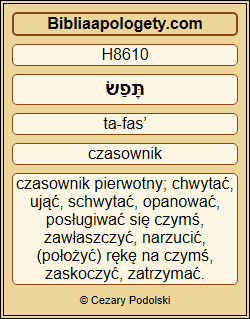 , nie H3808 zniszczysz H7843 , nie H3808 zniszczysz H7843 — jego drzewa H6086 — jego drzewa H6086 , uderzając H5080 , uderzając H5080 przeciw niemu H5921 siekierą H1631 przeciw niemu H5921 siekierą H1631 , gdyż H3588 z niego H4480 będziesz jadł H398, i — nie H3808 zetniesz H3772 , gdyż H3588 z niego H4480 będziesz jadł H398, i — nie H3808 zetniesz H3772 ; gdyż H3588 czy człowiek [jest] H120 ; gdyż H3588 czy człowiek [jest] H120 drzewem H6086 pola H7704 drzewem H6086 pola H7704 , aby przyjść H935 , aby przyjść H935 przed tobą H6440 w oblężeniu H4692 przed tobą H6440 w oblężeniu H4692 ? (Pwt20_19 tłum. AI) ? (Pwt20_19 tłum. AI) |
| L03 |
Pwt20_19 |
Jeśli przez wiele dni będziesz oblegał miasto i walczył z nim, nie zetniesz jego drzew podkładając siekierę, bo będziesz spożywał z nich owoce. Dlatego ich nie zniszczysz. Czy drzewo to człowiek, byś je oblegał? (Pwt20_19 BT_4) |
| L04 |
Pwt20_19 |
Jeśli H3588 przez wiele H7227 dni H3117 będziesz oblegał H6696 miasto H5892 i walczył H3898 z nim, nie zetniesz H3772 jego drzew H6086 podkładając H5080 siekierę H1631, bo będziesz spożywał H398 z nich owoce. Dlatego ich nie zniszczysz H7843. Czy drzewo H6086 to człowiek H120, byś je oblegał H4692? (Pwt20_19 BT_4) |
| L05 |
Pwt20_19 |
ki- |
ta•<cur> |
'el- |
'ir |
ja•<Mim> |
rab•<Bim> |
le•hil•la•<Chem> |
'a•<Le>•ha |
le•ta•fe•<Sa>, |
lo- |
tasz•<Chit> |
'et- |
'e•<ca> |
lin•<Do>•ach |
'a•<Law> |
gar•<Zen>, |
ki |
mi•<Men>•nu |
to•<Chel>, |
we•'o•<To> |
lo |
tich•<Rot>; |
ki |
ha•'a•<Dam> |
'ec |
has•sa•<De>, |
la•<wo> |
mip•pa•<Ne>•cha |
bam•ma•<cor>. |
| L06 |
Pwt20_19 |
כִּֽי־ |
תָצ֣וּר |
אֶל־ |
עִיר֩ |
יָמִ֨ים |
רַבִּ֜ים |
לְֽהִלָּחֵ֧ם |
עָלֶ֣יהָ |
לְתָפְשָׂ֗הּ |
לֹֽא־ |
תַשְׁחִ֤ית |
אֶת־ |
עֵצָהּ֙ |
לִנְדֹּ֤חַ |
עָלָיו֙ |
גַּרְזֶ֔ן |
כִּ֚י |
מִמֶּ֣נּוּ |
תֹאכֵ֔ל |
וְאֹת֖וֹ |
לֹ֣א |
תִכְרֹ֑ת |
כִּ֤י |
הָֽאָדָם֙ |
עֵ֣ץ |
הַשָּׂדֶ֔ה |
לָבֹ֥א |
מִפָּנֶ֖יךָ |
בַּמָּצֽוֹר׃ |
| L07 |
Pwt20_19 |
Gdy |
będziesz oblegał |
do |
miasta |
dni |
wiele, |
aby walczyć |
przeciw niemu, |
aby je zdobyć, |
nie |
zniszczysz |
— |
jego drzewa, |
uderzając |
przeciw niemu |
siekierą, |
gdyż |
z niego |
będziesz jadł, |
i — |
nie |
zetniesz; |
gdyż |
czy człowiek [jest] |
drzewem |
pola, |
aby przyjść |
przed tobą |
w oblężeniu? |
| L08 |
Pwt20_19 |
כִּֽי־ |
תָצ֣וּר |
אֶל־ |
עִיר֩ |
יָמִ֨ים |
רַבִּ֜ים |
לְֽ/הִלָּחֵ֧ם |
עָלֶ֣י/הָ |
לְ/תָפְשָׂ֗/הּ |
לֹֽא־ |
תַשְׁחִ֤ית |
אֶת־ |
עֵצָ/הּ֙ |
לִ/נְדֹּ֤חַ |
עָלָי/ו֙ |
גַּרְזֶ֔ן |
כִּ֚י |
מִמֶּ֣/נּוּ |
תֹאכֵ֔ל |
וְ/אֹת֖/וֹ |
לֹ֣א |
תִכְרֹ֑ת |
כִּ֤י |
הָֽ/אָדָם֙ |
עֵ֣ץ |
הַ/שָּׂדֶ֔ה |
לָ/בֹ֥א |
מִ/פָּנֶ֖י/ךָ |
בַּ/מָּצֽוֹר׃ |
| L09 |
Pwt20_19 |
HCSpój. |
HVqi2msCzas. qal, imperfektum, 2 os., m., lp. |
HRPrzyim. |
HNcfsaRzecz. posp., ż., lp., stan absolutny |
HNcmpaRzecz. posp., m., lm., stan absolutny |
HAampaPrzym. zwykły, m., lm., stan absolutny |
HR/VNcPrzyim. + Czas. nifal, bezok. konstrukcyjny |
HR/Sp3fsPrzyim. + Sufiks zaimkowy, 3 os., ż., lp. |
HR/Vqc/Sp3fsPrzyim. + Czas. qal, bezok. konstrukcyjny + Sufiks zaimkowy, 3 os., ż., lp. |
HTnPartykuła przecząca |
HVhi2msCzas. hifil, imperfektum, 2 os., m., lp. |
HToPartykuła znacznik dopełnienia bliższego |
HNcmsc/Sp3fsRzecz. posp., m., lp., stan konstrukcyjny + Sufiks zaimkowy, 3 os., ż., lp. |
HR/VqcPrzyim. + Czas. qal, bezok. konstrukcyjny |
HR/Sp3msPrzyim. + Sufiks zaimkowy, 3 os., m., lp. |
HNcmsaRzecz. posp., m., lp., stan absolutny |
HCSpój. |
HR/Sp1cpPrzyim. + Sufiks zaimkowy, 1 os., r. wspólny, lm. |
HVqi2msCzas. qal, imperfektum, 2 os., m., lp. |
HC/To/Sp3msSpój. + Partykuła znacznik dopełnienia bliższego + Sufiks zaimkowy, 3 os., m., lp. |
HTnPartykuła przecząca |
HVqi2msCzas. qal, imperfektum, 2 os., m., lp. |
HCSpój. |
HTi/NcmsaPartykuła pytajna + Rzecz. posp., m., lp., stan absolutny |
HNcmscRzecz. posp., m., lp., stan konstrukcyjny |
HTd/NcmsaPartykuła rodzajnik określony + Rzecz. posp., m., lp., stan absolutny |
HR/VqcPrzyim. + Czas. qal, bezok. konstrukcyjny |
HR/Ncbpc/Sp2msPrzyim. + Rzecz. posp., r. wspólny, lm., stan konstrukcyjny + Sufiks zaimkowy, 2 os., m., lp. |
HRd/NcmsaPrzyim. z rodzajnikiem + Rzecz. posp., m., lp., stan absolutny |
| L10 |
Pwt20_19 |
Kî|- |
täcûr |
´el- |
`îr |
yämîm |
raBBîm |
lü|hilläHëm |
`älʺhä |
lütopSäh |
lö|´- |
tašHît |
´et- |
`ëcâ |
linDöªH |
`äläyw |
Garzen |
Kî |
mimmeºnnû |
tö´kël |
wü´ötô |
lö´ |
tikröt |
Kî |
hä|´ädäm |
`ëc |
haSSädè |
läbö´ |
miPPänʺkä |
Bammäcôr |
| L11 |
Pwt20_19 |
H3588 |
H6696 |
H0413 |
H5892 |
H3117 |
H7227 |
H3898 |
H5921 |
H8610 |
H3808 |
H7843 |
H0853 |
H6086 |
H5080 |
H5921 |
H1631 |
H3588 |
H4480 |
H0398 |
H0853 |
H3808 |
H3772 |
H3588 |
H0120 |
H6086 |
H7704 |
H0935 |
H6440 |
H4692 |
| L12 |
Pwt20_19 |
When |
When thou shalt besiege |
about |
a city |
time |
a long |
in making war |
against |
against it to take |
shall not |
it thou shalt not destroy |
|
the trees |
thereof by forcing |
against |
an axe |
When |
at |
against them for thou mayest eat |
|
shall not |
of them and thou shalt not cut them down |
When |
[is] man's |
(for the tree |
of the field |
[life]) to employ |
accept |
should be besieged |
| L13 |
Pwt20_19 |
ki- |
ta·Tzur |
el- |
'ir |
ya·Mim |
rab·Bim |
le·hil·la·Chem |
'a·Lei·ha |
le·ta·fe·Sah, |
lo- |
tash·Chit |
et- |
'e·Tzah |
lin·Do·ach |
'a·Lav |
gar·Zen, |
ki |
mi·Men·nu |
to·Chel, |
ve·'o·To |
lo |
tich·Rot; |
ki |
ha·'a·Dam |
'etz |
has·sa·Deh, |
la·Vo |
mip·pa·Nei·cha |
bam·ma·Tzor. |
| L14 |
Pwt20_19 |
כִּי |
צוּר |
אֵל |
עִיר |
יוֹם |
רַב |
לָחַם |
עַל |
תָּפַשׂ |
לֹא |
שָׁחַת |
אֵת |
עֵץ |
נָדַח |
עַל |
גַּרְזֶן |
כִּי |
מִן |
אָכַל |
אֵת |
לֹא |
כָּרַת |
כִּי |
אָדָם |
עֵץ |
שָׂדֶה |
בּוֹא |
פָּנִים |
מָצוֹר |
| L15 |
Pwt20_19 |
(Ki) |
(Cur) |
('El) |
('Ir) |
(Jom) |
(Raw) |
la·(Cham) |
('Al) |
ta·(Fas) |
(Lo) |
sza·(Chat) |
('Et) |
('Ec) |
na·(Dach) |
('Al) |
gar·(Zen) |
(Ki) |
(Min) |
a·(Chal) |
('Et) |
(Lo) |
ka·(Rat) |
(Ki) |
'a·(Dam) |
('Ec) |
sa·(De) |
(Bo) |
pa·(Nim) |
ma·(Cor) |
| L16 |
Pwt20_19 |
kî |
ṣûr |
’ēl |
‘îr |
jôm |
raḇ |
lāḥam |
‘al |
tāp̱aś |
lō(’) |
šāḥaṯ |
’ēṯ |
‘ēṣ |
nāḏaḥ |
‘al |
garzen |
kî |
min |
’āḵal |
’ēṯ |
lō(’) |
kāraṯ |
kî |
’āḏām |
‘ēṣ |
śāḏe(h) |
bô(’) |
pānîm |
māṣôr |
| L17 |
Pwt20_19 |
kî |
ṣûr |
’ēl |
‘îr |
jôm |
rab |
lāḥam |
‘al |
tāpaś |
lō’ |
šāḥat |
’ēt |
‘ēṣ |
nādaḥ |
‘al |
garzen |
kî |
min |
’ākal |
’ēt |
lō’ |
kārat |
kî |
’ādām |
‘ēṣ |
śādeh |
bô’ |
pānîm |
māṣôr |
| L18 |
Pwt20_19 |
When thou shalt besiege a city a long time, in making war against it to take it, thou shalt not destroy the trees thereof by forcing an axe against them: for thou mayest eat of them, and thou shalt not cut them down (for the tree of the field [is] man's [life]) to employ [them] in the siege: (Pwt20_19 KJV) |
| L19 |
Pwt20_19 |
19 When thou shalt besiege <06696> (08799) a city <05892> a long <07227> time <03117>, in making war <03898> (08736) against it to take <08610> (08800) it, thou shalt not destroy <07843> (08686) the trees <06086> thereof by forcing <05080> (08800) an axe <01631> against them: for thou mayest eat <0398> (08799) of them, and thou shalt not cut them down <03772> (08799) (for the tree <06086> of the field <07704> is man's <0120> life) to employ <0935> (08800) them in the siege <06440> <04692>: (Pwt20_19 KJV) |
| L20 |
Pwt20_19 |
919/4478 |
5/36 |
1595/5500 |
153/1093 |
604/2302 |
59/462 |
17/177 |
1424/5759 |
6/65 |
1154/5164 |
30/147 |
3967/11047 |
97/329 |
6/51 |
1425/5759 |
2/4 |
920/4478 |
378/1215 |
308/806 |
3968/11047 |
1155/5164 |
61/288 |
921/4478 |
106/552 |
98/329 |
108/332 |
565/2550 |
582/2127 |
1/26 |
| L21 |
Pwt20_19 |
Pwt20_19_1 |
Pwt20_19_2 |
Pwt20_19_3 |
Pwt20_19_4 |
Pwt20_19_5 |
Pwt20_19_6 |
Pwt20_19_7 |
Pwt20_19_8 |
Pwt20_19_9 |
Pwt20_19_10 |
Pwt20_19_11 |
Pwt20_19_12 |
Pwt20_19_13 |
Pwt20_19_14 |
Pwt20_19_15 |
Pwt20_19_16 |
Pwt20_19_17 |
Pwt20_19_18 |
Pwt20_19_19 |
Pwt20_19_20 |
Pwt20_19_21 |
Pwt20_19_22 |
Pwt20_19_23 |
Pwt20_19_24 |
Pwt20_19_25 |
Pwt20_19_26 |
Pwt20_19_27 |
Pwt20_19_28 |
Pwt20_19_29 |
| |
| L01 |
Pwt20_20 |
Tylko drzewo, o którym wiesz, że nie drzewem pokarmu ono [jest], je zniszczysz i zetniesz, i zbudujesz oblężenie przeciw miastu, które ono prowadzi z tobą wojnę, aż je zdobędziesz. (Pwt20_20 tłum. AI) |
| L02 |
Pwt20_20 |
Tylko H7535 drzewo H6086, o którym H834 wiesz H3045 , że H3588 nie H3808 drzewem H6086 pokarmu H3978 , że H3588 nie H3808 drzewem H6086 pokarmu H3978 ono [jest] H1931 ono [jest] H1931 , je zniszczysz H7843 i zetniesz H3772, i zbudujesz H1129 oblężenie H4692 przeciw H5921 miastu H5892, które H834 ono H1931 prowadzi H6213 z tobą H5973 wojnę H4421, aż H5704 , je zniszczysz H7843 i zetniesz H3772, i zbudujesz H1129 oblężenie H4692 przeciw H5921 miastu H5892, które H834 ono H1931 prowadzi H6213 z tobą H5973 wojnę H4421, aż H5704 je zdobędziesz H3381 je zdobędziesz H3381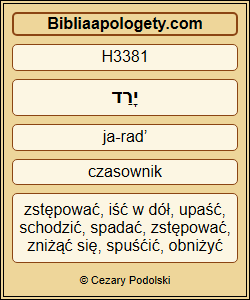 . (Pwt20_20 tłum. AI) . (Pwt20_20 tłum. AI) |
| L03 |
Pwt20_20 |
Tylko drzewa znane ci jako nieowocowe zetniesz i zbudujesz sobie narzędzia oblężnicze przeciw miastu, które z tobą toczy wojnę, aż je zdobędziesz. (Pwt20_20 BT_4) |
| L04 |
Pwt20_20 |
Tylko H7535 drzewa H6086 znane ci H3045 jako nieowocowe H3978 zetniesz H3772 i zbudujesz H1129 sobie narzędzia oblężnicze H4692 przeciw miastu H5892, które H834 z tobą toczy H6213 wojnę H4421, aż je zdobędziesz H3381. (Pwt20_20 BT_4) |
| L05 |
Pwt20_20 |
rak |
'ec |
'a•<szer>- |
te•<Da>', |
ki- |
lo- |
'ec |
ma•'a•<Chal> |
<Hu>, |
o•<To> |
tasz•<Chit> |
we•cha•<Ra>•ta; |
u•wa•<Ni>•ta |
ma•<cor>, |
'al- |
ha•'<Ir> |
'a•<szer>- |
hi |
'o•<Sa> |
'im•me•<Cha> |
mil•cha•<Ma> |
'ad |
rid•<Ta>. |
<Pe> |
| L06 |
Pwt20_20 |
רַ֞ק |
עֵ֣ץ |
אֲשֶׁר־ |
תֵּדַ֗ע |
כִּֽי־ |
לֹא־ |
עֵ֤ץ |
מַאֲכָל֙ |
ה֔וּא |
אֹת֥וֹ |
תַשְׁחִ֖ית |
וְכָרָ֑תָּ |
וּבָנִ֣יתָ |
מָצ֗וֹר |
עַל־ |
הָעִיר֙ |
אֲשֶׁר־ |
הִ֨וא |
עֹשָׂ֧ה |
עִמְּךָ֛ |
מִלְחָמָ֖ה |
עַ֥ד |
רִדְתָּֽהּ׃ |
פ |
| L07 |
Pwt20_20 |
Tylko |
drzewo, |
o którym |
wiesz, |
że |
nie |
drzewem |
pokarmu |
ono [jest], |
je |
zniszczysz |
i zetniesz, |
i zbudujesz |
oblężenie |
przeciw |
miastu, |
które |
ono |
prowadzi |
z tobą |
wojnę, |
aż |
je zdobędziesz. |
¶ |
| L08 |
Pwt20_20 |
רַ֞ק |
עֵ֣ץ |
אֲשֶׁר־ |
תֵּדַ֗ע |
כִּֽי־ |
לֹא־ |
עֵ֤ץ |
מַאֲכָל֙ |
ה֔וּא |
אֹת֥/וֹ |
תַשְׁחִ֖ית |
וְ/כָרָ֑תָּ |
וּ/בָנִ֣יתָ |
מָצ֗וֹר |
עַל־ |
הָ/עִיר֙ |
אֲשֶׁר־ |
הִ֨וא |
עֹשָׂ֧ה |
עִמְּ/ךָ֛ |
מִלְחָמָ֖ה |
עַ֥ד |
רִדְתָּֽ/הּ׃ |
פ |
| L09 |
Pwt20_20 |
HTaPartykuła twierdząca |
HNcmsaRzecz. posp., m., lp., stan absolutny |
HTrPartykuła względna |
HVqi2msCzas. qal, imperfektum, 2 os., m., lp. |
HCSpój. |
HTnPartykuła przecząca |
HNcmscRzecz. posp., m., lp., stan konstrukcyjny |
HNcmsaRzecz. posp., m., lp., stan absolutny |
HPp3msZaimek osobowy, 3 os., m., lp. |
HTo/Sp3msPartykuła znacznik dopełnienia bliższego + Sufiks zaimkowy, 3 os., m., lp. |
HVhi2msCzas. hifil, imperfektum, 2 os., m., lp. |
HC/Vqq2msSpój. + Czas. qal, perf. konsekutywne, 2 os., m., lp. |
HC/Vqq2msSpój. + Czas. qal, perf. konsekutywne, 2 os., m., lp. |
HNcmsaRzecz. posp., m., lp., stan absolutny |
HRPrzyim. |
HTd/NcfsaPartykuła rodzajnik określony + Rzecz. posp., ż., lp., stan absolutny |
HTrPartykuła względna |
HPp3fsZaimek osobowy, 3 os., ż., lp. |
HVqrfsaCzas. qal, imiesłów czynny, ż., lp., stan absolutny |
HR/Sp2msPrzyim. + Sufiks zaimkowy, 2 os., m., lp. |
HNcfsaRzecz. posp., ż., lp., stan absolutny |
HRPrzyim. |
HVqc/Sp3fsCzas. qal, bezok. konstrukcyjny + Sufiks zaimkowy, 3 os., ż., lp. |
MARK-PZnacznik podziału: petucha (akapit otwarty) |
| L10 |
Pwt20_20 |
raq |
`ëc |
´ášer- |
Tëda` |
Kî|- |
lö´- |
`ëc |
ma´ákäl |
hû´ |
´ötô |
tašHît |
wükäräºTTä |
ûbänîºtä |
mäcôr |
`al- |
hä`îr |
´ášer- |
hiw´ |
`öSâ |
`immükä |
milHämâ |
`ad |
ridTäh |
P |
| L11 |
Pwt20_20 |
H7535 |
H6086 |
H0834 |
H3045 |
H3588 |
H3808 |
H6086 |
H3978 |
H1931 |
H0853 |
H7843 |
H3772 |
H1129 |
H4692 |
H5921 |
H5892 |
H0834 |
H1931 |
H6213 |
H5973 |
H4421 |
H5704 |
H3381 |
|
| L12 |
Pwt20_20 |
but |
Only the trees |
which |
which thou knowest |
for |
not |
that they [be] not trees |
for meat |
he |
|
thou shalt destroy |
and cut them down |
and thou shalt build |
bulwarks |
against |
against the city |
which |
that |
that maketh |
with |
war |
until |
with thee until it be subdued |
|
| L13 |
Pwt20_20 |
rak |
'etz |
a·Sher- |
te·Da', |
ki- |
lo- |
'etz |
ma·'a·Chal |
Hu, |
o·To |
tash·Chit |
ve·cha·Ra·ta; |
u·va·Ni·ta |
ma·Tzor, |
al- |
ha·'Ir |
a·Sher- |
hi |
'o·Sah |
'im·me·Cha |
mil·cha·Mah |
'ad |
rid·Tah. |
Peh |
| L14 |
Pwt20_20 |
רַק |
עֵץ |
אֲשֶׁר |
יָדַע |
כִּי |
לֹא |
עֵץ |
מַאֲכָל |
הוּא |
אֵת |
שָׁחַת |
כָּרַת |
בָּנָה |
מָצוֹר |
עַל |
עִיר |
אֲשֶׁר |
הוּא |
עָשָׂה |
עִם |
מִלְחָמָה |
עַד |
יָרַד |
|
| L15 |
Pwt20_20 |
(Rak) |
('Ec) |
'a·(Szer) |
ja·(Da)' |
(Ki) |
(Lo) |
('Ec) |
ma·'a·(Chal) |
(Hu) |
('Et) |
sza·(Chat) |
ka·(Rat) |
ba·(Na) |
ma·(Cor) |
('Al) |
('Ir) |
'a·(Szer) |
(Hu) |
a·(Sa) |
('Im) |
mil·cha·(Ma) |
('Ad) |
ja·(Rad) |
|
| L16 |
Pwt20_20 |
raq |
‘ēṣ |
’ᵃ̆šer |
jāḏa‘ |
kî |
lō(’) |
‘ēṣ |
ma’ᵃ̆ḵāl |
hû(’) |
’ēṯ |
šāḥaṯ |
kāraṯ |
bānā(h) |
māṣôr |
‘al |
‘îr |
’ᵃ̆šer |
hû(’) |
‘āśā(h) |
‘im |
milḥāmā(h) |
‘aḏ |
jāraḏ |
|
| L17 |
Pwt20_20 |
raq |
‘ēṣ |
’ăšer |
jāda‘ |
kî |
lō’ |
‘ēṣ |
ma’ăkāl |
hû’ |
’ēt |
šāḥat |
kārat |
bānāh |
māṣôr |
‘al |
‘îr |
’ăšer |
hû’ |
‘āśāh |
‘im |
milḥāmāh |
‘ad |
jārad |
|
| L18 |
Pwt20_20 |
Only the trees which thou knowest that they [be] not trees for meat, thou shalt destroy and cut them down; and thou shalt build bulwarks against the city that maketh war with thee, until it be subdued. (Pwt20_20 KJV) |
| L19 |
Pwt20_20 |
20 Only the trees <06086> which thou knowest <03045> (08799) that they be not trees <06086> for meat <03978>, thou shalt destroy <07843> (08686) and cut them down <03772> (08804); and thou shalt build <01129> (08804) bulwarks <04692> against the city <05892> that maketh <06213> (08802) war <04421> with thee, until it be subdued <03381> (08800). (Pwt20_20 KJV) |
| L20 |
Pwt20_20 |
38/109 |
99/329 |
1714/5499 |
157/934 |
922/4478 |
1156/5164 |
100/329 |
6/29 |
594/1867 |
3969/11047 |
31/147 |
62/288 |
36/374 |
2/26 |
1426/5759 |
154/1093 |
1715/5499 |
595/1867 |
805/2617 |
209/1043 |
35/319 |
280/1259 |
83/378 |
|
| L21 |
Pwt20_20 |
Pwt20_20_1 |
Pwt20_20_2 |
Pwt20_20_3 |
Pwt20_20_4 |
Pwt20_20_5 |
Pwt20_20_6 |
Pwt20_20_7 |
Pwt20_20_8 |
Pwt20_20_9 |
Pwt20_20_10 |
Pwt20_20_11 |
Pwt20_20_12 |
Pwt20_20_13 |
Pwt20_20_14 |
Pwt20_20_15 |
Pwt20_20_16 |
Pwt20_20_17 |
Pwt20_20_18 |
Pwt20_20_19 |
Pwt20_20_20 |
Pwt20_20_21 |
Pwt20_20_22 |
Pwt20_20_23 |
Pwt20_20_24 |
| |