| L01 |
Prz27_1 |
Nie chwal się dniem jutrzejszym, bo nie wiesz, co urodzi dzień. (Prz27_1 tłum. AI) |
| L02 |
Prz27_1 |
Nie H408 chwal się H1984 chwal się H1984 dniem H3117 dniem H3117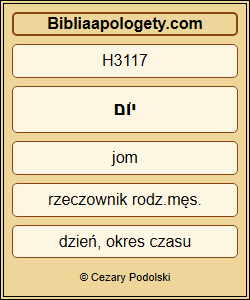 jutrzejszym H4279 jutrzejszym H4279 , bo H3588 , bo H3588 nie H3808 nie H3808 wiesz H3045 wiesz H3045 , co H4100 , co H4100 urodzi H3205 urodzi H3205 dzień H3117. (Prz27_1 tłum. AI) dzień H3117. (Prz27_1 tłum. AI) |
| L03 |
Prz27_1 |
Nie chwal się dniem jutrzejszym, bo nie wiesz, co dzień ci przyniesie. (Prz27_1 BT_4) |
| L04 |
Prz27_1 |
Nie chwal się dniem H3117 jutrzejszym H4279, bo nie wiesz H3045, co H4100 dzień H3117 ci przyniesie H3205. (Prz27_1 BT_4) |
| L05 |
Prz27_1 |
'al- |
<Tit>•hal•lel |
be•<jom> |
ma•<Char>; |
ki |
lo- |
te•<Da>', |
mah- |
<je>•led |
<jom>. |
| L06 |
Prz27_1 |
אַֽל־ |
תִּ֭תְהַלֵּל |
בְּי֣וֹם |
מָחָ֑ר |
כִּ֤י |
לֹא־ |
תֵ֝דַ֗ע |
מַה־ |
יֵּ֥לֶד |
יֽוֹם׃ |
| L07 |
Prz27_1 |
Nie |
chwal się |
dniem |
jutrzejszym, |
bo |
nie |
wiesz, |
co |
urodzi |
dzień. |
| L08 |
Prz27_1 |
אַֽל־ |
תִּ֭תְהַלֵּל |
בְּ/י֣וֹם |
מָחָ֑ר |
כִּ֤י |
לֹא־ |
תֵ֝דַ֗ע |
מַה־ |
יֵּ֥לֶד |
יֽוֹם׃ |
| L09 |
Prz27_1 |
HTnPartykuła przecząca |
HVtj2msCzas. hitpael, jussyw, 2 os., m., lp. |
HR/NcmscPrzyim. + Rzecz. posp., m., lp., stan konstrukcyjny |
HNcmsaRzecz. posp., m., lp., stan absolutny |
HCSpój. |
HTnPartykuła przecząca |
HVqi2msCzas. qal, imperfektum, 2 os., m., lp. |
HTiPartykuła pytajna |
HVqi3msCzas. qal, imperfektum, 3 os., m., lp. |
HNcmsaRzecz. posp., m., lp., stan absolutny |
| L10 |
Prz27_1 |
´a|l- |
Tithallël |
Büyôm |
mäHär |
Kî |
lö´- |
tëda` |
mà- |
yyëºled |
yôm |
| L11 |
Prz27_1 |
H0408 |
H1984 |
H3117 |
H4279 |
H3588 |
H3808 |
H3045 |
H4100 |
H3205 |
H3117 |
| L12 |
Prz27_1 |
not |
Boast |
not what a day |
not thyself of to morrow |
for |
not |
for thou knowest |
what |
may bring forth |
A day |
| L13 |
Prz27_1 |
al- |
Tit·hal·lel |
be·Yom |
ma·Char; |
ki |
lo- |
te·Da', |
mah- |
Ye·led |
Yom. |
| L14 |
Prz27_1 |
אַל |
הָלַל |
יוֹם |
מָחָר |
כִּי |
לֹא |
יָדַע |
מָה |
יָלַד |
יוֹם |
| L15 |
Prz27_1 |
('Al) |
ha·(Lal) |
(Jom) |
ma·(Char) |
(Ki) |
(Lo) |
ja·(Da)' |
(Ma) |
ja·(Lad) |
(Jom) |
| L16 |
Prz27_1 |
’al |
hālal |
jôm |
māḥār |
kî |
lō(’) |
jāḏa‘ |
mā(h) |
jālaḏ |
jôm |
| L17 |
Prz27_1 |
’al |
hālal |
jôm |
māḥār |
kî |
lō’ |
jāda‘ |
māh |
jālad |
jôm |
| L18 |
Prz27_1 |
Boast not thyself of to morrow; for thou knowest not what a day may bring forth. (Prz27_1 KJV) |
| L19 |
Prz27_1 |
1 Boast <01984> (08691) not thyself of to morrow <04279>; for thou knowest <03045> (08799) not what a day <03117> may bring forth <03205> (08799). (Prz27_1 KJV) |
| L20 |
Prz27_1 |
493/725 |
134/165 |
1683/2302 |
50/52 |
3065/4478 |
3349/5164 |
589/934 |
531/744 |
415/494 |
1684/2302 |
| L21 |
Prz27_1 |
Prz27_1_1 |
Prz27_1_2 |
Prz27_1_3 |
Prz27_1_4 |
Prz27_1_5 |
Prz27_1_6 |
Prz27_1_7 |
Prz27_1_8 |
Prz27_1_9 |
Prz27_1_10 |
| |
| L01 |
Prz27_2 |
Niech chwali cię obcy, a nie usta twoje; cudzoziemiec, a nie wargi twoje. (Prz27_2 tłum. AI) |
| L02 |
Prz27_2 |
Niech chwali cię H1984 obcy H2114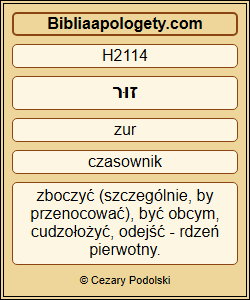 , a nie H3808 usta twoje H6310 , a nie H3808 usta twoje H6310 ; cudzoziemiec H5237 ; cudzoziemiec H5237 , a nie H408 wargi twoje H8193 , a nie H408 wargi twoje H8193 . (Prz27_2 tłum. AI) . (Prz27_2 tłum. AI) |
| L03 |
Prz27_2 |
Niech inny cię chwali - nie twe własne usta, ktoś obcy - nie własne twe wargi. (Prz27_2 BT_4) |
| L04 |
Prz27_2 |
Niech inny H2114 cię chwali H1984 – nie twe własne H6310 usta H6310, ktoś obcy H5237 – nie własne twe wargi H8193. (Prz27_2 BT_4) |
| L05 |
Prz27_2 |
je•hal•lel•<Cha> |
zar |
we•lo- |
<Fi>•cha; |
na•che•<Ri>, |
we•'al- |
se•fa•<Te>•cha. |
| L06 |
Prz27_2 |
יְהַלֶּלְךָ֣ |
זָ֣ר |
וְלֹא־ |
פִ֑יךָ |
נָ֝כְרִ֗י |
וְאַל־ |
שְׂפָתֶֽיךָ׃ |
| L07 |
Prz27_2 |
Niech chwali cię |
obcy, |
a nie |
usta twoje; |
cudzoziemiec, |
a nie |
wargi twoje. |
| L08 |
Prz27_2 |
יְהַלֶּלְ/ךָ֣ |
זָ֣ר |
וְ/לֹא־ |
פִ֑י/ךָ |
נָ֝כְרִ֗י |
וְ/אַל־ |
שְׂפָתֶֽי/ךָ׃ |
| L09 |
Prz27_2 |
HVpj3ms/Sp2msCzas. piel, jussyw, 3 os., m., lp. + Sufiks zaimkowy, 2 os., m., lp. |
HAamsaPrzym. zwykły, m., lp., stan absolutny |
HC/TnSpój. + Partykuła przecząca |
HNcmsc/Sp2msRzecz. posp., m., lp., stan konstrukcyjny + Sufiks zaimkowy, 2 os., m., lp. |
HAamsaPrzym. zwykły, m., lp., stan absolutny |
HC/TnSpój. + Partykuła przecząca |
HNcfdc/Sp2msRzecz. posp., ż., podw., stan konstrukcyjny + Sufiks zaimkowy, 2 os., m., lp. |
| L10 |
Prz27_2 |
yühallelkä |
zär |
wülö´- |
pîºkä |
nokrî |
wü´al- |
Süpätʺkä |
| L11 |
Prz27_2 |
H1984 |
H2114 |
H3808 |
H6310 |
H5237 |
H0408 |
H8193 |
| L12 |
Prz27_2 |
praise |
Let another man |
your own |
thee and not thine own mouth |
a stranger |
and not |
and not thine own lips |
| L13 |
Prz27_2 |
ye·hal·lel·Cha |
zar |
ve·lo- |
Fi·cha; |
na·che·Ri, |
ve·'al- |
se·fa·Tei·cha. |
| L14 |
Prz27_2 |
הָלַל |
זוּר |
לֹא |
פֶּה |
נׇכְרִי |
אַל |
שָׂפָה |
| L15 |
Prz27_2 |
ha·(Lal) |
(Zur) |
(Lo) |
(Pe) |
noch·(Ri) |
('Al) |
sa·(Fa) |
| L16 |
Prz27_2 |
hālal |
zûr |
lō(’) |
pe(h) |
noḵrî |
’al |
śāp̱ā(h) |
| L17 |
Prz27_2 |
hālal |
zûr |
lō’ |
peh |
nokrî |
’al |
śāpāh |
| L18 |
Prz27_2 |
Let another man praise thee, and not thine own mouth; a stranger, and not thine own lips. (Prz27_2 KJV) |
| L19 |
Prz27_2 |
2 Let another man <02114> (08801) praise <01984> (08762) thee, and not thine own mouth <06310>; a stranger <05237>, and not thine own lips <08193>. (Prz27_2 KJV) |
| L20 |
Prz27_2 |
135/165 |
44/77 |
3350/5164 |
380/497 |
36/45 |
494/725 |
138/173 |
| L21 |
Prz27_2 |
Prz27_2_1 |
Prz27_2_2 |
Prz27_2_3 |
Prz27_2_4 |
Prz27_2_5 |
Prz27_2_6 |
Prz27_2_7 |
| |
| L01 |
Prz27_3 |
Ciężar kamienia i brzemię piasku, lecz gniew głupca cięższy [jest] od obu. (Prz27_3 tłum. AI) |
| L02 |
Prz27_3 |
Ciężar H3514 kamienia H68 kamienia H68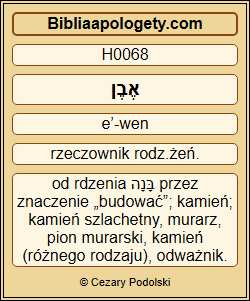 i brzemię H5192 i brzemię H5192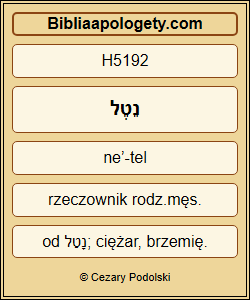 piasku H2344 piasku H2344 , lecz gniew H3708 , lecz gniew H3708 głupca H191 głupca H191 cięższy [jest H3515 cięższy [jest H3515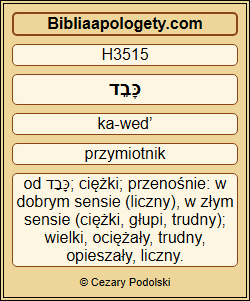 ] od obu H8147 ] od obu H8147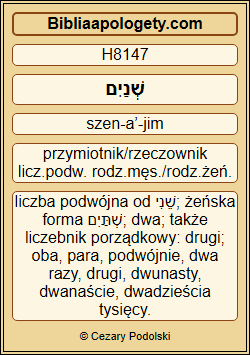 . (Prz27_3 tłum. AI) . (Prz27_3 tłum. AI) |
| L03 |
Prz27_3 |
Ciężki jest kamień i piasek nie lekki, gniew głupiego cięższy od obu. (Prz27_3 BT_4) |
| L04 |
Prz27_3 |
Ciężki H3514 jest kamień H68 i piasek H2344 nie lekki H5192, gniew H3708 głupiego H191 cięższy H3515 od obu H8147. (Prz27_3 BT_4) |
| L05 |
Prz27_3 |
koed- |
'<E>•wen |
we•<Ne>•tel |
ha•<Chol>; |
we•<Cha>•'as |
'e•<wil>, |
ka•<wed> |
misz•sze•ne•<Hem>. |
| L06 |
Prz27_3 |
כֹּֽבֶד־ |
אֶ֭בֶן |
וְנֵ֣טֶל |
הַח֑וֹל |
וְכַ֥עַס |
אֱ֝וִ֗יל |
כָּבֵ֥ד |
מִשְּׁנֵיהֶֽם׃ |
| L07 |
Prz27_3 |
Ciężar |
kamienia |
i brzemię |
piasku, |
lecz gniew |
głupca |
cięższy [jest] |
od obu. |
| L08 |
Prz27_3 |
כֹּֽבֶד־ |
אֶ֭בֶן |
וְ/נֵ֣טֶל |
הַ/ח֑וֹל |
וְ/כַ֥עַס |
אֱ֝וִ֗יל |
כָּבֵ֥ד |
מִ/שְּׁנֵי/הֶֽם׃ |
| L09 |
Prz27_3 |
HNcmscRzecz. posp., m., lp., stan konstrukcyjny |
HNcfsaRzecz. posp., ż., lp., stan absolutny |
HC/NcmscSpój. + Rzecz. posp., m., lp., stan konstrukcyjny |
HTd/NcmsaPartykuła rodzajnik określony + Rzecz. posp., m., lp., stan absolutny |
HC/NcmscSpój. + Rzecz. posp., m., lp., stan konstrukcyjny |
HAamsaPrzym. zwykły, m., lp., stan absolutny |
HAamsaPrzym. zwykły, m., lp., stan absolutny |
HR/Acmdc/Sp3mpPrzyim. + Przym. liczebnik główny, m., podw., stan konstrukcyjny + Sufiks zaimkowy, 3 os., m., lm. |
| L10 |
Prz27_3 |
Kö|bed- |
´eben |
wün뺆el |
haHôl |
wükaº`as |
´éwîl |
Käbëd |
miššünêhem |
| L11 |
Prz27_3 |
H3514 |
H0068 |
H5192 |
H2344 |
H3708 |
H0191 |
H3515 |
H8147 |
| L12 |
Prz27_3 |
[is] heavy |
A stone |
weighty |
and the sand |
wrath |
but a fool's |
[is] heavier |
than them both |
| L13 |
Prz27_3 |
koed- |
'E·ven |
ve·Ne·tel |
ha·Chol; |
ve·Cha·'as |
'e·Vil, |
ka·Ved |
mish·she·nei·Hem. |
| L14 |
Prz27_3 |
כֹּבֶד |
אֶבֶן |
נֵטֶל |
חוֹל |
כַּעַס |
אֱוִיל |
כָּבֵד |
שְׁנַיִם |
| L15 |
Prz27_3 |
(Koed) |
'(E)·wen |
(Ne)·tel |
(ChOl) |
(Ka)·'as |
'e·(Wil) |
ka·(Wed) |
sze·(Na)·jim |
| L16 |
Prz27_3 |
kṓḇeḏ |
’éḇen |
nḗṭel |
ḥôl |
ká‘as |
’ᵉ̆wîl |
kāḇēḏ |
šᵉnájim |
| L17 |
Prz27_3 |
kōbed |
’eben |
nēṭel |
ḥôl |
ka‘as |
’ĕwîl |
kābēd |
šenajim |
| L18 |
Prz27_3 |
A stone [is] heavy, and the sand weighty; but a fool's wrath [is] heavier than them both. (Prz27_3 KJV) |
| L19 |
Prz27_3 |
3 A stone <068> is heavy <03514>, and the sand <02344> weighty <05192>; but a fool's <0191> wrath <03708> is heavier <03515> than them both <08147>. (Prz27_3 KJV) |
| L20 |
Prz27_3 |
1/4 |
214/273 |
1/1 |
16/23 |
19/26 |
20/25 |
34/39 |
672/768 |
| L21 |
Prz27_3 |
Prz27_3_1 |
Prz27_3_2 |
Prz27_3_3 |
Prz27_3_4 |
Prz27_3_5 |
Prz27_3_6 |
Prz27_3_7 |
Prz27_3_8 |
| |
| L01 |
Prz27_4 |
Okrucieństwem [jest] gniew, i potokiem zapalczywość, lecz kto ostoi się przed zazdrością? (Prz27_4 tłum. AI) |
| L02 |
Prz27_4 |
Okrucieństwem [jest H395 ] gniew H2534 ] gniew H2534 , i potokiem H7858 , i potokiem H7858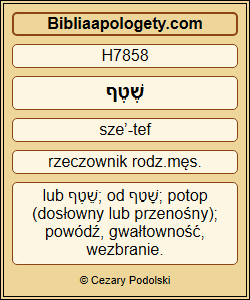 zapalczywość H639 zapalczywość H639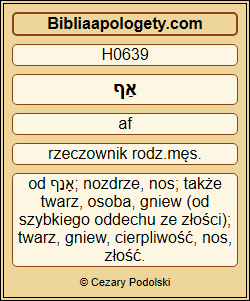 , lecz kto H4310 , lecz kto H4310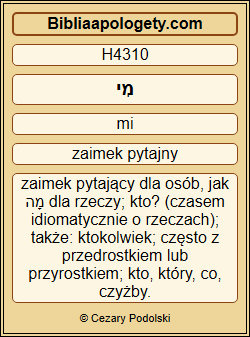 ostoi się H5975 ostoi się H5975 przed H6440 przed H6440 zazdrością H7068 zazdrością H7068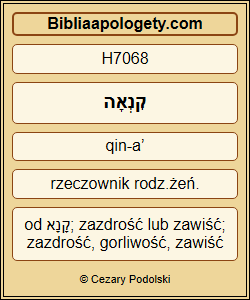 ? (Prz27_4 tłum. AI) ? (Prz27_4 tłum. AI) |
| L03 |
Prz27_4 |
Gwałtowny jest gniew, zapalczywość - nieubłagana, a kto się ostoi przed zazdrością? (Prz27_4 BT_4) |
| L04 |
Prz27_4 |
Gwałtowny H2534 jest gniew H639, zapalczywość H7858 – nieubłagana H395, a kto H4310 się ostoi H5975 przed zazdrością H7068? (Prz27_4 BT_4) |
| L05 |
Prz27_4 |
'ach•ze•ri•<jut> |
<Che>•ma |
we•<sze>•tef |
'<Af>; |
u•<Mi> |
<ja>•'a•mod |
lif•<Ne> |
kin•'<Ah>. |
| L06 |
Prz27_4 |
אַכְזְרִיּ֣וּת |
חֵ֭מָה |
וְשֶׁ֣טֶף |
אָ֑ף |
וּמִ֥י |
יַ֝עֲמֹד |
לִפְנֵ֥י |
קִנְאָֽה׃ |
| L07 |
Prz27_4 |
Okrucieństwem [jest] |
gniew, |
i potokiem |
zapalczywość, |
lecz kto |
ostoi się |
przed |
zazdrością? |
| L08 |
Prz27_4 |
אַכְזְרִיּ֣וּת |
חֵ֭מָה |
וְ/שֶׁ֣טֶף |
אָ֑ף |
וּ/מִ֥י |
יַ֝עֲמֹד |
לִ/פְנֵ֥י |
קִנְאָֽה׃ |
| L09 |
Prz27_4 |
HNcfscRzecz. posp., ż., lp., stan konstrukcyjny |
HNcfsaRzecz. posp., ż., lp., stan absolutny |
HC/NcmscSpój. + Rzecz. posp., m., lp., stan konstrukcyjny |
HNcmsaRzecz. posp., m., lp., stan absolutny |
HC/TiSpój. + Partykuła pytajna |
HVqi3msCzas. qal, imperfektum, 3 os., m., lp. |
HR/NcbpcPrzyim. + Rzecz. posp., r. wspólny, lm., stan konstrukcyjny |
HNcfsaRzecz. posp., ż., lp., stan absolutny |
| L10 |
Prz27_4 |
´akzüriyyût |
Hëmâ |
wüšeº†ep |
´äp |
ûmî |
ya`ámöd |
lipnê |
qin´â |
| L11 |
Prz27_4 |
H0395 |
H2534 |
H7858 |
H0639 |
H4310 |
H5975 |
H6440 |
H7068 |
| L12 |
Prz27_4 |
[is] cruel |
Wrath |
[is] outrageous |
and anger |
who |
but who [is] able to stand |
before |
envy |
| L13 |
Prz27_4 |
'ach·ze·ri·Yut |
Che·mah |
ve·She·tef |
'Af; |
u·Mi |
Ya·'a·mod |
lif·Nei |
kin·'Ah. |
| L14 |
Prz27_4 |
אַכְזְרִיּוּת |
חֵמָה |
שֶׁטֶף |
אַף |
מִי |
עָמַד |
פָּנִים |
קִנְאָה |
| L15 |
Prz27_4 |
ach·ze·rij·(Jut) |
che·(Ma) |
(Sze)·tef |
('Af) |
(Mi) |
'a·(Mad) |
pa·(Nim) |
kin·'(Ah) |
| L16 |
Prz27_4 |
’aḵzᵉrijjûṯ |
ḥēmā(h) |
šéṭep̱ |
’ap̱ |
mî |
‘āmaḏ |
pānîm |
qin’ā(h) |
| L17 |
Prz27_4 |
’akzerijjût |
ḥēmāh |
šeṭep |
’ap |
mî |
‘āmad |
pānîm |
qin’āh |
| L18 |
Prz27_4 |
Wrath [is] cruel, and anger [is] outrageous; but who [is] able to stand before envy? (Prz27_4 KJV) |
| L19 |
Prz27_4 |
4 Wrath <02534> is cruel <0395>, and anger <0639> is outrageous <07858>; but who is able to stand <05975> (08799) before <06440> envy <07068>? (Prz27_4 KJV) |
| L20 |
Prz27_4 |
1/1 |
49/122 |
3/6 |
172/276 |
277/422 |
363/523 |
1609/2127 |
20/44 |
| L21 |
Prz27_4 |
Prz27_4_1 |
Prz27_4_2 |
Prz27_4_3 |
Prz27_4_4 |
Prz27_4_5 |
Prz27_4_6 |
Prz27_4_7 |
Prz27_4_8 |
| |
| L01 |
Prz27_5 |
Lepsza [jest] nagana jawna niż miłość ukryta. (Prz27_5 tłum. AI) |
| L02 |
Prz27_5 |
Lepsza [jest H2896 ] nagana H8433 ] nagana H8433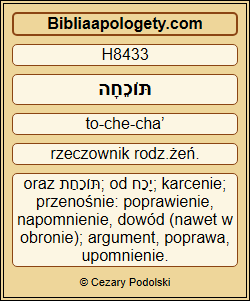 jawna H1540 jawna H1540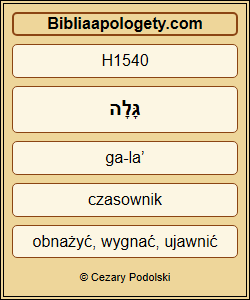 niż miłość H160 niż miłość H160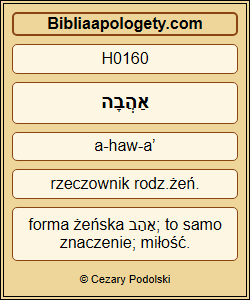 ukryta H5641 ukryta H5641 . (Prz27_5 tłum. AI) . (Prz27_5 tłum. AI) |
| L03 |
Prz27_5 |
Lepsza jest jawna nagana niż miłość tajona. (Prz27_5 BT_4) |
| L04 |
Prz27_5 |
Lepsza H2896 jest jawna H1540 nagana H8433 niż miłość H160 tajona H5641. (Prz27_5 BT_4) |
| L05 |
Prz27_5 |
<Toa> |
to•<Cha>•chat |
me•gul•<La>; |
me•'a•ha•<wa> |
me•sut•<Ta>•ret. |
| L06 |
Prz27_5 |
ט֭וֹבָה |
תּוֹכַ֣חַת |
מְגֻלָּ֑ה |
מֵֽאַהֲבָ֥ה |
מְסֻתָּֽרֶת׃ |
| L07 |
Prz27_5 |
Lepsza [jest] |
nagana |
jawna |
niż miłość |
ukryta. |
| L08 |
Prz27_5 |
ט֭וֹבָה |
תּוֹכַ֣חַת |
מְגֻלָּ֑ה |
מֵֽ/אַהֲבָ֥ה |
מְסֻתָּֽרֶת׃ |
| L09 |
Prz27_5 |
HAafsaPrzym. zwykły, ż., lp., stan absolutny |
HNcfsaRzecz. posp., ż., lp., stan absolutny |
HVPsfsaCzas. pual, imiesłów bierny, ż., lp., stan absolutny |
HR/NcfsaPrzyim. + Rzecz. posp., ż., lp., stan absolutny |
HVPsfsaCzas. pual, imiesłów bierny, ż., lp., stan absolutny |
| L10 |
Prz27_5 |
†ôºbâ |
TôkaºHat |
mügullâ |
më|´ahábâ |
müsuTTäºret |
| L11 |
Prz27_5 |
H2896 |
H8433 |
H1540 |
H0160 |
H5641 |
| L12 |
Prz27_5 |
[is] better |
rebuke |
Open |
love |
than secret |
| L13 |
Prz27_5 |
Toah |
to·Cha·chat |
me·gul·Lah; |
me·'a·ha·Vah |
me·sut·Ta·ret. |
| L14 |
Prz27_5 |
טוֹב |
תּוֹכֵחָה |
גָּלָה |
אַהֲבָה |
סָתַר |
| L15 |
Prz27_5 |
(Tow) |
to·che·(Cha) |
ga·(La) |
'a·ha·(Wa) |
sa·(Tar) |
| L16 |
Prz27_5 |
ṭôḇ |
tôḵēḥā(h) |
gālā(h) |
’ahᵃ̆ḇā(h) |
sāṯar |
| L17 |
Prz27_5 |
ṭôb |
tôkēḥāh |
gālāh |
’ahăbāh |
sātar |
| L18 |
Prz27_5 |
Open rebuke [is] better than secret love. (Prz27_5 KJV) |
| L19 |
Prz27_5 |
5 Open <01540> (08794) rebuke <08433> is better <02896> than secret <05641> (08794) love <0160>. (Prz27_5 KJV) |
| L20 |
Prz27_5 |
408/561 |
21/28 |
104/185 |
18/40 |
51/79 |
| L21 |
Prz27_5 |
Prz27_5_1 |
Prz27_5_2 |
Prz27_5_3 |
Prz27_5_4 |
Prz27_5_5 |
| |
| L01 |
Prz27_6 |
Wierne [są] rany przyjaciela, lecz obfite [są] pocałunki wroga. (Prz27_6 tłum. AI) |
| L02 |
Prz27_6 |
Wierne [są H539 ] rany H6482 ] rany H6482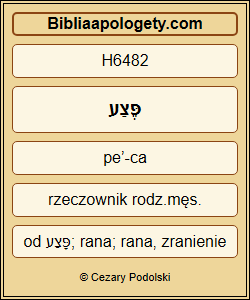 przyjaciela H157 przyjaciela H157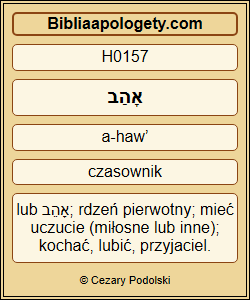 , lecz obfite [są H6280 , lecz obfite [są H6280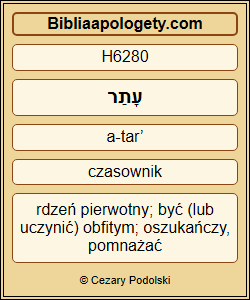 ] pocałunki H5390 ] pocałunki H5390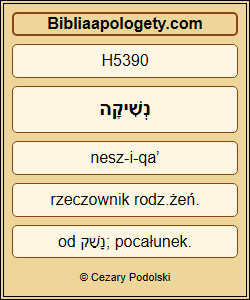 wroga H8130 wroga H8130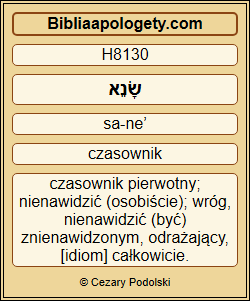 . (Prz27_6 tłum. AI) . (Prz27_6 tłum. AI) |
| L03 |
Prz27_6 |
Razy przyjaciela - [znakiem] wierności, pocałunki wroga - zwodnicze. (Prz27_6 BT_4) |
| L04 |
Prz27_6 |
Razy H6482 przyjaciela H157 – [znakiem] wierności H539, pocałunki H5390 wroga H8130 – zwodnicze H6280. (Prz27_6 BT_4) |
| L05 |
Prz27_6 |
<Ne>•'e•ma•nim |
pic•'<e> |
o•<Hew>; |
we•na'•ta•<Rot>, |
ne•szi•<Kot> |
so•<Ne>. |
| L06 |
Prz27_6 |
נֶ֭אֱמָנִים |
פִּצְעֵ֣י |
אוֹהֵ֑ב |
וְ֝נַעְתָּר֗וֹת |
נְשִׁיק֥וֹת |
שׂוֹנֵֽא׃ |
| L07 |
Prz27_6 |
Wierne [są] |
rany |
przyjaciela, |
lecz obfite [są] |
pocałunki |
wroga. |
| L08 |
Prz27_6 |
נֶ֭אֱמָנִים |
פִּצְעֵ֣י |
אוֹהֵ֑ב |
וְ֝/נַעְתָּר֗וֹת |
נְשִׁיק֥וֹת |
שׂוֹנֵֽא׃ |
| L09 |
Prz27_6 |
HVNrmpaCzas. nifal, imiesłów czynny, m., lm., stan absolutny |
HNcmpcRzecz. posp., m., lm., stan konstrukcyjny |
HVqrmsaCzas. qal, imiesłów czynny, m., lp., stan absolutny |
HC/VNsfpaSpój. + Czas. nifal, imiesłów bierny, ż., lm., stan absolutny |
HNcfpcRzecz. posp., ż., lm., stan konstrukcyjny |
HVqrmsaCzas. qal, imiesłów czynny, m., lp., stan absolutny |
| L10 |
Prz27_6 |
ne´émänîm |
Pic`ê |
´ôhëb |
wüna`Tärôt |
nüšîqôt |
Sônë´ |
| L11 |
Prz27_6 |
H0539 |
H6482 |
H0157 |
H6280 |
H5390 |
H8130 |
| L12 |
Prz27_6 |
Faithful |
[are] the wounds |
of a friend |
[are] deceitful |
but the kisses |
of an enemy |
| L13 |
Prz27_6 |
Ne·'e·ma·nim |
pitz·'Ei |
o·Hev; |
ve·na'·ta·Rot, |
ne·shi·Kot |
so·Ne. |
| L14 |
Prz27_6 |
אָמַן |
פֶּצַע |
אָהַב |
עָתַר |
נְשִׁיקָה |
שָׂנֵא |
| L15 |
Prz27_6 |
'a·(Man) |
(Pe)·ca' |
'a·(Haw) |
'a·(Tar) |
ne·szi·(Ka) |
sa·(Ne) |
| L16 |
Prz27_6 |
’āman |
péṣa‘ |
’āhaḇ |
‘āṯar |
nᵉšîqā(h) |
śānē(’) |
| L17 |
Prz27_6 |
’āman |
peṣa‘ |
’āhab |
‘ātar |
nešîqāh |
śānē’ |
| L18 |
Prz27_6 |
Faithful [are] the wounds of a friend; but the kisses of an enemy [are] deceitful. (Prz27_6 KJV) |
| L19 |
Prz27_6 |
6 Faithful <0539> (08737) are the wounds <06482> of a friend <0157> (08802); but the kisses <05390> of an enemy <08130> (08802) are] deceitful <06280> (08737). (Prz27_6 KJV) |
| L20 |
Prz27_6 |
82/108 |
7/8 |
140/207 |
1/2 |
1/2 |
120/145 |
| L21 |
Prz27_6 |
Prz27_6_1 |
Prz27_6_2 |
Prz27_6_3 |
Prz27_6_4 |
Prz27_6_5 |
Prz27_6_6 |
| |
| L01 |
Prz27_7 |
Dusza syta depcze plaster miodu, lecz dusza głodna — wszelka gorycz [jest] słodka. (Prz27_7 tłum. AI) |
| L02 |
Prz27_7 |
Dusza H5315 syta H7649 syta H7649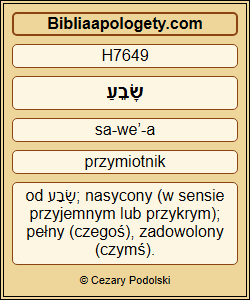 depcze H947 depcze H947 plaster miodu H5317 plaster miodu H5317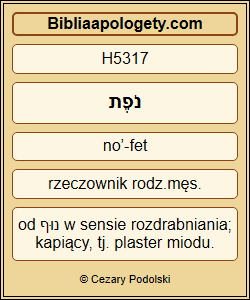 , lecz dusza H5315 głodna H7457 , lecz dusza H5315 głodna H7457 — wszelka H3605 — wszelka H3605 gorycz [jest H4751 gorycz [jest H4751 ] słodka H4966 ] słodka H4966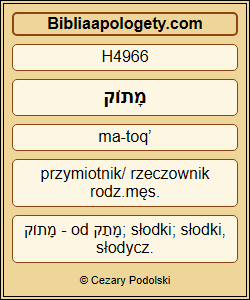 . (Prz27_7 tłum. AI) . (Prz27_7 tłum. AI) |
| L03 |
Prz27_7 |
Kto syty - depcze po miodzie, głodnemu i gorycz jest słodka. (Prz27_7 BT_4) |
| L04 |
Prz27_7 |
Kto syty H7649 – depcze H947 po miodzie H5317, głodnemu H7457 i gorycz H4751 jest słodka H4966. (Prz27_7 BT_4) |
| L05 |
Prz27_7 |
<Ne>•fesz |
we•'a |
ta•<wus> |
<No>•fet; |
we•<Ne>•fesz |
re•'e•<wa>, |
kol- |
mar |
ma•<Tok>. |
| L06 |
Prz27_7 |
נֶ֣פֶשׁ |
שְׂ֭בֵעָה |
תָּב֣וּס |
נֹ֑פֶת |
וְנֶ֥פֶשׁ |
רְ֝עֵבָ֗ה |
כָּל־ |
מַ֥ר |
מָתֽוֹק׃ |
| L07 |
Prz27_7 |
Dusza |
syta |
depcze |
plaster miodu, |
lecz dusza |
głodna — |
wszelka |
gorycz [jest] |
słodka. |
| L08 |
Prz27_7 |
נֶ֣פֶשׁ |
שְׂ֭בֵעָה |
תָּב֣וּס |
נֹ֑פֶת |
וְ/נֶ֥פֶשׁ |
רְ֝עֵבָ֗ה |
כָּל־ |
מַ֥ר |
מָתֽוֹק׃ |
| L09 |
Prz27_7 |
HNcbsaRzecz. posp., r. wspólny, lp., stan absolutny |
HAafsaPrzym. zwykły, ż., lp., stan absolutny |
HVqi3fsCzas. qal, imperfektum, 3 os., ż., lp. |
HNcmsaRzecz. posp., m., lp., stan absolutny |
HC/NcbsaSpój. + Rzecz. posp., r. wspólny, lp., stan absolutny |
HAafsaPrzym. zwykły, ż., lp., stan absolutny |
HNcmscRzecz. posp., m., lp., stan konstrukcyjny |
HAamsaPrzym. zwykły, m., lp., stan absolutny |
HAamsaPrzym. zwykły, m., lp., stan absolutny |
| L10 |
Prz27_7 |
neºpeš |
Sübë`â |
Täbûs |
nöºpet |
wüneºpeš |
rü`ëbâ |
Kol- |
mar |
mätôq |
| L11 |
Prz27_7 |
H5315 |
H7649 |
H0947 |
H5317 |
H5315 |
H7457 |
H3605 |
H4751 |
H4966 |
| L12 |
Prz27_7 |
soul |
The full |
loatheth |
an honeycomb |
soul |
but to the hungry |
any |
every bitter thing |
is sweet |
| L13 |
Prz27_7 |
Ne·fesh |
ve·'ah |
ta·Vus |
No·fet; |
ve·Ne·fesh |
re·'e·Vah, |
kol- |
mar |
ma·Tok. |
| L14 |
Prz27_7 |
נֶפֶשׁ |
שָׂבֵעַ |
בּוּס |
נֹפֶת |
נֶפֶשׁ |
רָעֵב |
כֹּל |
מַר |
מָתוֹק |
| L15 |
Prz27_7 |
(Ne)·fesz |
sa·(We)·a' |
(Bus) |
(No)·fet |
(Ne)·fesz |
ra·'(Ew) |
(Kol) |
(Mar) |
ma·(Tok) |
| L16 |
Prz27_7 |
nép̱eš |
śāḇēᵃ‘ |
bûs |
nṓp̱eṯ |
nép̱eš |
rā‘ēḇ |
kōl |
mar |
māṯôq |
| L17 |
Prz27_7 |
nepeš |
śābēa‘ |
bûs |
nōpet |
nepeš |
rā‘ēb |
kōl |
mar |
mātôq |
| L18 |
Prz27_7 |
The full soul loatheth an honeycomb; but to the hungry soul every bitter thing is sweet. (Prz27_7 KJV) |
| L19 |
Prz27_7 |
7 The full <07649> soul <05315> loatheth <0947> (08799) an honeycomb <05317>; but to the hungry <07457> soul <05315> every bitter thing <04751> is sweet <04966>. (Prz27_7 KJV) |
| L20 |
Prz27_7 |
561/751 |
8/8 |
4/12 |
4/5 |
562/751 |
9/16 |
3985/5415 |
23/41 |
6/12 |
| L21 |
Prz27_7 |
Prz27_7_1 |
Prz27_7_2 |
Prz27_7_3 |
Prz27_7_4 |
Prz27_7_5 |
Prz27_7_6 |
Prz27_7_7 |
Prz27_7_8 |
Prz27_7_9 |
| |
| L01 |
Prz27_8 |
Jak ptak błądzący z gniazda swego, tak człowiek błądzący z miejsca swego. (Prz27_8 tłum. AI) |
| L02 |
Prz27_8 |
Jak ptak H6833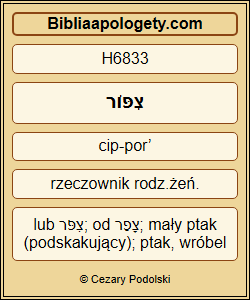 błądzący H5074 błądzący H5074 z H4480 z H4480 gniazda swego H7064 gniazda swego H7064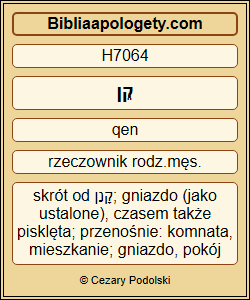 , tak H3651 , tak H3651 człowiek H376 człowiek H376 błądzący H5074 z miejsca swego H4725 błądzący H5074 z miejsca swego H4725 . (Prz27_8 tłum. AI) . (Prz27_8 tłum. AI) |
| L03 |
Prz27_8 |
Jak ptak, co uciekł z gniazda, tak człowiek, co uciekł z ojczyzny. (Prz27_8 BT_4) |
| L04 |
Prz27_8 |
Jak ptak H6833, co uciekł H5074 z gniazda H7064, tak człowiek H376, co uciekł H5074 z ojczyzny H4725. (Prz27_8 BT_4) |
| L05 |
Prz27_8 |
<Ke>•cip•por |
no•<De>•det |
min- |
kin•<Na>; |
ken- |
'<Isz>, |
no•<Ded> |
mi•me•ko•<Mo>. |
| L06 |
Prz27_8 |
כְּ֭צִפּוֹר |
נוֹדֶ֣דֶת |
מִן־ |
קִנָּ֑הּ |
כֵּֽן־ |
אִ֝֗ישׁ |
נוֹדֵ֥ד |
מִמְּקוֹמֽוֹ׃ |
| L07 |
Prz27_8 |
Jak ptak |
błądzący |
z |
gniazda swego, |
tak |
człowiek |
błądzący |
z miejsca swego. |
| L08 |
Prz27_8 |
כְּ֭/צִפּוֹר |
נוֹדֶ֣דֶת |
מִן־ |
קִנָּ֑/הּ |
כֵּֽן־ |
אִ֝֗ישׁ |
נוֹדֵ֥ד |
מִ/מְּקוֹמֽ/וֹ׃ |
| L09 |
Prz27_8 |
HR/NcbsaPrzyim. + Rzecz. posp., r. wspólny, lp., stan absolutny |
HVqrfsaCzas. qal, imiesłów czynny, ż., lp., stan absolutny |
HRPrzyim. |
HNcmsc/Sp3fsRzecz. posp., m., lp., stan konstrukcyjny + Sufiks zaimkowy, 3 os., ż., lp. |
HTmPartykuła wskazująca |
HNcmsaRzecz. posp., m., lp., stan absolutny |
HVqrmsaCzas. qal, imiesłów czynny, m., lp., stan absolutny |
HR/Ncmsc/Sp3msPrzyim. + Rzecz. posp., m., lp., stan konstrukcyjny + Sufiks zaimkowy, 3 os., m., lp. |
| L10 |
Prz27_8 |
KüciPPôr |
nôdeºdet |
min- |
qinnäh |
Kë|n- |
´îš |
nôdëd |
mimmüqômô |
| L11 |
Prz27_8 |
H6833 |
H5074 |
H4480 |
H7064 |
H3651 |
H0376 |
H5074 |
H4725 |
| L12 |
Prz27_8 |
As a bird |
that wandereth |
from |
from her nest |
So |
so [is] a man |
that wandereth |
from his place |
| L13 |
Prz27_8 |
Ke·tzip·por |
no·De·det |
min- |
kin·Nah; |
ken- |
'Ish, |
no·Ded |
mi·me·ko·Mo. |
| L14 |
Prz27_8 |
צִפּוֹר |
נָדַד |
מִן |
קֵן |
כֵּן |
אִישׁ |
נָדַד |
מָקוֹם |
| L15 |
Prz27_8 |
cip·(POr) |
na·(Dad) |
(Min) |
(Ken) |
(Ken) |
('Isz) |
na·(Dad) |
ma·(KOm) |
| L16 |
Prz27_8 |
ṣippôr |
nāḏaḏ |
min |
qēn |
kēn |
’îš |
nāḏaḏ |
māqôm |
| L17 |
Prz27_8 |
ṣippôr |
nādad |
min |
qēn |
kēn |
’îš |
nādad |
māqôm |
| L18 |
Prz27_8 |
As a bird that wandereth from her nest, so [is] a man that wandereth from his place. (Prz27_8 KJV) |
| L19 |
Prz27_8 |
8 As a bird <06833> that wandereth <05074> (08802) from her nest <07064>, so is a man <0376> that wandereth <05074> (08802) from his place <04725>. (Prz27_8 KJV) |
| L20 |
Prz27_8 |
31/40 |
12/28 |
945/1215 |
8/13 |
435/767 |
1607/2004 |
13/28 |
299/401 |
| L21 |
Prz27_8 |
Prz27_8_1 |
Prz27_8_2 |
Prz27_8_3 |
Prz27_8_4 |
Prz27_8_5 |
Prz27_8_6 |
Prz27_8_7 |
Prz27_8_8 |
| |
| L01 |
Prz27_9 |
Olej i kadzidło rozweselają serce, a słodycz przyjaciela jego [jest] z rady duszy. (Prz27_9 tłum. AI) |
| L02 |
Prz27_9 |
Olej H8081 i kadzidło H7004 i kadzidło H7004 rozweselają H8055 rozweselają H8055 serce H3820 serce H3820 , a słodycz H4986 , a słodycz H4986 przyjaciela jego [jest H7453 przyjaciela jego [jest H7453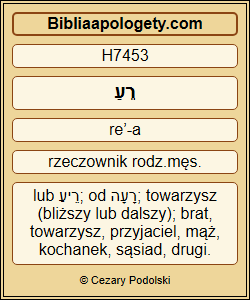 ] z rady H6098 ] z rady H6098 duszy H5315. (Prz27_9 tłum. AI) duszy H5315. (Prz27_9 tłum. AI) |
| L03 |
Prz27_9 |
Olejki, pachnidło - serce radują i dobre słowo przyjaciela, dzięki radzie z duszy. (Prz27_9 BT_4) |
| L04 |
Prz27_9 |
Olejki H8081, pachnidło H7004 – serce H3820 radują H8055 i dobre słowo H1697 przyjaciela H7453, dzięki radzie H6098 z duszy H5315. (Prz27_9 BT_4) przyjaciela H7453, dzięki radzie H6098 z duszy H5315. (Prz27_9 BT_4) |
| L05 |
Prz27_9 |
<sze>•men |
<U>•ke•to•ret |
je•sam•mach- |
<Lew>; |
u•<Me>•tek |
re•'<E>•hu, |
me•'a•cat- |
<Na>•fesz. |
| L06 |
Prz27_9 |
שֶׁ֣מֶן |
וּ֭קְטֹרֶת |
יְשַׂמַּֽח־ |
לֵ֑ב |
וּמֶ֥תֶק |
רֵ֝עֵ֗הוּ |
מֵֽעֲצַת־ |
נָֽפֶשׁ׃ |
| L07 |
Prz27_9 |
Olej |
i kadzidło |
rozweselają |
serce, |
a słodycz |
przyjaciela jego [jest] |
z rady |
duszy. |
| L08 |
Prz27_9 |
שֶׁ֣מֶן |
וּ֭/קְטֹרֶת |
יְשַׂמַּֽח־ |
לֵ֑ב |
וּ/מֶ֥תֶק |
רֵ֝עֵ֗/הוּ |
מֵֽ/עֲצַת־ |
נָֽפֶשׁ׃ |
| L09 |
Prz27_9 |
HNcmsaRzecz. posp., m., lp., stan absolutny |
HC/NcfsaSpój. + Rzecz. posp., ż., lp., stan absolutny |
HVpi3msCzas. piel, imperfektum, 3 os., m., lp. |
HNcmsaRzecz. posp., m., lp., stan absolutny |
HC/NcmscSpój. + Rzecz. posp., m., lp., stan konstrukcyjny |
HNcmsc/Sp3msRzecz. posp., m., lp., stan konstrukcyjny + Sufiks zaimkowy, 3 os., m., lp. |
HR/NcfscPrzyim. + Rzecz. posp., ż., lp., stan konstrukcyjny |
HNcbsaRzecz. posp., r. wspólny, lp., stan absolutny |
| L10 |
Prz27_9 |
šeºmen |
ûqü†öret |
yüSamma|H- |
lëb |
ûmeºteq |
rë`ëºhû |
më|`ácat- |
näºpeš |
| L11 |
Prz27_9 |
H8081 |
H7004 |
H8055 |
H3820 |
H4986 |
H7453 |
H6098 |
H5315 |
| L12 |
Prz27_9 |
Ointment |
and perfume |
rejoice |
the heart |
so [doth] the sweetness |
of a man's friend |
counsel |
by hearty |
| L13 |
Prz27_9 |
She·men |
U·ke·to·ret |
ye·sam·mach- |
Lev; |
u·Me·tek |
re·'E·hu, |
me·'a·tzat- |
Na·fesh. |
| L14 |
Prz27_9 |
שֶׁמֶן |
קְטֹרֶת |
שָׂמַח |
לֵב |
מֶתֶק |
רֵעַ |
עֵצָה |
נֶפֶשׁ |
| L15 |
Prz27_9 |
(Sze)·men |
ke·(To)·ret |
sa·(Mach) |
(Lew) |
(Me)·tek |
(Re)·a' |
'e·(Ca) |
(Ne)·fesz |
| L16 |
Prz27_9 |
šémen |
qᵉṭṓreṯ |
śāmaḥ |
lēḇ |
méṯeq |
rēᵃ‘ |
‘ēṣā(h) |
nép̱eš |
| L17 |
Prz27_9 |
šemen |
qeṭōret |
śāmaḥ |
lēb |
meteq |
rēa‘ |
‘ēṣāh |
nepeš |
| L18 |
Prz27_9 |
Ointment and perfume rejoice the heart: so [doth] the sweetness of a man's friend by hearty counsel. (Prz27_9 KJV) |
| L19 |
Prz27_9 |
9 Ointment <08081> and perfume <07004> rejoice <08055> (08762) the heart <03820>: so doth the sweetness <04986> of a man's friend <07453> by hearty <05315> counsel <06098>. (Prz27_9 KJV) |
| L20 |
Prz27_9 |
151/193 |
56/60 |
107/148 |
379/592 |
2/2 |
132/185 |
57/88 |
563/751 |
| L21 |
Prz27_9 |
Prz27_9_1 |
Prz27_9_2 |
Prz27_9_3 |
Prz27_9_4 |
Prz27_9_5 |
Prz27_9_6 |
Prz27_9_7 |
Prz27_9_8 |
| |
| L01 |
Prz27_10 |
Przyjaciela swego i przyjaciela ojca swego nie opuszczaj, a do domu brata swego nie wchodź w dniu nieszczęścia swego; lepszy [jest] sąsiad bliski niż brat daleki. (Prz27_10 tłum. AI) |
| L02 |
Prz27_10 |
Przyjaciela swego H7453 i przyjaciela ojca swego H1 nie H408 opuszczaj H5800 nie H408 opuszczaj H5800 , a do domu H1004 , a do domu H1004 brata swego H251 brata swego H251 nie H408 wchodź H935 nie H408 wchodź H935 w dniu H3117 nieszczęścia swego H343 w dniu H3117 nieszczęścia swego H343 ; lepszy [jest H2896] sąsiad H7934 ; lepszy [jest H2896] sąsiad H7934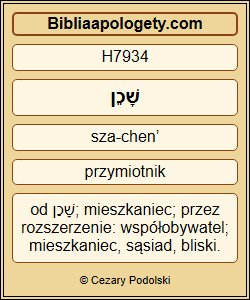 bliski H7138 bliski H7138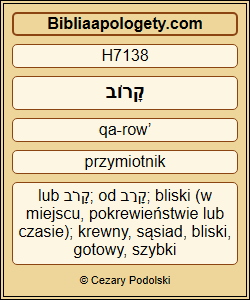 niż brat H251 daleki H7350 niż brat H251 daleki H7350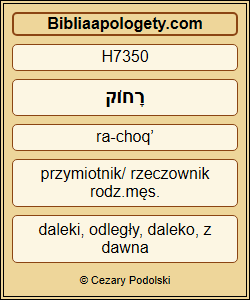 . (Prz27_10 tłum. AI) . (Prz27_10 tłum. AI) |
| L03 |
Prz27_10 |
Nie gardź swoim i ojca przyjacielem, a w dniu klęski nie chodź do brata, bo lepszy sąsiad bliski niż brat daleki. (Prz27_10 BT_4) |
| L04 |
Prz27_10 |
Nie gardź H5800 swoim H7453 i ojca H1 przyjacielem H7453, a w dniu H3117 klęski H343 nie chodź H935 do brata H251, bo lepszy H2896 sąsiad H7934 bliski H7138 niż brat H251 daleki H7350. (Prz27_10 BT_4) |
| L05 |
Prz27_10 |
re•'a•<Cha> |
[we•re•'e |
ch] |
(we•<Re>•a' |
k) |
'a•<wi>•cha |
'al- |
ta•'a•<Zo>, |
u•<wet> |
'a•<Chi>•cha, |
'al- |
<Ta>•<wo> |
be•<jom> |
'e•<De>•cha; |
<Tow> |
sza•<Chen> |
ka•<Row>, |
me•'<Ach> |
ra•<Chok>. |
| L06 |
Prz27_10 |
רֵֽעֲךָ֨ |
[וְרֵעֶה |
כ] |
(וְרֵ֪עַ |
ק) |
אָבִ֡יךָ |
אַֽל־ |
תַּעֲזֹ֗ב |
וּבֵ֥ית |
אָחִ֗יךָ |
אַל־ |
תָּ֭בוֹא |
בְּי֣וֹם |
אֵידֶ֑ךָ |
ט֥וֹב |
שָׁכֵ֥ן |
קָ֝ר֗וֹב |
מֵאָ֥ח |
רָחֽוֹק׃ |
| L07 |
Prz27_10 |
Przyjaciela swego |
[i przyjaciela |
כ] |
(i przyjaciela |
ק) |
ojca swego |
nie |
opuszczaj, |
a do domu |
brata swego |
nie |
wchodź |
w dniu |
nieszczęścia swego; |
lepszy [jest] |
sąsiad |
bliski |
niż brat |
daleki. |
| L08 |
Prz27_10 |
רֵֽעֲ/ךָ֨ |
ו/רעה |
|
וְ/רֵ֪עַ |
|
אָבִ֡י/ךָ |
אַֽל־ |
תַּעֲזֹ֗ב |
וּ/בֵ֥ית |
אָחִ֗י/ךָ |
אַל־ |
תָּ֭בוֹא |
בְּ/י֣וֹם |
אֵידֶ֑/ךָ |
ט֥וֹב |
שָׁכֵ֥ן |
קָ֝ר֗וֹב |
מֵ/אָ֥ח |
רָחֽוֹק׃ |
| L09 |
Prz27_10 |
HNcmsc/Sp2msRzecz. posp., m., lp., stan konstrukcyjny + Sufiks zaimkowy, 2 os., m., lp. |
HC/NcmscSpój. + Rzecz. posp., m., lp., stan konstrukcyjny |
MARK-KZnacznik wariantu: ketiv (forma zapisana) |
HC/NcmscSpój. + Rzecz. posp., m., lp., stan konstrukcyjny |
MARK-QZnacznik wariantu: qere (forma czytana) |
HNcmsc/Sp2msRzecz. posp., m., lp., stan konstrukcyjny + Sufiks zaimkowy, 2 os., m., lp. |
HTnPartykuła przecząca |
HVqj2msCzas. qal, jussyw, 2 os., m., lp. |
HC/NcmscSpój. + Rzecz. posp., m., lp., stan konstrukcyjny |
HNcmsc/Sp2msRzecz. posp., m., lp., stan konstrukcyjny + Sufiks zaimkowy, 2 os., m., lp. |
HTnPartykuła przecząca |
HVqj2msCzas. qal, jussyw, 2 os., m., lp. |
HR/NcmscPrzyim. + Rzecz. posp., m., lp., stan konstrukcyjny |
HNcmsc/Sp2msRzecz. posp., m., lp., stan konstrukcyjny + Sufiks zaimkowy, 2 os., m., lp. |
HAamsaPrzym. zwykły, m., lp., stan absolutny |
HAamsaPrzym. zwykły, m., lp., stan absolutny |
HAamsaPrzym. zwykły, m., lp., stan absolutny |
HR/NcmsaPrzyim. + Rzecz. posp., m., lp., stan absolutny |
HAamsaPrzym. zwykły, m., lp., stan absolutny |
| L10 |
Prz27_10 |
rë|`ákä |
(würë`è) |
|
[würëª`] |
|
´äbîºkä |
´a|l- |
Ta`ázöb |
ûbêt |
´äHîºkä |
´al- |
Täbô´ |
Büyôm |
´êdeºkä |
†ôb |
šäkën |
qärôb |
më´äH |
räHôq |
| L11 |
Prz27_10 |
H7453 |
|
|
|
|
H0001 |
H0408 |
H5800 |
H1004 |
H0251 |
H0408 |
H0935 |
H3117 |
H0343 |
H2896 |
H7934 |
H7138 |
H0251 |
H7350 |
| L12 |
Prz27_10 |
Thine own friend |
|
|
friend |
|
and thy father's |
not |
forsake |
house |
into thy brother's |
not |
not neither go |
in the day |
of thy calamity |
[for] better |
[is] a neighbour |
[that is] near |
than a brother |
far off |
| L13 |
Prz27_10 |
re·'a·Cha |
[ve·re·'eh |
ch] |
(ve·Re·a' |
k) |
'a·Vi·cha |
al- |
ta·'a·Zo, |
u·Veit |
'a·Chi·cha, |
al- |
Ta·Vo |
be·Yom |
'ei·De·cha; |
Tov |
sha·Chen |
ka·Rov, |
me·'Ach |
ra·Chok. |
| L14 |
Prz27_10 |
רֵעַ |
|
|
|
|
אָב |
אַל |
עָזַב |
בַּיִת |
אָח |
אַל |
בּוֹא |
יוֹם |
אֵיד |
טוֹב |
שָׁכֵן |
קָרוֹב |
אָח |
רָחוֹק |
| L15 |
Prz27_10 |
(Re)·a' |
|
|
|
|
'(Aw) |
('Al) |
'a·(Zaw) |
(Ba)·jit |
'(Ach) |
('Al) |
(Bo) |
(Jom) |
('Ed) |
(Tow) |
sze·(Chen) |
ka·(ROw) |
'(Ach) |
ra·(Chok) |
| L16 |
Prz27_10 |
rēᵃ‘ |
|
|
|
|
’āḇ |
’al |
‘āzaḇ |
bájiṯ |
’āḥ |
’al |
bô(’) |
jôm |
’êḏ |
ṭôḇ |
šāḵēn |
qārôḇ |
’āḥ |
rāḥôq |
| L17 |
Prz27_10 |
rēa‘ |
|
|
|
|
’āb |
’al |
‘āzab |
bajit |
’āḥ |
’al |
bô’ |
jôm |
’êd |
ṭôb |
šākēn |
qārôb |
’āḥ |
rāḥôq |
| L18 |
Prz27_10 |
Thine own friend, and thy father's friend, forsake not; neither go into thy brother's house in the day of thy calamity: [for] better [is] a neighbour [that is] near than a brother far off. (Prz27_10 KJV) |
| L19 |
Prz27_10 |
10 Thine own friend <07453>, and thy father's <01> friend <07453>, forsake <05800> (08799) not; neither go <0935> (08799) into thy brother's <0251> house <01004> in the day <03117> of thy calamity <0343>: for better <02896> is a neighbour <07934> that is near <07138> than a brother <0251> far off <07350>. (Prz27_10 KJV) |
| L20 |
Prz27_10 |
133/185 |
|
|
1/1 |
|
1067/1212 |
495/725 |
152/211 |
1500/2052 |
580/630 |
496/725 |
1850/2550 |
1685/2302 |
15/24 |
409/561 |
11/19 |
44/77 |
581/630 |
48/85 |
| L21 |
Prz27_10 |
Prz27_10_1 |
Prz27_10_2 |
Prz27_10_3 |
Prz27_10_4 |
Prz27_10_5 |
Prz27_10_6 |
Prz27_10_7 |
Prz27_10_8 |
Prz27_10_9 |
Prz27_10_10 |
Prz27_10_11 |
Prz27_10_12 |
Prz27_10_13 |
Prz27_10_14 |
Prz27_10_15 |
Prz27_10_16 |
Prz27_10_17 |
Prz27_10_18 |
Prz27_10_19 |
| |
| L01 |
Prz27_11 |
Bądź mądry, synu mój, i rozwesel serce moje, abym odpowiedział lżącemu mnie słowem. (Prz27_11 tłum. AI) |
| L02 |
Prz27_11 |
Bądź mądry H2449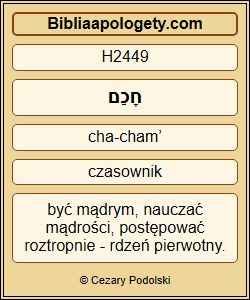 , synu mój H1121 , synu mój H1121 , i rozwesel H8056 , i rozwesel H8056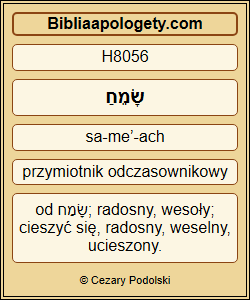 serce moje H3820, abym odpowiedział H7725 serce moje H3820, abym odpowiedział H7725 lżącemu mnie H2778 lżącemu mnie H2778 słowem H1697. (Prz27_11 tłum. AI) słowem H1697. (Prz27_11 tłum. AI) |
| L03 |
Prz27_11 |
Bądź mądry, synu, rozwesel me serce, a tym, co lżą mnie, odpowiem. (Prz27_11 BT_4) |
| L04 |
Prz27_11 |
Bądź mądry H2449, synu H1121, rozwesel H8055 me serce H3820, a tym, co lżą H2778 mnie, odpowiem H7725. (Prz27_11 BT_4) |
| L05 |
Prz27_11 |
cha•<Cham> |
<Be>•ni |
we•sam•<Mach> |
lib•<Bi>; |
we•'a•<szi>•wa |
cho•re•<Fi> |
da•<war>. |
| L06 |
Prz27_11 |
חֲכַ֣ם |
בְּ֭נִי |
וְשַׂמַּ֣ח |
לִבִּ֑י |
וְאָשִׁ֖יבָה |
חֹרְפִ֣י |
דָבָֽר׃ |
| L07 |
Prz27_11 |
Bądź mądry, |
synu mój, |
i rozwesel |
serce moje, |
abym odpowiedział |
lżącemu mnie |
słowem. |
| L08 |
Prz27_11 |
חֲכַ֣ם |
בְּ֭נִ/י |
וְ/שַׂמַּ֣ח |
לִבִּ֑/י |
וְ/אָשִׁ֖יבָה |
חֹרְפִ֣/י |
דָבָֽר׃ |
| L09 |
Prz27_11 |
HVqv2msCzas. qal, imperatyw, 2 os., m., lp. |
HNcmsc/Sp1csRzecz. posp., m., lp., stan konstrukcyjny + Sufiks zaimkowy, 1 os., r. wspólny, lp. |
HC/Vpv2msSpój. + Czas. piel, imperatyw, 2 os., m., lp. |
HNcmsc/Sp1csRzecz. posp., m., lp., stan konstrukcyjny + Sufiks zaimkowy, 1 os., r. wspólny, lp. |
HC/Vhh1csSpój. + Czas. hifil, kohortatyw, 1 os., r. wspólny, lp. |
HVqrmsc/Sp1csCzas. qal, imiesłów czynny, m., lp., stan konstrukcyjny + Sufiks zaimkowy, 1 os., r. wspólny, lp. |
HNcmsaRzecz. posp., m., lp., stan absolutny |
| L10 |
Prz27_11 |
Hákam |
Bünî |
wüSammaH |
liBBî |
wü´äšîºbâ |
Hörpî |
däbär |
| L11 |
Prz27_11 |
H2449 |
H1121 |
H8056 |
H3820 |
H7725 |
H2778 |
H1697 |
| L12 |
Prz27_11 |
be wise |
My son |
glad |
and make my heart |
break |
him that reproacheth |
act |
| L13 |
Prz27_11 |
cha·Cham |
Be·ni |
ve·sam·Mach |
lib·Bi; |
ve·'a·Shi·vah |
cho·re·Fi |
da·Var. |
| L14 |
Prz27_11 |
חָכַם |
בֵּן |
שָׂמֵחַ |
לֵב |
שׁוּב |
חָרַף |
דָּבָר |
| L15 |
Prz27_11 |
cha·(Cham) |
(Ben) |
sa·(Me)·ach |
(Lew) |
(Szuw) |
cha·(Raf) |
da·(War) |
| L16 |
Prz27_11 |
ḥāḵam |
bēn |
śāmēᵃḥ |
lēḇ |
šûḇ |
ḥārap̱ |
dāḇār |
| L17 |
Prz27_11 |
ḥākam |
bēn |
śāmēaḥ |
lēb |
šûb |
ḥārap |
dābār |
| L18 |
Prz27_11 |
My son, be wise, and make my heart glad, that I may answer him that reproacheth me. (Prz27_11 KJV) |
| L19 |
Prz27_11 |
11 My son <01121>, be wise <02449> (08798), and make my heart <03820> glad <08055> (08761), that I may answer <07725> (08686) <01697> him that reproacheth <02778> (08802) me. (Prz27_11 KJV) |
| L20 |
Prz27_11 |
20/26 |
4281/4921 |
20/27 |
380/592 |
696/1041 |
33/41 |
991/1428 |
| L21 |
Prz27_11 |
Prz27_11_1 |
Prz27_11_2 |
Prz27_11_3 |
Prz27_11_4 |
Prz27_11_5 |
Prz27_11_6 |
Prz27_11_7 |
| |
| L01 |
Prz27_12 |
Roztropny widzi zło i ukrywa się, lecz prości przechodzą dalej i zostają ukarani. (Prz27_12 tłum. AI) |
| L02 |
Prz27_12 |
Roztropny H6175 widzi H7200 widzi H7200 zło H7451 zło H7451 i ukrywa się H5641, lecz prości H6612 i ukrywa się H5641, lecz prości H6612 przechodzą dalej H5674 przechodzą dalej H5674 i zostają ukarani H6064 i zostają ukarani H6064 . (Prz27_12 tłum. AI) . (Prz27_12 tłum. AI) |
| L03 |
Prz27_12 |
Rozważny zło widzi i kryje się, nierozważni tam idą i szkodę ponoszą. (Prz27_12 BT_4) |
| L04 |
Prz27_12 |
Rozważny H6175 zło H7451 widzi H7200 i kryje się H5641, nierozważni H6612 tam idą H5674 i szkodę ponoszą H6064. (Prz27_12 BT_4) |
| L05 |
Prz27_12 |
'a•<Rum> |
ra•'<A |
ra•'<A |
nis•<Tar>; |
pe•ta•<jim>, |
'a•we•<Ru> |
ne•'e•<Na>•szu. |
| L06 |
Prz27_12 |
עָר֤וּם |
רָאָ֣ה |
רָעָ֣ה |
נִסְתָּ֑ר |
פְּ֝תָאיִ֗ם |
עָבְר֥וּ |
נֶעֱנָֽשׁוּ׃ |
| L07 |
Prz27_12 |
Roztropny |
widzi |
zło |
i ukrywa się, |
lecz prości |
przechodzą dalej |
i zostają ukarani. |
| L08 |
Prz27_12 |
עָר֤וּם |
רָאָ֣ה |
רָעָ֣ה |
נִסְתָּ֑ר |
פְּ֝תָאיִ֗ם |
עָבְר֥וּ |
נֶעֱנָֽשׁוּ׃ |
| L09 |
Prz27_12 |
HAamsaPrzym. zwykły, m., lp., stan absolutny |
HVqp3msCzas. qal, perfectum, 3 os., m., lp. |
HNcfsaRzecz. posp., ż., lp., stan absolutny |
HVNp3msCzas. nifal, perfectum, 3 os., m., lp. |
HNcmpaRzecz. posp., m., lm., stan absolutny |
HVqp3cpCzas. qal, perfectum, 3 os., r. wspólny, lm. |
HVNp3cpCzas. nifal, perfectum, 3 os., r. wspólny, lm. |
| L10 |
Prz27_12 |
`ärûm |
rä´â |
rä`â |
nisTär |
Pütä´yìm |
`äbrû |
ne`én亚û |
| L11 |
Prz27_12 |
H6175 |
H7200 |
H7451 |
H5641 |
H6612 |
H5674 |
H6064 |
| L12 |
Prz27_12 |
A prudent |
[man] foreseeth |
the evil |
[and] hideth |
himself [but] the simple |
pass on |
[and] are punished |
| L13 |
Prz27_12 |
'a·Rum |
ra·'Ah |
ra·'Ah |
nis·Tar; |
pe·ta·Yim, |
'a·ve·Ru |
ne·'e·Na·shu. |
| L14 |
Prz27_12 |
עָרוּם |
רָאָה |
רַע |
סָתַר |
פְּתִי |
עָבַר |
עָנַשׁ |
| L15 |
Prz27_12 |
'a·(Rum) |
ra·('A) |
(Ra') |
sa·(Tar) |
pe·(Ti) |
'a·(War) |
'a·(Nasz) |
| L16 |
Prz27_12 |
‘ārûm |
rā’ā(h) |
ra‘ |
sāṯar |
pᵉṯî |
‘āḇar |
‘ānaš |
| L17 |
Prz27_12 |
‘ārûm |
rā’āh |
ra‘ |
sātar |
petî |
‘ābar |
‘ānaš |
| L18 |
Prz27_12 |
A prudent [man] foreseeth the evil, [and] hideth himself; [but] the simple pass on, [and] are punished. (Prz27_12 KJV) |
| L19 |
Prz27_12 |
12 A prudent <06175> man foreseeth <07200> (08804) the evil <07451>, and hideth <05641> (08738) himself; but the simple <06612> pass on <05674> (08804), and are punished <06064> (08738). (Prz27_12 KJV) |
| L20 |
Prz27_12 |
11/11 |
917/1296 |
411/665 |
52/79 |
18/19 |
408/550 |
8/9 |
| L21 |
Prz27_12 |
Prz27_12_1 |
Prz27_12_2 |
Prz27_12_3 |
Prz27_12_4 |
Prz27_12_5 |
Prz27_12_6 |
Prz27_12_7 |
| |
| L01 |
Prz27_13 |
Weź szatę jego, bo poręczył za obcego, a za obcą kobietę weź go w zastaw. (Prz27_13 tłum. AI) |
| L02 |
Prz27_13 |
Weź H3947 szatę jego H899 szatę jego H899 , bo H3588 poręczył za H6148 , bo H3588 poręczył za H6148 obcego H2114, a za H1157 obcego H2114, a za H1157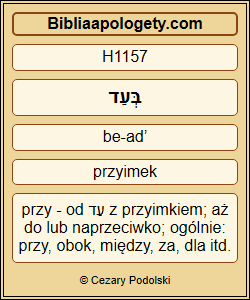 obcą kobietę H5237 weź go w zastaw H2254 obcą kobietę H5237 weź go w zastaw H2254 . (Prz27_13 tłum. AI) . (Prz27_13 tłum. AI) |
| L03 |
Prz27_13 |
Zabierz mu suknię, bo ręczy za obcego, za nieznajomych - weź zastaw! (Prz27_13 BT_4) |
| L04 |
Prz27_13 |
Zabierz H3947 mu suknię H899, bo ręczy H6148 za obcego H2114, za nieznajomych H5237 – weź zastaw H2254. (Prz27_13 BT_4) |
| L05 |
Prz27_13 |
kach- |
big•do |
ki- |
'<A>•raw |
<Zar>; |
u•we•'<Ad> |
na•che•ri•<ja> |
chaw•<Le>•hu. |
| L06 |
Prz27_13 |
קַח־ |
בִּ֭גְדוֹ |
כִּי־ |
עָ֣רַב |
זָ֑ר |
וּבְעַ֖ד |
נָכְרִיָּ֣ה |
חַבְלֵֽהוּ׃ |
| L07 |
Prz27_13 |
Weź |
szatę jego, |
bo |
poręczył za |
obcego, |
a za |
obcą kobietę |
weź go w zastaw. |
| L08 |
Prz27_13 |
קַח־ |
בִּ֭גְד/וֹ |
כִּי־ |
עָ֣רַב |
זָ֑ר |
וּ/בְעַ֖ד |
נָכְרִיָּ֣ה |
חַבְלֵֽ/הוּ׃ |
| L09 |
Prz27_13 |
HVqv2msCzas. qal, imperatyw, 2 os., m., lp. |
HNcmsc/Sp3msRzecz. posp., m., lp., stan konstrukcyjny + Sufiks zaimkowy, 3 os., m., lp. |
HCSpój. |
HVqp3msCzas. qal, perfectum, 3 os., m., lp. |
HAamsaPrzym. zwykły, m., lp., stan absolutny |
HC/RSpój. + Przyim. |
HAafsaPrzym. zwykły, ż., lp., stan absolutny |
HVqv2ms/Sp3msCzas. qal, imperatyw, 2 os., m., lp. + Sufiks zaimkowy, 3 os., m., lp. |
| L10 |
Prz27_13 |
qaH- |
Bigdô |
Kî- |
`äºrab |
zär |
ûbü`ad |
nokriyyâ |
Hablëºhû |
| L11 |
Prz27_13 |
H3947 |
H0899 |
H3588 |
H6148 |
H2114 |
H1157 |
H5237 |
H2254 |
| L12 |
Prz27_13 |
Take |
his garment |
when |
that is surety |
for a stranger |
and for |
of him for a strange woman |
and take a pledge |
| L13 |
Prz27_13 |
kach- |
big·do |
ki- |
'A·rav |
Zar; |
u·ve·'Ad |
na·che·ri·Yah |
chav·Le·hu. |
| L14 |
Prz27_13 |
לָקַח |
בֶּגֶד |
כִּי |
עָרַב |
זוּר |
בְּעַד |
נׇכְרִי |
חָבַל |
| L15 |
Prz27_13 |
la·(Kach) |
(Be)·ged |
(Ki) |
'a·(Raw) |
(Zur) |
be·'(Ad) |
noch·(Ri) |
cha·(Wal) |
| L16 |
Prz27_13 |
lāqaḥ |
bég̱eḏ |
kî |
‘āraḇ |
zûr |
bᵉ‘aḏ |
noḵrî |
ḥāḇal |
| L17 |
Prz27_13 |
lāqaḥ |
beged |
kî |
‘ārab |
zûr |
be‘ad |
nokrî |
ḥābal |
| L18 |
Prz27_13 |
Take his garment that is surety for a stranger, and take a pledge of him for a strange woman. (Prz27_13 KJV) |
| L19 |
Prz27_13 |
13 Take <03947> (08798) his garment <0899> that is surety <06148> (08804) for a stranger <02114> (08801), and take a pledge <02254> (08798) of him for a strange woman <05237>. (Prz27_13 KJV) |
| L20 |
Prz27_13 |
782/964 |
175/216 |
3066/4478 |
17/23 |
45/77 |
75/102 |
37/45 |
16/27 |
| L21 |
Prz27_13 |
Prz27_13_1 |
Prz27_13_2 |
Prz27_13_3 |
Prz27_13_4 |
Prz27_13_5 |
Prz27_13_6 |
Prz27_13_7 |
Prz27_13_8 |
| |
| L01 |
Prz27_14 |
Błogosławiący bliźniego swego głosem wielkim rano wcześnie — za przekleństwo będzie poczytane mu. (Prz27_14 tłum. AI) |
| L02 |
Prz27_14 |
Błogosławiący H1288 bliźniego swego H7453 głosem H6963 bliźniego swego H7453 głosem H6963 wielkim H1419 wielkim H1419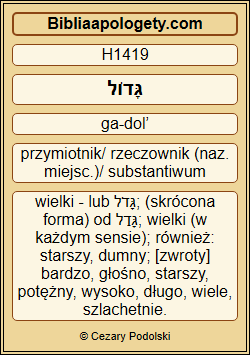 rano H1242 rano H1242 wcześnie H7925 wcześnie H7925 — za przekleństwo H7045 — za przekleństwo H7045 będzie poczytane H2803 będzie poczytane H2803 mu. (Prz27_14 tłum. AI) mu. (Prz27_14 tłum. AI) |
| L03 |
Prz27_14 |
Kto rankiem głośno błogosławi bliźniego, policzą mu to za przekleństwo. (Prz27_14 BT_4) |
| L04 |
Prz27_14 |
Kto rankiem H1242 głośno H1419 błogosławi H1288 bliźniego H7453, policzą mu to za przekleństwo H7045. (Prz27_14 BT_4) |
| L05 |
Prz27_14 |
me•<wa>•<Rech> |
re•'<E>•hu |
be•<Kol> |
<Ga>•dol |
bab•<Bo>•ker |
hasz•<Kem>; |
ke•la•<La>, |
te•<Cha>•szew |
lo. |
| L06 |
Prz27_14 |
מְבָ֘רֵ֤ךְ |
רֵעֵ֨הוּ ׀ |
בְּק֣וֹל |
גָּ֭דוֹל |
בַּבֹּ֣קֶר |
הַשְׁכֵּ֑ים |
קְ֝לָלָ֗ה |
תֵּחָ֥שֶׁב |
לֽוֹ׃ |
| L07 |
Prz27_14 |
Błogosławiący |
bliźniego swego |
głosem |
wielkim |
rano |
wcześnie — |
za przekleństwo |
będzie poczytane |
mu. |
| L08 |
Prz27_14 |
מְבָ֘רֵ֤ךְ |
רֵעֵ֨/הוּ ׀ |
בְּ/ק֣וֹל |
גָּ֭דוֹל |
בַּ/בֹּ֣קֶר |
הַשְׁכֵּ֑ים |
קְ֝לָלָ֗ה |
תֵּחָ֥שֶׁב |
לֽ/וֹ׃ |
| L09 |
Prz27_14 |
HVprmsaCzas. piel, imiesłów czynny, m., lp., stan absolutny |
HNcmsc/Sp3msRzecz. posp., m., lp., stan konstrukcyjny + Sufiks zaimkowy, 3 os., m., lp. |
HR/NcmsaPrzyim. + Rzecz. posp., m., lp., stan absolutny |
HAamsaPrzym. zwykły, m., lp., stan absolutny |
HRd/NcmsaPrzyim. z rodzajnikiem + Rzecz. posp., m., lp., stan absolutny |
HVhaCzas. hifil, bezok. absolutny |
HNcfsaRzecz. posp., ż., lp., stan absolutny |
HVNi3fsCzas. nifal, imperfektum, 3 os., ż., lp. |
HR/Sp3msPrzyim. + Sufiks zaimkowy, 3 os., m., lp. |
| L10 |
Prz27_14 |
mübärëk |
rë`ëºhû |
Büqôl |
Gädôl |
BaBBöºqer |
hašKêm |
qülälâ |
TëH亚eb |
lô |
| L11 |
Prz27_14 |
H1288 |
H7453 |
H6963 |
H1419 |
H1242 |
H7925 |
H7045 |
H2803 |
H0000  |
| L12 |
Prz27_14 |
He that blesseth |
his friend |
voice |
with a loud |
in the morning |
rising early |
a curse |
it shall be counted |
|
| L13 |
Prz27_14 |
me·Va·Rech |
re·'E·hu |
be·Kol |
Ga·dol |
bab·Bo·ker |
hash·Keim; |
ke·la·Lah, |
te·Cha·shev |
lo. |
| L14 |
Prz27_14 |
בָּרַךְ |
רֵעַ |
קוֹל |
גָּדוֹל |
בֹּקֶר |
שָׁכַם |
קְלָלָה |
חָשַׁב |
|
| L15 |
Prz27_14 |
ba·(Rach) |
(Re)·a' |
(Kol) |
ga·(DOl) |
(Bo)·ker |
sza·(Cham) |
ke·la·(La) |
cha·(Szaw) |
|
| L16 |
Prz27_14 |
bāraḵ |
rēᵃ‘ |
qôl |
gāḏôl |
bṓqer |
šāḵam |
qᵉlālā(h) |
ḥāšaḇ |
|
| L17 |
Prz27_14 |
bārak |
rēa‘ |
qôl |
gādôl |
bōqer |
šākam |
qelālāh |
ḥāšab |
|
| L18 |
Prz27_14 |
He that blesseth his friend with a loud voice, rising early in the morning, it shall be counted a curse to him. (Prz27_14 KJV) |
| L19 |
Prz27_14 |
14 He that blesseth <01288> (08764) his friend <07453> with a loud <01419> voice <06963>, rising early <07925> (08687) in the morning <01242>, it shall be counted <02803> (08735) a curse <07045> to him. (Prz27_14 KJV) |
| L20 |
Prz27_14 |
314/330 |
134/185 |
310/507 |
365/527 |
177/214 |
48/65 |
23/33 |
83/124 |
4888/6521 |
| L21 |
Prz27_14 |
Prz27_14_1 |
Prz27_14_2 |
Prz27_14_3 |
Prz27_14_4 |
Prz27_14_5 |
Prz27_14_6 |
Prz27_14_7 |
Prz27_14_8 |
Prz27_14_9 |
| |
| L01 |
Prz27_15 |
Kapanie ciągłe w dniu ulewy i kobieta sporów są podobne. (Prz27_15 tłum. AI) |
| L02 |
Prz27_15 |
Kapanie H1812 ciągłe H2956 ciągłe H2956 w dniu H3117 ulewy H5464 w dniu H3117 ulewy H5464 i kobieta H802 i kobieta H802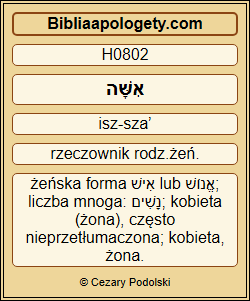 sporów są podobne H7737 sporów są podobne H7737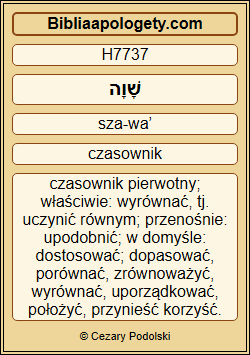 . (Prz27_15 tłum. AI) . (Prz27_15 tłum. AI) |
| L03 |
Prz27_15 |
Rynna ciekąca stale w dzień dżdżysty, podobna do żony swarliwej. (Prz27_15 BT_4) |
| L04 |
Prz27_15 |
Rynna ciekąca H1812 stale H2956 w dzień H3117 dżdżysty H5464, podobna do żony H802 swarliwej H4079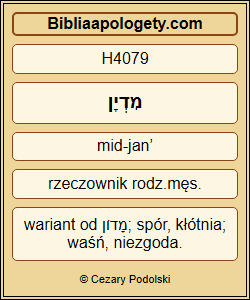 . (Prz27_15 BT_4) . (Prz27_15 BT_4) |
| L05 |
Prz27_15 |
<De>•lef |
<To>•red |
be•<jom> |
sag•<Rir>; |
we•'<E>•szet |
[mi•do•nim |
ch] |
(mid•ja•<Nim>, |
k) |
nisz•ta•<wa>. |
| L06 |
Prz27_15 |
דֶּ֣לֶף |
ט֭וֹרֵד |
בְּי֣וֹם |
סַגְרִ֑יר |
וְאֵ֥שֶׁת |
[מִדֹונִים |
כ] |
(מִ֝דְיָנִ֗ים |
ק) |
נִשְׁתָּוָֽה׃ |
| L07 |
Prz27_15 |
Kapanie |
ciągłe |
w dniu |
ulewy |
i kobieta |
[kłótni |
כ] |
(sporów |
ק) |
są podobne. |
| L08 |
Prz27_15 |
דֶּ֣לֶף |
ט֭וֹרֵד |
בְּ/י֣וֹם |
סַגְרִ֑יר |
וְ/אֵ֥שֶׁת |
מדונים |
|
מִ֝דְיָנִ֗ים |
|
נִשְׁתָּוָֽה׃ |
| L09 |
Prz27_15 |
HNcmsaRzecz. posp., m., lp., stan absolutny |
HVqrmsaCzas. qal, imiesłów czynny, m., lp., stan absolutny |
HR/NcmscPrzyim. + Rzecz. posp., m., lp., stan konstrukcyjny |
HNcmsaRzecz. posp., m., lp., stan absolutny |
HC/NcfscSpój. + Rzecz. posp., ż., lp., stan konstrukcyjny |
HNcmpaRzecz. posp., m., lm., stan absolutny |
MARK-KZnacznik wariantu: ketiv (forma zapisana) |
HNcmpaRzecz. posp., m., lm., stan absolutny |
MARK-QZnacznik wariantu: qere (forma czytana) |
HVDp3fsCzas. nitpael, perfectum, 3 os., ż., lp. |
| L10 |
Prz27_15 |
Deºlep |
†ôrëd |
Büyôm |
sagrîr |
wü´ëºšet |
(mìdônîm) |
|
[midyänîm] |
|
nišTäwâ |
| L11 |
Prz27_15 |
H1812 |
H2956 |
H3117 |
H5464 |
H0802 |
|
|
|
|
H7737 |
| L12 |
Prz27_15 |
dropping |
A continual |
day |
in a very rainy |
woman |
|
|
brawling |
|
are alike |
| L13 |
Prz27_15 |
De·lef |
To·red |
be·Yom |
sag·Rir; |
ve·'E·shet |
[mi·do·nim |
ch] |
(mid·ya·Nim, |
k) |
nish·ta·Vah. |
| L14 |
Prz27_15 |
דֶּלֶף |
טָרַד |
יוֹם |
סַגְרִיד |
אִשָּׁה |
|
|
|
|
שָׁוָה |
| L15 |
Prz27_15 |
(De)·lef |
ta·(Rad) |
(Jom) |
sag·(Rid) |
'isz·(Sza) |
|
|
|
|
sza·(Wa) |
| L16 |
Prz27_15 |
délep̱ |
ṭāraḏ |
jôm |
sag̱rîḏ |
’iššā(h) |
|
|
|
|
šāwā(h) |
| L17 |
Prz27_15 |
delep |
ṭārad |
jôm |
sagrîd |
’iššāh |
|
|
|
|
šāwāh |
| L18 |
Prz27_15 |
A continual dropping in a very rainy day and a contentious woman are alike. (Prz27_15 KJV) |
| L19 |
Prz27_15 |
15 A continual <02956> (08802) dropping <01812> in a very rainy <05464> day <03117> and a contentious <04079> (08675) <04066> woman <0802> are alike <07737> (08739). (Prz27_15 KJV) |
| L20 |
Prz27_15 |
2/2 |
2/2 |
1686/2302 |
1/1 |
675/781 |
|
|
7/7 |
|
15/21 |
| L21 |
Prz27_15 |
Prz27_15_1 |
Prz27_15_2 |
Prz27_15_3 |
Prz27_15_4 |
Prz27_15_5 |
Prz27_15_6 |
Prz27_15_7 |
Prz27_15_8 |
Prz27_15_9 |
Prz27_15_10 |
| |
| L01 |
Prz27_16 |
Powstrzymujący ją powstrzymuje wiatr, a oliwę prawica jego chwyta. (Prz27_16 tłum. AI) |
| L02 |
Prz27_16 |
Powstrzymujący ją H6845 powstrzymuje H6845 wiatr H7307 powstrzymuje H6845 wiatr H7307 , a oliwę H8081 prawica jego H3225 , a oliwę H8081 prawica jego H3225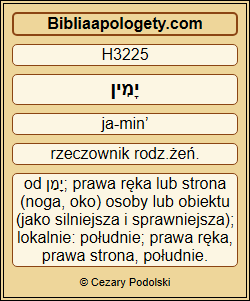 chwyta H7121 chwyta H7121 . (Prz27_16 tłum. AI) . (Prz27_16 tłum. AI) |
| L03 |
Prz27_16 |
Kto chce ją wstrzymać, ten wiatr wstrzymuje lub zbiera oliwę do ręki. (Prz27_16 BT_4) |
| L04 |
Prz27_16 |
Kto chce ją wstrzymać H6845, ten wiatr H7307 wstrzymuje H6845 lub zbiera H7122 oliwę H8081 do ręki H3225. (Prz27_16 BT_4) oliwę H8081 do ręki H3225. (Prz27_16 BT_4) |
| L05 |
Prz27_16 |
co•fe•<Ne>•ha |
ca•fan- |
<Ru>•ach; |
we•<sze>•men |
je•mi•<No> |
jik•<Ra>. |
| L06 |
Prz27_16 |
צֹפְנֶ֥יהָ |
צָֽפַן־ |
ר֑וּחַ |
וְשֶׁ֖מֶן |
יְמִינ֣וֹ |
יִקְרָֽא׃ |
| L07 |
Prz27_16 |
Powstrzymujący ją |
powstrzymuje |
wiatr, |
a oliwę |
prawica jego |
chwyta. |
| L08 |
Prz27_16 |
צֹפְנֶ֥י/הָ |
צָֽפַן־ |
ר֑וּחַ |
וְ/שֶׁ֖מֶן |
יְמִינ֣/וֹ |
יִקְרָֽא׃ |
| L09 |
Prz27_16 |
HVqrmpc/Sp3fsCzas. qal, imiesłów czynny, m., lm., stan konstrukcyjny + Sufiks zaimkowy, 3 os., ż., lp. |
HVqp3msCzas. qal, perfectum, 3 os., m., lp. |
HNcbsaRzecz. posp., r. wspólny, lp., stan absolutny |
HC/NcmscSpój. + Rzecz. posp., m., lp., stan konstrukcyjny |
HNcfsc/Sp3msRzecz. posp., ż., lp., stan konstrukcyjny + Sufiks zaimkowy, 3 os., m., lp. |
HVqi3msCzas. qal, imperfektum, 3 os., m., lp. |
| L10 |
Prz27_16 |
cöpnʺhä |
cä|pan- |
rûªH |
wüšeºmen |
yümînô |
yiqrä´ |
| L11 |
Prz27_16 |
H6845 |
H6845 |
H7307 |
H8081 |
H3225 |
H7121 |
| L12 |
Prz27_16 |
Whosoever hideth |
her hideth |
the wind |
and the ointment |
of his right hand |
[which] bewrayeth |
| L13 |
Prz27_16 |
tzo·fe·Nei·ha |
tza·fan- |
Ru·ach; |
ve·She·men |
ye·mi·No |
yik·Ra. |
| L14 |
Prz27_16 |
צָפַן |
צָפַן |
רוּחַ |
שֶׁמֶן |
יָמִין |
קָרָא |
| L15 |
Prz27_16 |
ca·(Fan) |
ca·(Fan) |
(Ru)·ach |
(Sze)·men |
ja·(Min) |
ka·(Ra) |
| L16 |
Prz27_16 |
ṣāp̱an |
ṣāp̱an |
rûᵃḥ |
šémen |
jāmîn |
qārā(’) |
| L17 |
Prz27_16 |
ṣāpan |
ṣāpan |
rûaḥ |
šemen |
jāmîn |
qārā’ |
| L18 |
Prz27_16 |
Whosoever hideth her hideth the wind, and the ointment of his right hand, [which] bewrayeth [itself]. (Prz27_16 KJV) |
| L19 |
Prz27_16 |
16 Whosoever hideth <06845> (08802) her hideth <06845> (08804) the wind <07307>, and the ointment <08081> of his right hand <03225>, which bewrayeth <07121> (08799) itself. (Prz27_16 KJV) |
| L20 |
Prz27_16 |
24/29 |
25/29 |
191/377 |
152/193 |
109/138 |
514/731 |
| L21 |
Prz27_16 |
Prz27_16_1 |
Prz27_16_2 |
Prz27_16_3 |
Prz27_16_4 |
Prz27_16_5 |
Prz27_16_6 |
| |
| L01 |
Prz27_17 |
Żelazo żelazem ostrzy się, a człowiek ostrzy oblicze bliźniego swego. (Prz27_17 tłum. AI) |
| L02 |
Prz27_17 |
Żelazo H1270 żelazem H1270 ostrzy się H2300 żelazem H1270 ostrzy się H2300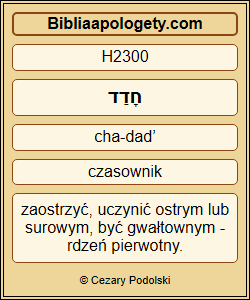 , a człowiek H376 ostrzy H2300 oblicze H6440 bliźniego swego H7453. (Prz27_17 tłum. AI) , a człowiek H376 ostrzy H2300 oblicze H6440 bliźniego swego H7453. (Prz27_17 tłum. AI) |
| L03 |
Prz27_17 |
Żelazo żelazem się ostrzy, a człowiek urabia charakter bliźniego. (Prz27_17 BT_4) |
| L04 |
Prz27_17 |
Żelazo H1270 żelazem H1270 się ostrzy H2300, a człowiek H376 urabia charakter bliźniego H7453. (Prz27_17 BT_4) |
| L05 |
Prz27_17 |
bar•<Zel> |
be•war•<Zel> |
<ja>•chad; |
we•'<Isz>, |
<ja>•chad |
pe•ne- |
re•'<E>•hu. |
| L06 |
Prz27_17 |
בַּרְזֶ֣ל |
בְּבַרְזֶ֣ל |
יָ֑חַד |
וְ֝אִ֗ישׁ |
יַ֣חַד |
פְּנֵֽי־ |
רֵעֵֽהוּ׃ |
| L07 |
Prz27_17 |
Żelazo |
żelazem |
ostrzy się, |
a człowiek |
ostrzy |
oblicze |
bliźniego swego. |
| L08 |
Prz27_17 |
בַּרְזֶ֣ל |
בְּ/בַרְזֶ֣ל |
יָ֑חַד |
וְ֝/אִ֗ישׁ |
יַ֣חַד |
פְּנֵֽי־ |
רֵעֵֽ/הוּ׃ |
| L09 |
Prz27_17 |
HNcmsaRzecz. posp., m., lp., stan absolutny |
HR/NcmsaPrzyim. + Rzecz. posp., m., lp., stan absolutny |
HVhi3msCzas. hifil, imperfektum, 3 os., m., lp. |
HC/NcmsaSpój. + Rzecz. posp., m., lp., stan absolutny |
HVhi3msCzas. hifil, imperfektum, 3 os., m., lp. |
HNcbpcRzecz. posp., r. wspólny, lm., stan konstrukcyjny |
HNcmsc/Sp3msRzecz. posp., m., lp., stan konstrukcyjny + Sufiks zaimkowy, 3 os., m., lp. |
| L10 |
Prz27_17 |
Barzel |
Bübarzel |
yäºHad |
wü´îš |
yaºHad |
Pünê|- |
rë`ëºhû |
| L11 |
Prz27_17 |
H1270 |
H1270 |
H2300 |
H0376 |
H2300 |
H6440 |
H7453 |
| L12 |
Prz27_17 |
Iron |
iron |
sharpeneth |
so a man |
sharpeneth |
the countenance |
of his friend |
| L13 |
Prz27_17 |
bar·Zel |
be·var·Zel |
Ya·chad; |
ve·'Ish, |
Ya·chad |
pe·nei- |
re·'E·hu. |
| L14 |
Prz27_17 |
בַּרְזֶל |
בַּרְזֶל |
חָדַד |
אִישׁ |
חָדַד |
פָּנִים |
רֵעַ |
| L15 |
Prz27_17 |
bar·(Zel) |
bar·(Zel) |
cha·(Dad) |
('Isz) |
cha·(Dad) |
pa·(Nim) |
(Re)·a' |
| L16 |
Prz27_17 |
barzel |
barzel |
ḥāḏaḏ |
’îš |
ḥāḏaḏ |
pānîm |
rēᵃ‘ |
| L17 |
Prz27_17 |
barzel |
barzel |
ḥādad |
’îš |
ḥādad |
pānîm |
rēa‘ |
| L18 |
Prz27_17 |
Iron sharpeneth iron; so a man sharpeneth the countenance of his friend. (Prz27_17 KJV) |
| L19 |
Prz27_17 |
17 Iron <01270> sharpeneth <02300> (08799) iron <01270>; so a man <0376> sharpeneth <02300> (08686) the countenance <06440> of his friend <07453>. (Prz27_17 KJV) |
| L20 |
Prz27_17 |
52/76 |
53/76 |
1/6 |
1608/2004 |
2/6 |
1610/2127 |
135/185 |
| L21 |
Prz27_17 |
Prz27_17_1 |
Prz27_17_2 |
Prz27_17_3 |
Prz27_17_4 |
Prz27_17_5 |
Prz27_17_6 |
Prz27_17_7 |
| |
| L01 |
Prz27_18 |
Strzegący figowca będzie jadł owoc jego, a strzegący pana swego będzie uczczony. (Prz27_18 tłum. AI) |
| L02 |
Prz27_18 |
Strzegący H5341 figowca H8384 figowca H8384 będzie jadł H398 będzie jadł H398 owoc jego H6529 owoc jego H6529 , a strzegący H8104 , a strzegący H8104 pana swego H113 pana swego H113 będzie uczczony H3513 będzie uczczony H3513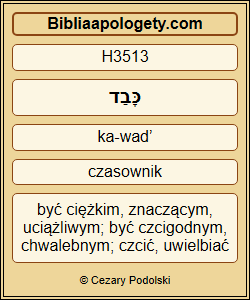 . (Prz27_18 tłum. AI) . (Prz27_18 tłum. AI) |
| L03 |
Prz27_18 |
Stróż drzewa figowego - spożywa jego owoc, czujny o pana - doznaje szacunku. (Prz27_18 BT_4) |
| L04 |
Prz27_18 |
Stróż H5341 drzewa figowego H8384 – spożywa H398 jego owoc H6529, czujny o pana H113 – doznaje szacunku H3513. (Prz27_18 BT_4) |
| L05 |
Prz27_18 |
no•<cer> |
<Te>•'e•na |
jo•<Chal> |
pir•<jah>; |
we•szo•<Mer> |
'a•do•<Naw> |
je•chub•<Bad>. |
| L06 |
Prz27_18 |
נֹצֵ֣ר |
תְּ֭אֵנָה |
יֹאכַ֣ל |
פִּרְיָ֑הּ |
וְשֹׁמֵ֖ר |
אֲדֹנָ֣יו |
יְכֻבָּֽד׃ |
| L07 |
Prz27_18 |
Strzegący |
figowca |
będzie jadł |
owoc jego, |
a strzegący |
pana swego |
będzie uczczony. |
| L08 |
Prz27_18 |
נֹצֵ֣ר |
תְּ֭אֵנָה |
יֹאכַ֣ל |
פִּרְיָ֑/הּ |
וְ/שֹׁמֵ֖ר |
אֲדֹנָ֣י/ו |
יְכֻבָּֽד׃ |
| L09 |
Prz27_18 |
HVqrmscCzas. qal, imiesłów czynny, m., lp., stan konstrukcyjny |
HNcfsaRzecz. posp., ż., lp., stan absolutny |
HVqi3msCzas. qal, imperfektum, 3 os., m., lp. |
HNcmsc/Sp3fsRzecz. posp., m., lp., stan konstrukcyjny + Sufiks zaimkowy, 3 os., ż., lp. |
HC/VqrmsaSpój. + Czas. qal, imiesłów czynny, m., lp., stan absolutny |
HNcmpc/Sp3msRzecz. posp., m., lm., stan konstrukcyjny + Sufiks zaimkowy, 3 os., m., lp. |
HVPi3msCzas. pual, imperfektum, 3 os., m., lp. |
| L10 |
Prz27_18 |
nöcër |
Tü´ënâ |
yö´kal |
Piryäh |
wüšömër |
´ádönäyw |
yükuBBäd |
| L11 |
Prz27_18 |
H5341 |
H8384 |
H0398 |
H6529 |
H8104 |
H0113 |
H3513 |
| L12 |
Prz27_18 |
Whoso keepeth |
the fig tree |
shall eat |
the fruit |
thereof so he that waiteth |
on his master |
shall be honoured |
| L13 |
Prz27_18 |
no·Tzer |
Te·'e·nah |
yo·Chal |
pir·Yah; |
ve·sho·Mer |
'a·do·Nav |
ye·chub·Bad. |
| L14 |
Prz27_18 |
נָצַר |
תְּאֵן |
אָכַל |
פְּרִי |
שָׁמַר |
אָדוֹן |
כָּבַד |
| L15 |
Prz27_18 |
na·(Car) |
te·('En) |
a·(Chal) |
pe·(Ri) |
sza·(Mar) |
a·(Don) |
ka·(Wad) |
| L16 |
Prz27_18 |
nāṣar |
tᵉ’ēn |
’āḵal |
pᵉrî |
šāmar |
’āḏôn |
kāḇaḏ |
| L17 |
Prz27_18 |
nāṣar |
te’ēn |
’ākal |
perî |
šāmar |
’ādôn |
kābad |
| L18 |
Prz27_18 |
Whoso keepeth the fig tree shall eat the fruit thereof: so he that waiteth on his master shall be honoured. (Prz27_18 KJV) |
| L19 |
Prz27_18 |
18 Whoso keepeth <05341> (08802) the fig tree <08384> shall eat <0398> (08799) the fruit <06529> thereof: so he that waiteth <08104> (08802) on his master <0113> shall be honoured <03513> (08792). (Prz27_18 KJV) |
| L20 |
Prz27_18 |
48/61 |
12/39 |
561/806 |
66/119 |
389/468 |
284/324 |
80/114 |
| L21 |
Prz27_18 |
Prz27_18_1 |
Prz27_18_2 |
Prz27_18_3 |
Prz27_18_4 |
Prz27_18_5 |
Prz27_18_6 |
Prz27_18_7 |
| |
| L01 |
Prz27_19 |
Jak w wodzie oblicze [odpowiada] obliczu, tak serce człowieka człowiekowi. (Prz27_19 tłum. AI) |
| L02 |
Prz27_19 |
Jak w wodzie H4325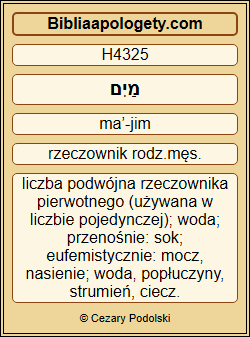 oblicze H6440 [odpowiada] obliczu H6440, tak H3651 serce H3820 człowieka H120 oblicze H6440 [odpowiada] obliczu H6440, tak H3651 serce H3820 człowieka H120 człowiekowi H120. (Prz27_19 tłum. AI) człowiekowi H120. (Prz27_19 tłum. AI) |
| L03 |
Prz27_19 |
Oblicze odbija się w wodzie, a w sercu odbija się człowiek. (Prz27_19 BT_4) |
| L04 |
Prz27_19 |
Oblicze H6440 odbija się w wodzie H4325, a w sercu H3820 odbija się człowiek H120. (Prz27_19 BT_4) |
| L05 |
Prz27_19 |
<Kam>•ma•jim |
hap•pa•<Nim> |
lap•pa•<Nim>; |
ken |
lew- |
ha•'a•<Dam>, |
la•'a•<Dam>. |
| L06 |
Prz27_19 |
כַּ֭מַּיִם |
הַפָּנִ֣ים |
לַפָּנִ֑ים |
כֵּ֤ן |
לֵֽב־ |
הָ֝אָדָ֗ם |
לָאָדָֽם׃ |
| L07 |
Prz27_19 |
Jak w wodzie |
oblicze |
[odpowiada] obliczu, |
tak |
serce |
człowieka |
człowiekowi. |
| L08 |
Prz27_19 |
כַּ֭/מַּיִם |
הַ/פָּנִ֣ים |
לַ/פָּנִ֑ים |
כֵּ֤ן |
לֵֽב־ |
הָ֝/אָדָ֗ם |
לָ/אָדָֽם׃ |
| L09 |
Prz27_19 |
HRd/NcmpaPrzyim. z rodzajnikiem + Rzecz. posp., m., lm., stan absolutny |
HTd/NcbpaPartykuła rodzajnik określony + Rzecz. posp., r. wspólny, lm., stan absolutny |
HRd/NcbpaPrzyim. z rodzajnikiem + Rzecz. posp., r. wspólny, lm., stan absolutny |
HTmPartykuła wskazująca |
HNcmscRzecz. posp., m., lp., stan konstrukcyjny |
HTd/NcmsaPartykuła rodzajnik określony + Rzecz. posp., m., lp., stan absolutny |
HRd/NcmsaPrzyim. z rodzajnikiem + Rzecz. posp., m., lp., stan absolutny |
| L10 |
Prz27_19 |
Kammayìm |
haPPänîm |
laPPänîm |
Kën |
lë|b- |
hä´ädäm |
lä´ädäm |
| L11 |
Prz27_19 |
H4325 |
H6440 |
H6440 |
H3651 |
H3820 |
H0120 |
H0120 |
| L12 |
Prz27_19 |
As in water |
face |
[answereth] to face |
So |
so the heart |
of man |
to man |
| L13 |
Prz27_19 |
Kam·ma·yim |
hap·pa·Nim |
lap·pa·Nim; |
ken |
lev- |
ha·'a·Dam, |
la·'a·Dam. |
| L14 |
Prz27_19 |
מַיִם |
פָּנִים |
פָּנִים |
כֵּן |
לֵב |
אָדָם |
אָדָם |
| L15 |
Prz27_19 |
(Ma)·jim |
pa·(Nim) |
pa·(Nim) |
(Ken) |
(Lew) |
'a·(Dam) |
'a·(Dam) |
| L16 |
Prz27_19 |
májim |
pānîm |
pānîm |
kēn |
lēḇ |
’āḏām |
’āḏām |
| L17 |
Prz27_19 |
majim |
pānîm |
pānîm |
kēn |
lēb |
’ādām |
’ādām |
| L18 |
Prz27_19 |
As in water face [answereth] to face, so the heart of man to man. (Prz27_19 KJV) |
| L19 |
Prz27_19 |
19 As in water <04325> face <06440> answereth to face, <06440>, so the heart <03820> of man <0120> to man <0120>. (Prz27_19 KJV) |
| L20 |
Prz27_19 |
411/579 |
1611/2127 |
1612/2127 |
436/767 |
381/592 |
268/552 |
269/552 |
| L21 |
Prz27_19 |
Prz27_19_1 |
Prz27_19_2 |
Prz27_19_3 |
Prz27_19_4 |
Prz27_19_5 |
Prz27_19_6 |
Prz27_19_7 |
| |
| L01 |
Prz27_20 |
Szeol i Abaddon nie nasycą się, a oczy człowieka nie nasycą się. (Prz27_20 tłum. AI) |
| L02 |
Prz27_20 |
Szeol H7585 i Abaddon nie H3808 nasycą się H7646 i Abaddon nie H3808 nasycą się H7646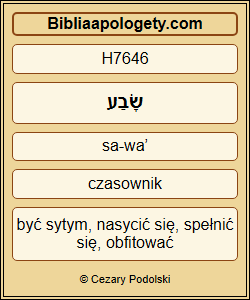 , a oczy H5869 , a oczy H5869 człowieka H120 nie H3808 nasycą się H7646. (Prz27_20 tłum. AI) człowieka H120 nie H3808 nasycą się H7646. (Prz27_20 tłum. AI) |
| L03 |
Prz27_20 |
Szeol i zatrata niesyte, niesyte i oczy człowieka. (Prz27_20 BT_4) |
| L04 |
Prz27_20 |
Szeol H7585 i zatrata H10 niesyte H7646, niesyte H7646 i oczy H5869 człowieka H120. (Prz27_20 BT_4) niesyte H7646, niesyte H7646 i oczy H5869 człowieka H120. (Prz27_20 BT_4) |
| L05 |
Prz27_20 |
sze•'ol |
[wa•'a•wad•do |
ch] |
(<wa>•'a•wad•dow |
k) |
lo |
tis•<Ba>'•na; |
we•'e•<Ne> |
ha•'a•<Dam>, |
lo |
tis•<Ba>'•na. |
| L06 |
Prz27_20 |
שְׁא֣וֹל |
[וַאֲבַדֹּה |
כ] |
(וַ֭אֲבַדֹּו |
ק) |
לֹ֣א |
תִשְׂבַּ֑עְנָה |
וְעֵינֵ֥י |
הָ֝אָדָ֗ם |
לֹ֣א |
תִשְׂבַּֽעְנָה׃ |
| L07 |
Prz27_20 |
Szeol |
[i Abaddon |
כ] |
(i Abaddon |
ק) |
nie |
nasycą się, |
a oczy |
człowieka |
nie |
nasycą się. |
| L08 |
Prz27_20 |
שְׁא֣וֹל |
ו/אבדה |
|
וַ֭/אֲבַדּוֹ |
|
לֹ֣א |
תִשְׂבַּ֑עְנָה |
וְ/עֵינֵ֥י |
הָ֝/אָדָ֗ם |
לֹ֣א |
תִשְׂבַּֽעְנָה׃ |
| L09 |
Prz27_20 |
HNpRzecz. własny |
HC/NcmscSpój. + Rzecz. posp., m., lp., stan konstrukcyjny |
MARK-KZnacznik wariantu: ketiv (forma zapisana) |
HC/NcmscSpój. + Rzecz. posp., m., lp., stan konstrukcyjny |
MARK-QZnacznik wariantu: qere (forma czytana) |
HTnPartykuła przecząca |
HVqi3fpCzas. qal, imperfektum, 3 os., ż., lm. |
HC/NcbdcSpój. + Rzecz. posp., r. wspólny, podw., stan konstrukcyjny |
HTd/NcmsaPartykuła rodzajnik określony + Rzecz. posp., m., lp., stan absolutny |
HTnPartykuła przecząca |
HVqi3fpCzas. qal, imperfektum, 3 os., ż., lm. |
| L10 |
Prz27_20 |
šü´ôl |
(wa´ábaDDò) |
|
[wa´ábaDDô] |
|
lö´ |
tiSBaº`nâ |
wü`ênê |
hä´ädäm |
lö´ |
tiSBaº`nâ |
| L11 |
Prz27_20 |
H7585 |
|
|
|
|
H3808 |
H7646 |
H5869 |
H0120 |
H3808 |
H7646 |
| L12 |
Prz27_20 |
Hell |
|
|
destruction |
|
are never |
full |
so the eyes |
of man |
Nor |
are never satisfied |
| L13 |
Prz27_20 |
she·'ol |
[va·'a·vad·doh |
ch] |
(Va·'a·vad·dov |
k) |
lo |
tis·Ba'·nah; |
ve·'ei·Nei |
ha·'a·Dam, |
lo |
tis·Ba'·nah. |
| L14 |
Prz27_20 |
שְׁאוֹל |
|
|
|
|
לֹא |
שָׂבַע |
עַיִן |
אָדָם |
לֹא |
שָׂבַע |
| L15 |
Prz27_20 |
sze·('Ol) |
|
|
|
|
(Lo) |
sa·(Wa') |
'(A)·jin |
'a·(Dam) |
(Lo) |
sa·(Wa') |
| L16 |
Prz27_20 |
šᵉ(’)ôl |
|
|
|
|
lō(’) |
śāḇa‘ |
‘ájin |
’āḏām |
lō(’) |
śāḇa‘ |
| L17 |
Prz27_20 |
še’ôl |
|
|
|
|
lō’ |
śāba‘ |
‘ajin |
’ādām |
lō’ |
śāba‘ |
| L18 |
Prz27_20 |
Hell and destruction are never full; so the eyes of man are never satisfied. (Prz27_20 KJV) |
| L19 |
Prz27_20 |
20 Hell <07585> and destruction <011> (08675) <010> are never <03808> full <07646> (08799); so the eyes <05869> of man <0120> are never satisfied <07646> (08799). (Prz27_20 KJV) |
| L20 |
Prz27_20 |
43/66 |
|
|
1/1 |
|
3351/5164 |
57/99 |
639/878 |
270/552 |
3352/5164 |
58/99 |
| L21 |
Prz27_20 |
Prz27_20_1 |
Prz27_20_2 |
Prz27_20_3 |
Prz27_20_4 |
Prz27_20_5 |
Prz27_20_6 |
Prz27_20_7 |
Prz27_20_8 |
Prz27_20_9 |
Prz27_20_10 |
Prz27_20_11 |
| |
| L01 |
Prz27_21 |
Tygiel [jest] dla srebra, a piec dla złota, a człowiek [jest oceniany] według pochwały swojej. (Prz27_21 tłum. AI) |
| L02 |
Prz27_21 |
Tygiel [jest H4715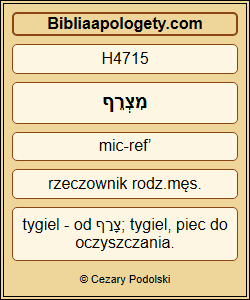 ] dla srebra H3701 ] dla srebra H3701 , a piec H3564 , a piec H3564 dla złota H2091 dla złota H2091 , a człowiek [jest oceniany H376] według H6310 pochwały swojej H4110 , a człowiek [jest oceniany H376] według H6310 pochwały swojej H4110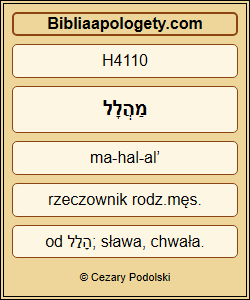 . (Prz27_21 tłum. AI) . (Prz27_21 tłum. AI) |
| L03 |
Prz27_21 |
Czym dla srebra - tygiel, dla złota - piec, tym dla człowieka - pochwała. (Prz27_21 BT_4) |
| L04 |
Prz27_21 |
Czym dla srebra H3701 – tygiel H4715, dla złota H2091 – piec H3564, tym dla człowieka H376 – pochwała H4110. (Prz27_21 BT_4) |
| L05 |
Prz27_21 |
mac•<Ref> |
<Lak>•ke•sef |
we•<Chur> |
laz•za•<Haw>; |
we•'<Isz>, |
le•<Fi> |
ma•ha•la•<Lo>. |
| L06 |
Prz27_21 |
מַצְרֵ֣ף |
לַ֭כֶּסֶף |
וְכ֣וּר |
לַזָּהָ֑ב |
וְ֝אִ֗ישׁ |
לְפִ֣י |
מַהֲלָלֽוֹ׃ |
| L07 |
Prz27_21 |
Tygiel [jest] |
dla srebra, |
a piec |
dla złota, |
a człowiek [jest oceniany] |
według |
pochwały swojej. |
| L08 |
Prz27_21 |
מַצְרֵ֣ף |
לַ֭/כֶּסֶף |
וְ/כ֣וּר |
לַ/זָּהָ֑ב |
וְ֝/אִ֗ישׁ |
לְ/פִ֣י |
מַהֲלָלֽ/וֹ׃ |
| L09 |
Prz27_21 |
HNcmsaRzecz. posp., m., lp., stan absolutny |
HRd/NcmsaPrzyim. z rodzajnikiem + Rzecz. posp., m., lp., stan absolutny |
HC/NcmsaSpój. + Rzecz. posp., m., lp., stan absolutny |
HRd/NcmsaPrzyim. z rodzajnikiem + Rzecz. posp., m., lp., stan absolutny |
HC/NcmsaSpój. + Rzecz. posp., m., lp., stan absolutny |
HR/NcmscPrzyim. + Rzecz. posp., m., lp., stan konstrukcyjny |
HNcmsc/Sp3msRzecz. posp., m., lp., stan konstrukcyjny + Sufiks zaimkowy, 3 os., m., lp. |
| L10 |
Prz27_21 |
macrëp |
laKKesep |
wükûr |
lazzähäb |
wü´îš |
lüpî |
mahálälô |
| L11 |
Prz27_21 |
H4715 |
H3701 |
H3564 |
H2091 |
H0376 |
H6310 |
H4110 |
| L12 |
Prz27_21 |
[As] the fining pot |
for silver |
and the furnace |
for gold |
so [is] a man |
to |
his praise |
| L13 |
Prz27_21 |
matz·Ref |
Lak·ke·sef |
ve·Chur |
laz·za·Hav; |
ve·'Ish, |
le·Fi |
ma·ha·la·Lo. |
| L14 |
Prz27_21 |
מִצְרֵף |
כֶּסֶף |
כּוּר |
זָהָב |
אִישׁ |
פֶּה |
מַהֲלָל |
| L15 |
Prz27_21 |
mic·(Ref) |
(Ke)·sef |
(Kur) |
za·(Haw) |
('Isz) |
(Pe) |
ma·ha·(Lal) |
| L16 |
Prz27_21 |
miṣrēp̱ |
késep̱ |
kûr |
zāhāḇ |
’îš |
pe(h) |
mahᵃ̆lāl |
| L17 |
Prz27_21 |
miṣrēp |
kesep |
kûr |
zāhāb |
’îš |
peh |
mahălāl |
| L18 |
Prz27_21 |
[As] the fining pot for silver, and the furnace for gold; so [is] a man to his praise. (Prz27_21 KJV) |
| L19 |
Prz27_21 |
21 As the fining pot <04715> for silver <03701>, and the furnace <03564> for gold <02091>; so is a man <0376> to <06310> his praise <04110>. (Prz27_21 KJV) |
| L20 |
Prz27_21 |
2/2 |
329/403 |
4/9 |
341/389 |
1609/2004 |
381/497 |
1/1 |
| L21 |
Prz27_21 |
Prz27_21_1 |
Prz27_21_2 |
Prz27_21_3 |
Prz27_21_4 |
Prz27_21_5 |
Prz27_21_6 |
Prz27_21_7 |
| |
| L01 |
Prz27_22 |
Jeśli stłuczesz — głupca w moździerzu pośród ziaren tłuczkiem, nie odstąpi od niego głupota jego. (Prz27_22 tłum. AI) |
| L02 |
Prz27_22 |
Jeśli H518 stłuczesz H3806 stłuczesz H3806 — głupca H191 w moździerzu H4388 — głupca H191 w moździerzu H4388 pośród H8432 pośród H8432 ziaren H7383 ziaren H7383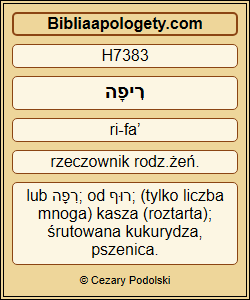 tłuczkiem H5940 tłuczkiem H5940 , nie H3808 odstąpi H5493 , nie H3808 odstąpi H5493 od niego H5921 od niego H5921 głupota jego H200 głupota jego H200 . (Prz27_22 tłum. AI) . (Prz27_22 tłum. AI) |
| L03 |
Prz27_22 |
Choć stłuczesz głupiego w moździerzu tłuczkiem - razem z ziarnami - głupota go nie opuści. (Prz27_22 BT_4) |
| L04 |
Prz27_22 |
Choć stłuczesz H3806 głupiego H191 w moździerzu H4388 tłuczkiem H5940 – razem z ziarnami H7383 – głupota H200 go nie opuści H5493. (Prz27_22 BT_4) |
| L05 |
Prz27_22 |
'im |
tich•tosz- |
'et- |
ha•'e•<wil> |
bam•mach•<Tesz> |
be•<Toch> |
<Ha>•ri•fot |
ba•'e•<Li>; |
lo- |
ta•<Sur> |
me•'a•<Law>, |
iw•wal•<To>. |
<Pe> |
| L06 |
Prz27_22 |
אִ֥ם |
תִּכְתּֽוֹשׁ־ |
אֶת־ |
הָאֱוִ֨יל ׀ |
בַּֽמַּכְתֵּ֡שׁ |
בְּת֣וֹךְ |
הָ֭רִיפוֹת |
בַּֽעֱלִ֑י |
לֹא־ |
תָס֥וּר |
מֵ֝עָלָ֗יו |
אִוַּלְתּֽוֹ׃ |
פ |
| L07 |
Prz27_22 |
Jeśli |
stłuczesz |
— |
głupca |
w moździerzu |
pośród |
ziaren |
tłuczkiem, |
nie |
odstąpi |
od niego |
głupota jego. |
¶ |
| L08 |
Prz27_22 |
אִ֥ם |
תִּכְתּֽוֹשׁ־ |
אֶת־ |
הָ/אֱוִ֨יל ׀ |
בַּֽ/מַּכְתֵּ֡שׁ |
בְּ/ת֣וֹךְ |
הָ֭/רִיפוֹת |
בַּֽ/עֱלִ֑י |
לֹא־ |
תָס֥וּר |
מֵ֝/עָלָ֗י/ו |
אִוַּלְתּֽ/וֹ׃ |
פ |
| L09 |
Prz27_22 |
HCSpój. |
HVqi2msCzas. qal, imperfektum, 2 os., m., lp. |
HToPartykuła znacznik dopełnienia bliższego |
HTd/AamsaPartykuła rodzajnik określony + Przym. zwykły, m., lp., stan absolutny |
HRd/NcmsaPrzyim. z rodzajnikiem + Rzecz. posp., m., lp., stan absolutny |
HR/NcmscPrzyim. + Rzecz. posp., m., lp., stan konstrukcyjny |
HTd/NcfpaPartykuła rodzajnik określony + Rzecz. posp., ż., lm., stan absolutny |
HRd/NcmsaPrzyim. z rodzajnikiem + Rzecz. posp., m., lp., stan absolutny |
HTnPartykuła przecząca |
HVqi3fsCzas. qal, imperfektum, 3 os., ż., lp. |
HR/R/Sp3msPrzyim. + Przyim. + Sufiks zaimkowy, 3 os., m., lp. |
HNcfsc/Sp3msRzecz. posp., ż., lp., stan konstrukcyjny + Sufiks zaimkowy, 3 os., m., lp. |
MARK-PZnacznik podziału: petucha (akapit otwarty) |
| L10 |
Prz27_22 |
´ìm |
TikTô|š- |
´et- |
hä´éwîl |
Ba|mmakTëš |
Bütôk |
härîpôt |
Ba|`élî |
lö´- |
täsûr |
më`äläyw |
´iwwalTô |
P |
| L11 |
Prz27_22 |
H0518 |
H3806 |
H0853 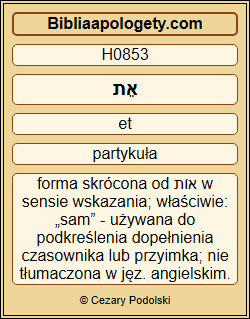 |
H0191 |
H4388 |
H8432 |
H7383 |
H5940 |
H3808 |
H5493 |
H5921 |
H0200 |
|
| L12 |
Prz27_22 |
Though |
Though thou shouldest bray |
|
a fool |
in a mortar |
among |
wheat |
with a pestle |
will not |
depart |
and |
[yet] will not his foolishness |
|
| L13 |
Prz27_22 |
'im |
tich·toosh- |
et- |
ha·'e·Vil |
bam·mach·Tesh |
be·Toch |
Ha·ri·fot |
ba·'e·Li; |
lo- |
ta·Sur |
me·'a·Lav, |
iv·val·To. |
Peh |
| L14 |
Prz27_22 |
אִם |
כָּתַשׁ |
אֵת |
אֱוִיל |
מַכְתֵּשׁ |
תָּוֶךְ |
רִיפָה |
עֱלִי |
לֹא |
סוּר |
עַל |
אִוֶּלֶת |
|
| L15 |
Prz27_22 |
'(Im) |
ka·(Tasz) |
('Et) |
'e·(Wil) |
mach·(Tesz) |
(Ta)·wech |
ri·(Fa) |
'e·(Li) |
(Lo) |
(Sur) |
('Al) |
'iw·(We)·let |
|
| L16 |
Prz27_22 |
’im |
kāṯaš |
’ēṯ |
’ᵉ̆wîl |
maḵtēš |
tā́weḵ |
rîp̱ā(h) |
‘ᵉ̆lî |
lō(’) |
sûr |
‘al |
’iwwéleṯ |
|
| L17 |
Prz27_22 |
’im |
kātaš |
’ēt |
’ĕwîl |
maktēš |
tāwek |
rîpāh |
‘ĕlî |
lō’ |
sûr |
‘al |
’iwwelet |
|
| L18 |
Prz27_22 |
Though thou shouldest bray a fool in a mortar among wheat with a pestle, [yet] will not his foolishness depart from him. (Prz27_22 KJV) |
| L19 |
Prz27_22 |
22 Though thou shouldest bray <03806> (08799) a fool <0191> in a mortar <04388> among <08432> wheat <07383> with a pestle <05940>, yet will not his foolishness <0200> depart <05493> (08799) from him. (Prz27_22 KJV) |
| L20 |
Prz27_22 |
811/1068 |
1/1 |
8840/11047 |
21/25 |
2/2 |
250/416 |
2/2 |
1/1 |
3353/5164 |
232/300 |
3947/5759 |
25/25 |
|
| L21 |
Prz27_22 |
Prz27_22_1 |
Prz27_22_2 |
Prz27_22_3 |
Prz27_22_4 |
Prz27_22_5 |
Prz27_22_6 |
Prz27_22_7 |
Prz27_22_8 |
Prz27_22_9 |
Prz27_22_10 |
Prz27_22_11 |
Prz27_22_12 |
Prz27_22_13 |
| |
| L01 |
Prz27_23 |
Dobrze poznaj oblicze owczarni swojej, przyłóż serce swoje do stad. (Prz27_23 tłum. AI) |
| L02 |
Prz27_23 |
Dobrze H3045 poznaj H3045 oblicze H6440 owczarni swojej H6629 , przyłóż H7896 , przyłóż H7896 serce swoje H3820 do stad H5739 serce swoje H3820 do stad H5739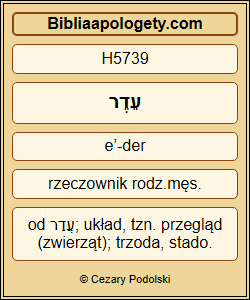 . (Prz27_23 tłum. AI) . (Prz27_23 tłum. AI) |
| L03 |
Prz27_23 |
Troszcz się o potrzeby zwierząt, zwracaj uwagę na trzodę; (Prz27_23 BT_4) |
| L04 |
Prz27_23 |
Troszcz się H3045 H3045 o potrzeby H6440 zwierząt H6629, zwracaj uwagę H7896 H3820 na trzodę H5739. (Prz27_23 BT_4) |
| L05 |
Prz27_23 |
ja•<Do>•a' |
<Te>•da' |
pe•<Ne> |
co•<Ne>•cha; |
szit |
lib•be•cha, |
la•'a•da•<Rim>. |
| L06 |
Prz27_23 |
יָדֹ֣עַ |
תֵּ֭דַע |
פְּנֵ֣י |
צֹאנֶ֑ךָ |
שִׁ֥ית |
לִ֝בְּךָ֗ |
לַעֲדָרִֽים׃ |
| L07 |
Prz27_23 |
Dobrze |
poznaj |
oblicze |
owczarni swojej, |
przyłóż |
serce swoje |
do stad. |
| L08 |
Prz27_23 |
יָדֹ֣עַ |
תֵּ֭דַע |
פְּנֵ֣י |
צֹאנֶ֑/ךָ |
שִׁ֥ית |
לִ֝בְּ/ךָ֗ |
לַ/עֲדָרִֽים׃ |
| L09 |
Prz27_23 |
HVqaCzas. qal, bezok. absolutny |
HVqj2msCzas. qal, jussyw, 2 os., m., lp. |
HNcbpcRzecz. posp., r. wspólny, lm., stan konstrukcyjny |
HNcbsc/Sp2msRzecz. posp., r. wspólny, lp., stan konstrukcyjny + Sufiks zaimkowy, 2 os., m., lp. |
HVqv2msCzas. qal, imperatyw, 2 os., m., lp. |
HNcmsc/Sp2msRzecz. posp., m., lp., stan konstrukcyjny + Sufiks zaimkowy, 2 os., m., lp. |
HR/NcmpaPrzyim. + Rzecz. posp., m., lm., stan absolutny |
| L10 |
Prz27_23 |
yädöª` |
Tëda` |
Pünê |
cö´neºkä |
šît |
liBBükä |
la`ádärîm |
| L11 |
Prz27_23 |
H3045 |
H3045 |
H6440 |
H6629 |
H7896 |
H3820 |
H5739 |
| L12 |
Prz27_23 |
Be thou diligent |
to know |
the state |
of thy flocks |
[and] look |
well |
to thy herds |
| L13 |
Prz27_23 |
ya·Do·a' |
Te·da' |
pe·Nei |
tzo·Ne·cha; |
shit |
lib·be·cha, |
la·'a·da·Rim. |
| L14 |
Prz27_23 |
יָדַע |
יָדַע |
פָּנִים |
צֹאן |
שִׁית |
לֵב |
עֵדֶר |
| L15 |
Prz27_23 |
ja·(Da)' |
ja·(Da)' |
pa·(Nim) |
(Con) |
(Szit) |
(Lew) |
'(E)·der |
| L16 |
Prz27_23 |
jāḏa‘ |
jāḏa‘ |
pānîm |
ṣō(’)n |
šîṯ |
lēḇ |
‘ḗḏer |
| L17 |
Prz27_23 |
jāda‘ |
jāda‘ |
pānîm |
ṣō’n |
šît |
lēb |
‘ēder |
| L18 |
Prz27_23 |
Be thou diligent to know the state of thy flocks, [and] look well to thy herds. (Prz27_23 KJV) |
| L19 |
Prz27_23 |
23 Be thou diligent <03045> (08799) to know <03045> (08800) the state <06440> of thy flocks <06629>, and look <07896> (08798) well <03820> to thy herds <05739>. (Prz27_23 KJV) |
| L20 |
Prz27_23 |
590/934 |
591/934 |
1613/2127 |
198/274 |
66/80 |
382/592 |
16/39 |
| L21 |
Prz27_23 |
Prz27_23_1 |
Prz27_23_2 |
Prz27_23_3 |
Prz27_23_4 |
Prz27_23_5 |
Prz27_23_6 |
Prz27_23_7 |
| |
| L01 |
Prz27_24 |
Bo nie [jest] na wieki bogactwo, ani korona na pokolenie i pokolenie. (Prz27_24 tłum. AI) |
| L02 |
Prz27_24 |
Bo H3588 nie [jest H3808] na wieki H5769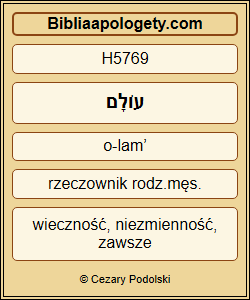 bogactwo H2633 bogactwo H2633 , ani H518 korona H5145 , ani H518 korona H5145 na H1755 na H1755 pokolenie i pokolenie. (Prz27_24 tłum. AI) pokolenie i pokolenie. (Prz27_24 tłum. AI) |
| L03 |
Prz27_24 |
nie trwa na wieki bogactwo, ani na pokolenia - korona. (Prz27_24 BT_4) |
| L04 |
Prz27_24 |
Nie trwa na wieki H5769 bogactwo H2633, ani na pokolenia H1755 – korona H5145. (Prz27_24 BT_4) |
| L05 |
Prz27_24 |
ki |
lo |
le•'o•<Lam> |
<Cho>•sen; |
we•'im- |
<Ne>•zer, |
le•<Dor> |
[dor |
ch] |
(wa•<Dor>. |
k) |
| L06 |
Prz27_24 |
כִּ֤י |
לֹ֣א |
לְעוֹלָ֣ם |
חֹ֑סֶן |
וְאִם־ |
נֵ֝֗זֶר |
לְד֣וֹר |
[דֹור |
כ] |
(וָדֹֽור׃ |
ק) |
| L07 |
Prz27_24 |
Bo |
nie [jest] |
na wieki |
bogactwo, |
ani |
korona |
na pokolenie |
[pokolenie |
כ] |
(i pokolenie. |
ק) |
| L08 |
Prz27_24 |
כִּ֤י |
לֹ֣א |
לְ/עוֹלָ֣ם |
חֹ֑סֶן |
וְ/אִם־ |
נֵ֝֗זֶר |
לְ/ד֣וֹר |
דור |
|
וָ/דֽוֹר׃ |
|
| L09 |
Prz27_24 |
HCSpój. |
HTnPartykuła przecząca |
HR/NcmsaPrzyim. + Rzecz. posp., m., lp., stan absolutny |
HNcmsaRzecz. posp., m., lp., stan absolutny |
HC/CSpój. + Spój. |
HNcmsaRzecz. posp., m., lp., stan absolutny |
HR/NcmsaPrzyim. + Rzecz. posp., m., lp., stan absolutny |
HNcmsaRzecz. posp., m., lp., stan absolutny |
MARK-KZnacznik wariantu: ketiv (forma zapisana) |
HC/NcmsaSpój. + Rzecz. posp., m., lp., stan absolutny |
MARK-QZnacznik wariantu: qere (forma czytana) |
| L10 |
Prz27_24 |
Kî |
lö´ |
lü`ôläm |
Höºsen |
wü´im- |
nëºzer |
lüdôr |
(dôr) |
|
[wädô|r] |
|
| L11 |
Prz27_24 |
H3588 |
H3808 |
H5769 |
H2633 |
H0518 |
H5145 |
H1755 |
|
|
|
|
| L12 |
Prz27_24 |
for |
are not |
[are] not for ever |
For riches |
Nor |
and doth the crown |
[endure] to every |
|
|
all |
|
| L13 |
Prz27_24 |
ki |
lo |
le·'o·Lam |
Cho·sen; |
ve·'im- |
Ne·zer, |
le·Dor |
[dor |
ch] |
(va·Dor. |
k) |
| L14 |
Prz27_24 |
כִּי |
לֹא |
עוֹלָם |
חֹסֶן |
אִם |
נֶזֶר |
דּוֹר |
|
|
|
|
| L15 |
Prz27_24 |
(Ki) |
(Lo) |
o·(Lam) |
(Cho)·sen |
'(Im) |
(Ne)·zer |
(Dor) |
|
|
|
|
| L16 |
Prz27_24 |
kî |
lō(’) |
‘ôlām |
ḥṓsen |
’im |
nézer |
dôr |
|
|
|
|
| L17 |
Prz27_24 |
kî |
lō’ |
‘ôlām |
ḥōsen |
’im |
nezer |
dôr |
|
|
|
|
| L18 |
Prz27_24 |
For riches [are] not for ever: and doth the crown [endure] to every generation? (Prz27_24 KJV) |
| L19 |
Prz27_24 |
24 For riches <02633> are not for ever <05769>: and doth the crown <05145> endure to every <01755> generation <01755>? (Prz27_24 KJV) |
| L20 |
Prz27_24 |
3067/4478 |
3354/5164 |
306/438 |
2/5 |
812/1068 |
23/25 |
131/166 |
|
|
1/1 |
|
| L21 |
Prz27_24 |
Prz27_24_1 |
Prz27_24_2 |
Prz27_24_3 |
Prz27_24_4 |
Prz27_24_5 |
Prz27_24_6 |
Prz27_24_7 |
Prz27_24_8 |
Prz27_24_9 |
Prz27_24_10 |
Prz27_24_11 |
| |
| L01 |
Prz27_25 |
Odsłoniła się trawa, i ukazuje się zieleń, i zebrane zostają zioła gór. (Prz27_25 tłum. AI) |
| L02 |
Prz27_25 |
Odsłoniła się H1540 trawa H2682 , i ukazuje się H7200 zieleń H1877 , i ukazuje się H7200 zieleń H1877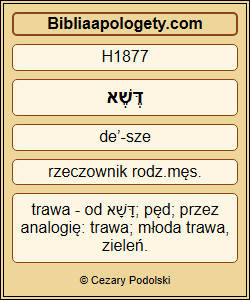 , i zebrane zostają H622 , i zebrane zostają H622 zioła H6212 zioła H6212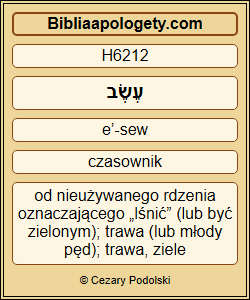 gór H2022 gór H2022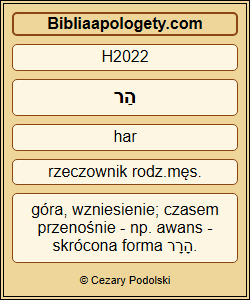 . (Prz27_25 tłum. AI) . (Prz27_25 tłum. AI) |
| L03 |
Prz27_25 |
Wyrosła trawa, pojawia się potraw, zbierze się górskie siano: (Prz27_25 BT_4) |
| L04 |
Prz27_25 |
Wyrosła trawa H2682, pojawia się potraw H1877, zbierze się górskie siano H6212: (Prz27_25 BT_4) |
| L05 |
Prz27_25 |
ga•<La> |
<Cha>•cir |
we•nir•'ah- |
<De>•sze; |
we•ne•'es•<Fu>, |
is•se•<wot> |
ha•<Rim>. |
| L06 |
Prz27_25 |
גָּלָ֣ה |
חָ֭צִיר |
וְנִרְאָה־ |
דֶ֑שֶׁא |
וְ֝נֶאֶסְפ֗וּ |
עִשְּׂב֥וֹת |
הָרִֽים׃ |
| L07 |
Prz27_25 |
Odsłoniła się |
trawa, |
i ukazuje się |
zieleń, |
i zebrane zostają |
zioła |
gór. |
| L08 |
Prz27_25 |
גָּלָ֣ה |
חָ֭צִיר |
וְ/נִרְאָה־ |
דֶ֑שֶׁא |
וְ֝/נֶאֶסְפ֗וּ |
עִשְּׂב֥וֹת |
הָרִֽים׃ |
| L09 |
Prz27_25 |
HVqp3msCzas. qal, perfectum, 3 os., m., lp. |
HNcmsaRzecz. posp., m., lp., stan absolutny |
HC/VNp3msSpój. + Czas. nifal, perfectum, 3 os., m., lp. |
HNcmsaRzecz. posp., m., lp., stan absolutny |
HC/VNp3cpSpój. + Czas. nifal, perfectum, 3 os., r. wspólny, lm. |
HNcmpcRzecz. posp., m., lm., stan konstrukcyjny |
HNcmpaRzecz. posp., m., lm., stan absolutny |
| L10 |
Prz27_25 |
Gälâ |
Häcîr |
wünir´â- |
deºše´ |
wüne´espû |
`iSSübôt |
härîm |
| L11 |
Prz27_25 |
H1540 |
H2682 |
H7200 |
H1877 |
H0622 |
H6212 |
H2022 |
| L12 |
Prz27_25 |
appeareth |
The hay |
sheweth |
and the tender grass |
are gathered |
itself and herbs |
of the mountains |
| L13 |
Prz27_25 |
ga·Lah |
Cha·tzir |
ve·nir·'ah- |
De·she; |
ve·ne·'es·Fu, |
is·se·Vot |
ha·Rim. |
| L14 |
Prz27_25 |
גָּלָה |
חָצִיר |
רָאָה |
דֶּשֶׁא |
אָסַף |
עֶשֶׂב |
הַר |
| L15 |
Prz27_25 |
ga·(La) |
cha·(Cir) |
ra·('A) |
(De)·sze |
'a·(Saf) |
(E)·sew |
(Har) |
| L16 |
Prz27_25 |
gālā(h) |
ḥāṣîr |
rā’ā(h) |
déše(’) |
’āsap̱ |
‘éśeḇ |
har |
| L17 |
Prz27_25 |
gālāh |
ḥāṣîr |
rā’āh |
deše’ |
’āsap |
‘eśeb |
har |
| L18 |
Prz27_25 |
The hay appeareth, and the tender grass sheweth itself, and herbs of the mountains are gathered. (Prz27_25 KJV) |
| L19 |
Prz27_25 |
25 The hay <02682> appeareth <01540> (08804), and the tender grass <01877> sheweth <07200> (08738) itself, and herbs <06212> of the mountains <02022> are gathered <0622> (08738). (Prz27_25 KJV) |
| L20 |
Prz27_25 |
105/185 |
12/21 |
918/1296 |
10/15 |
138/202 |
26/33 |
361/546 |
| L21 |
Prz27_25 |
Prz27_25_1 |
Prz27_25_2 |
Prz27_25_3 |
Prz27_25_4 |
Prz27_25_5 |
Prz27_25_6 |
Prz27_25_7 |
| |
| L01 |
Prz27_26 |
Owce [są] na odzienie twoje, a ceną pola [są] kozły. (Prz27_26 tłum. AI) |
| L02 |
Prz27_26 |
Owce [są H3532 ] na odzienie twoje H3830 ] na odzienie twoje H3830 , a ceną H4242 , a ceną H4242 pola [są H7704 pola [są H7704 ] kozły H6260 ] kozły H6260 . (Prz27_26 tłum. AI) . (Prz27_26 tłum. AI) |
| L03 |
Prz27_26 |
owce na suknie dla ciebie, a kozły, by za pole zapłacić; (Prz27_26 BT_4) |
| L04 |
Prz27_26 |
owce H3532 na suknie H3830 dla ciebie, a kozły H6260, by za pole H7704 zapłacić H4242. (Prz27_26 BT_4) |
| L05 |
Prz27_26 |
ke•wa•<Sim> |
lil•wu•<sze>•cha; |
u•me•<Chir> |
<De>, |
'at•tu•<Dim>. |
| L06 |
Prz27_26 |
כְּבָשִׂ֥ים |
לִלְבוּשֶׁ֑ךָ |
וּמְחִ֥יר |
שָׂ֝דֶ֗ה |
עַתּוּדִֽים׃ |
| L07 |
Prz27_26 |
Owce [są] |
na odzienie twoje, |
a ceną |
pola [są] |
kozły. |
| L08 |
Prz27_26 |
כְּבָשִׂ֥ים |
לִ/לְבוּשֶׁ֑/ךָ |
וּ/מְחִ֥יר |
שָׂ֝דֶ֗ה |
עַתּוּדִֽים׃ |
| L09 |
Prz27_26 |
HNcmpaRzecz. posp., m., lm., stan absolutny |
HR/Ncmsc/Sp2msPrzyim. + Rzecz. posp., m., lp., stan konstrukcyjny + Sufiks zaimkowy, 2 os., m., lp. |
HC/NcmscSpój. + Rzecz. posp., m., lp., stan konstrukcyjny |
HNcmsaRzecz. posp., m., lp., stan absolutny |
HNcmpaRzecz. posp., m., lm., stan absolutny |
| L10 |
Prz27_26 |
KübäSîm |
lilbûšeºkä |
ûmüHîr |
Sädè |
`aTTûdîm |
| L11 |
Prz27_26 |
H3532 |
H3830 |
H4242 |
H7704 |
H6260 |
| L12 |
Prz27_26 |
The lambs |
[are] for thy clothing |
[are] the price |
of the field |
and the goats |
| L13 |
Prz27_26 |
ke·va·Sim |
lil·vu·She·cha; |
u·me·Chir |
Deh, |
'at·tu·Dim. |
| L14 |
Prz27_26 |
כֶּבֶשׂ |
לְבוּשׁ |
מְחִיר |
שָׂדֶה |
עַתּוּד |
| L15 |
Prz27_26 |
ke·(Wes) |
le·(Wusz) |
me·(Chir) |
sa·(De) |
'at·(Tud) |
| L16 |
Prz27_26 |
keḇeś |
lᵉḇûš |
mᵉḥîr |
śāḏe(h) |
‘attûḏ |
| L17 |
Prz27_26 |
kebeś |
lebûš |
meḥîr |
śādeh |
‘attûd |
| L18 |
Prz27_26 |
The lambs [are] for thy clothing, and the goats [are] the price of the field. (Prz27_26 KJV) |
| L19 |
Prz27_26 |
26 The lambs <03532> are for thy clothing <03830>, and the goats <06260> are the price <04242> of the field <07704>. (Prz27_26 KJV) |
| L20 |
Prz27_26 |
95/107 |
24/33 |
9/15 |
241/332 |
20/29 |
| L21 |
Prz27_26 |
Prz27_26_1 |
Prz27_26_2 |
Prz27_26_3 |
Prz27_26_4 |
Prz27_26_5 |
| |
| L01 |
Prz27_27 |
I dość [będzie] mleka kóz na chleb twój, na chleb domu twojego i na życie służących twoich. (Prz27_27 tłum. AI) |
| L02 |
Prz27_27 |
I dość [będzie H1767 ] mleka H2461 ] mleka H2461 kóz H5795 kóz H5795 na chleb twój H3899 na chleb twój H3899 , na chleb H3899 domu twojego H1004 i na życie H2416 , na chleb H3899 domu twojego H1004 i na życie H2416 służących twoich H5291 służących twoich H5291 . (Prz27_27 tłum. AI) . (Prz27_27 tłum. AI) |
| L03 |
Prz27_27 |
dość mleka koziego, byś siebie utrzymał, <utrzymał swój dom> i wyżywił swoje służące. (Prz27_27 BT_4) |
| L04 |
Prz27_27 |
Dość H1767 mleka H2461 koziego H5795, byś siebie utrzymał H3899, i wyżywił swoje służące H5291. (Prz27_27 BT_4) |
| L05 |
Prz27_27 |
we•<De> |
cha•<Lew> |
'iz•<Zim>, |
<Le>•lach•me•cha |
le•<Le>•chem |
be•<Te>•cha; |
we•chai•<jim>, |
le•na•'a•ro•<Te>•cha. |
| L06 |
Prz27_27 |
וְדֵ֤י ׀ |
חֲלֵ֬ב |
עִזִּ֗ים |
לְֽ֭לַחְמְךָ |
לְלֶ֣חֶם |
בֵּיתֶ֑ךָ |
וְ֝חַיִּ֗ים |
לְנַעֲרוֹתֶֽיךָ׃ |
| L07 |
Prz27_27 |
I dość [będzie] |
mleka |
kóz |
na chleb twój, |
na chleb |
domu twojego |
i na życie |
służących twoich. |
| L08 |
Prz27_27 |
וְ/דֵ֤י ׀ |
חֲלֵ֬ב |
עִזִּ֗ים |
לְֽ֭/לַחְמְ/ךָ |
לְ/לֶ֣חֶם |
בֵּיתֶ֑/ךָ |
וְ֝/חַיִּ֗ים |
לְ/נַעֲרוֹתֶֽי/ךָ׃ |
| L09 |
Prz27_27 |
HC/NcmscSpój. + Rzecz. posp., m., lp., stan konstrukcyjny |
HNcmscRzecz. posp., m., lp., stan konstrukcyjny |
HNcfpaRzecz. posp., ż., lm., stan absolutny |
HR/Ncbsc/Sp2msPrzyim. + Rzecz. posp., r. wspólny, lp., stan konstrukcyjny + Sufiks zaimkowy, 2 os., m., lp. |
HR/NcbscPrzyim. + Rzecz. posp., r. wspólny, lp., stan konstrukcyjny |
HNcmsc/Sp2msRzecz. posp., m., lp., stan konstrukcyjny + Sufiks zaimkowy, 2 os., m., lp. |
HC/NcmpaSpój. + Rzecz. posp., m., lm., stan absolutny |
HR/Ncfpc/Sp2msPrzyim. + Rzecz. posp., ż., lm., stan konstrukcyjny + Sufiks zaimkowy, 2 os., m., lp. |
| L10 |
Prz27_27 |
wüdê |
Hálëb |
`izzîm |
lü|laHmükä |
lüleºHem |
Bêteºkä |
wüHayyîm |
lüna`árôtʺkä |
| L11 |
Prz27_27 |
H1767 |
H2461 |
H5795 |
H3899 |
H3899 |
H1004 |
H2416 |
H5291 |
| L12 |
Prz27_27 |
enough |
milk |
And [thou shalt have] goats' |
for thy food |
for the food |
of thy household |
and [for] the maintenance |
for thy maidens |
| L13 |
Prz27_27 |
ve·Dei |
cha·Lev |
'iz·Zim, |
Le·lach·me·cha |
le·Le·chem |
bei·Te·cha; |
ve·chai·Yim, |
le·na·'a·ro·Tei·cha. |
| L14 |
Prz27_27 |
דַּי |
חָלָב |
עֵז |
לֶחֶם |
לֶחֶם |
בַּיִת |
חַי |
נַעֲרָה |
| L15 |
Prz27_27 |
(Dai) |
cha·(Law) |
('Ez) |
(Le)·chem |
(Le)·chem |
(Ba)·jit |
(Chai) |
na·'a·(Ra) |
| L16 |
Prz27_27 |
daj |
ḥālāḇ |
‘ēz |
léḥem |
léḥem |
bájiṯ |
ḥaj |
na‘ᵃ̆rā(h) |
| L17 |
Prz27_27 |
daj |
ḥālāb |
‘ēz |
leḥem |
leḥem |
bajit |
ḥaj |
na‘ărāh |
| L18 |
Prz27_27 |
And [thou shalt have] goats' milk enough for thy food, for the food of thy household, and [for] the maintenance for thy maidens. (Prz27_27 KJV) |
| L19 |
Prz27_27 |
27 And thou shalt have goats' <05795> milk <02461> enough <01767> for thy food <03899>, for the food <03899> of thy household <01004>, and for the maintenance <02416> for thy maidens <05291>. (Prz27_27 KJV) |
| L20 |
Prz27_27 |
22/40 |
29/44 |
68/74 |
223/295 |
224/295 |
1501/2052 |
354/499 |
48/50 |
| L21 |
Prz27_27 |
Prz27_27_1 |
Prz27_27_2 |
Prz27_27_3 |
Prz27_27_4 |
Prz27_27_5 |
Prz27_27_6 |
Prz27_27_7 |
Prz27_27_8 |
| |