| L01 |
Prz30_1 |
Słowa Agura, syna Jake, wyrocznia. Wypowiedź męża do Itiela, do Itiela i Ukala. (Prz30_1 tłum. AI) |
| L02 |
Prz30_1 |
Słowa H1697 Agura H94 Agura H94 , syna H1121 , syna H1121 Jake H3348 Jake H3348 , wyrocznia H4853 , wyrocznia H4853 . Wypowiedź H5002 . Wypowiedź H5002 męża H1397 męża H1397 do Itiela H384 do Itiela H384 , do Itiela H384 i Ukala H401 , do Itiela H384 i Ukala H401 . (Prz30_1 tłum. AI) . (Prz30_1 tłum. AI) |
| L03 |
Prz30_1 |
Słowa Agura, syna Jake z Massa. Mowa tego człowieka do Itiela, do Itiela i Ukala. (Prz30_1 BT_4) |
| L04 |
Prz30_1 |
Słowa H1697 Agura H94, syna H1121 Jake H3348 z Massa H4853. Mowa H5002 tego człowieka H1397 do Itiela H384, do Itiela H384 i Ukala H401. (Prz30_1 BT_4) |
| L05 |
Prz30_1 |
diw•<Re> |
'a•<Gur> |
bin- |
ja•<Ke>, |
ham•<Mas>•<Sa> |
ne•'<Um> |
<Hag>•ge•wer |
le•'i•ti•'<El>; |
le•'<I>•ti•'<El> |
we•'u•<Chal>. |
| L06 |
Prz30_1 |
דִּבְרֵ֤י ׀ |
אָג֥וּר |
בִּן־ |
יָקֶ֗ה |
הַמַּ֫שָּׂ֥א |
נְאֻ֣ם |
הַ֭גֶּבֶר |
לְאִֽיתִיאֵ֑ל |
לְאִ֖יתִיאֵ֣ל |
וְאֻכָֽל׃ |
| L07 |
Prz30_1 |
Słowa |
Agura, |
syna |
Jake, |
wyrocznia. |
Wypowiedź |
męża |
do Itiela, |
do Itiela |
i Ukala. |
| L08 |
Prz30_1 |
דִּבְרֵ֤י ׀ |
אָג֥וּר |
בִּן־ |
יָקֶ֗ה |
הַ/מַּ֫שָּׂ֥א |
נְאֻ֣ם |
הַ֭/גֶּבֶר |
לְ/אִֽיתִיאֵ֑ל |
לְ/אִ֖יתִיאֵ֣ל |
וְ/אֻכָֽל׃ |
| L09 |
Prz30_1 |
HNcmpcRzecz. posp., m., lm., stan konstrukcyjny |
HNpRzecz. własny |
HNcmscRzecz. posp., m., lp., stan konstrukcyjny |
HNpRzecz. własny |
HTd/NcmsaPartykuła rodzajnik określony + Rzecz. posp., m., lp., stan absolutny |
HNcmscRzecz. posp., m., lp., stan konstrukcyjny |
HTd/NcmsaPartykuła rodzajnik określony + Rzecz. posp., m., lp., stan absolutny |
HR/NpPrzyim. + Rzecz. własny |
HR/NpPrzyim. + Rzecz. własny |
HC/NpSpój. + Rzecz. własny |
| L10 |
Prz30_1 |
Dibrê |
´ägûr |
Bin- |
yäqè |
hammaSSä´ |
nü´ùm |
haGGeber |
lü´î|tî´ël |
lü´îºtî´ël |
wü´ùkäl |
| L11 |
Prz30_1 |
H1697 |
H0094 |
H1121 |
H3348 |
H4853 |
H5002 |
H1397 |
H0384 |
H0384 |
H0401 |
| L12 |
Prz30_1 |
The words |
of Agur |
the son |
of Jakeh |
[even] the prophecy |
spake |
the man |
unto Ithiel |
even unto Ithiel |
and Ucal |
| L13 |
Prz30_1 |
div·Rei |
'a·Gur |
bin- |
ya·Keh, |
ham·Mas·Sa |
ne·'Um |
Hag·ge·ver |
le·'i·ti·'El; |
le·'I·ti·'El |
ve·'u·Chal. |
| L14 |
Prz30_1 |
דָּבָר |
אָגוּר |
בֵּן |
יָקֶה |
מַשָּׂא |
נְאֻם |
גֶּבֶר |
אִיתִיאֵל |
אִיתִיאֵל |
אֻכָל |
| L15 |
Prz30_1 |
da·(War) |
'a·(Gur) |
(Ben) |
ja·(Ke) |
mas·(Sa) |
ne·('Um) |
(Ge)·wer |
'i·ti·'(El) |
'i·ti·'(El) |
'u·(Chal) |
| L16 |
Prz30_1 |
dāḇār |
’āg̱ûr |
bēn |
jāqe(h) |
maśśā(’) |
nᵉ’um |
géḇer |
’îṯî’ēl |
’îṯî’ēl |
’uḵāl |
| L17 |
Prz30_1 |
dābār |
’āgûr |
bēn |
jāqeh |
maśśā’ |
ne’um |
geber |
’îtî’ēl |
’îtî’ēl |
’ukāl |
| L18 |
Prz30_1 |
The words of Agur the son of Jakeh, [even] the prophecy: the man spake unto Ithiel, even unto Ithiel and Ucal, (Prz30_1 KJV) |
| L19 |
Prz30_1 |
1 The words <01697> of Agur <094> the son <01121> of Jakeh <03348>, even the prophecy <04853>: the man <01397> spake <05002> (08803) unto Ithiel <0384>, even unto Ithiel <0384> and Ucal <0401>, (Prz30_1 KJV) |
| L20 |
Prz30_1 |
995/1428 |
1/1 |
4284/4921 |
1/1 |
30/65 |
20/376 |
45/65 |
2/3 |
3/3 |
1/1 |
| L21 |
Prz30_1 |
Prz30_1_1 |
Prz30_1_2 |
Prz30_1_3 |
Prz30_1_4 |
Prz30_1_5 |
Prz30_1_6 |
Prz30_1_7 |
Prz30_1_8 |
Prz30_1_9 |
Prz30_1_10 |
| |
| L01 |
Prz30_2 |
Bo głupszy jestem od człowieka, i nie mam rozumu człowieczego w sobie. (Prz30_2 tłum. AI) |
| L02 |
Prz30_2 |
Bo H3588 głupszy H1198 głupszy H1198 jestem H595 jestem H595 od człowieka H376 od człowieka H376 , i nie mam H3808 , i nie mam H3808 rozumu H998 rozumu H998 człowieczego H120 człowieczego H120 w sobie. (Prz30_2 tłum. AI) w sobie. (Prz30_2 tłum. AI) |
| L03 |
Prz30_2 |
Jestem najgłupszy z ludzi, nie mam ludzkiej zdolności, (Prz30_2 BT_4) |
| L04 |
Prz30_2 |
Jestem najgłupszy H1198 z ludzi H376, nie mam rozumu H998 ludzkiego H120. (Prz30_2 BT_4) |
| L05 |
Prz30_2 |
ki |
<wa>•'ar |
'a•no•<Chi> |
me•'<Isz>; |
we•lo- |
wi•<Nat> |
'a•<Dam> |
<Li>. |
| L06 |
Prz30_2 |
כִּ֤י |
בַ֣עַר |
אָנֹכִ֣י |
מֵאִ֑ישׁ |
וְלֹֽא־ |
בִינַ֖ת |
אָדָ֣ם |
לִֽי׃ |
| L07 |
Prz30_2 |
Bo |
głupszy |
jestem |
od człowieka, |
i nie mam |
rozumu |
człowieczego |
w sobie. |
| L08 |
Prz30_2 |
כִּ֤י |
בַ֣עַר |
אָנֹכִ֣י |
מֵ/אִ֑ישׁ |
וְ/לֹֽא־ |
בִינַ֖ת |
אָדָ֣ם |
לִֽ/י׃ |
| L09 |
Prz30_2 |
HCSpój. |
HAamsaPrzym. zwykły, m., lp., stan absolutny |
HPp1csZaimek osobowy, 1 os., r. wspólny, lp. |
HR/NcmsaPrzyim. + Rzecz. posp., m., lp., stan absolutny |
HC/TnSpój. + Partykuła przecząca |
HNcfscRzecz. posp., ż., lp., stan konstrukcyjny |
HNcmsaRzecz. posp., m., lp., stan absolutny |
HR/Sp1csPrzyim. + Sufiks zaimkowy, 1 os., r. wspólny, lp. |
| L10 |
Prz30_2 |
Kî |
baº`ar |
´änökî |
më´îš |
wülö|´- |
bînat |
´ädäm |
lî |
| L11 |
Prz30_2 |
H3588 |
H1198 |
H0595 |
H0376 |
H3808 |
H0998 |
H0120 |
H0000  |
| L12 |
Prz30_2 |
Surely |
Surely I [am] more brutish |
I |
than [any] man |
not |
and have not the understanding |
of a man |
|
| L13 |
Prz30_2 |
ki |
Va·'ar |
'a·no·Chi |
me·'Ish; |
ve·lo- |
vi·Nat |
'a·Dam |
Li. |
| L14 |
Prz30_2 |
כִּי |
בַּעַר |
אָנֹכִי |
אִישׁ |
לֹא |
בִּינָה |
אָדָם |
|
| L15 |
Prz30_2 |
(Ki) |
(Ba)·'ar |
'a·no·(Chi) |
('Isz) |
(Lo) |
bi·(Na) |
'a·(Dam) |
|
| L16 |
Prz30_2 |
kî |
bá‘ar |
’ānōḵî |
’îš |
lō(’) |
bînā(h) |
’āḏām |
|
| L17 |
Prz30_2 |
kî |
ba‘ar |
’ānōkî |
’îš |
lō’ |
bînāh |
’ādām |
|
| L18 |
Prz30_2 |
Surely I [am] more brutish than [any] man, and have not the understanding of a man. (Prz30_2 KJV) |
| L19 |
Prz30_2 |
2 Surely I am more brutish <01198> than any man <0376>, and have not the understanding <0998> of a man <0120>. (Prz30_2 KJV) |
| L20 |
Prz30_2 |
3070/4478 |
4/4 |
264/359 |
1626/2004 |
3363/5164 |
28/38 |
279/552 |
4891/6521 |
| L21 |
Prz30_2 |
Prz30_2_1 |
Prz30_2_2 |
Prz30_2_3 |
Prz30_2_4 |
Prz30_2_5 |
Prz30_2_6 |
Prz30_2_7 |
Prz30_2_8 |
| |
| L01 |
Prz30_3 |
I nie nauczyłem się mądrości, ani wiedzy Świętego nie znam. (Prz30_3 tłum. AI) |
| L02 |
Prz30_3 |
I nie H3808 nauczyłem się H3925 mądrości H2451 mądrości H2451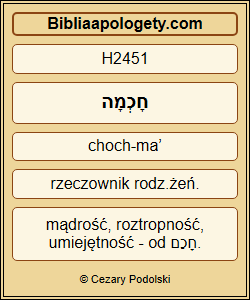 , ani wiedzy H1847 , ani wiedzy H1847 Świętego H6918 Świętego H6918 nie znam H3045 nie znam H3045 . (Prz30_3 tłum. AI) . (Prz30_3 tłum. AI) |
| L03 |
Prz30_3 |
nie nabyłem mądrości, wiedza Świętego mi obca. (Prz30_3 BT_4) |
| L04 |
Prz30_3 |
Nie nabyłem H3925 mądrości H2451, wiedzy H1847 Świętego H6918 nie posiadam H3045. (Prz30_3 BT_4) |
| L05 |
Prz30_3 |
we•lo- |
la•<Mad>•ti |
choch•ma |
we•<Da>•'at |
ke•do•<szim> |
'e•<Da>'. |
| L06 |
Prz30_3 |
וְלֹֽא־ |
לָמַ֥דְתִּי |
חָכְמָ֑ה |
וְדַ֖עַת |
קְדֹשִׁ֣ים |
אֵדָֽע׃ |
| L07 |
Prz30_3 |
I nie |
nauczyłem się |
mądrości, |
ani wiedzy |
Świętego |
nie znam. |
| L08 |
Prz30_3 |
וְ/לֹֽא־ |
לָמַ֥דְתִּי |
חָכְמָ֑ה |
וְ/דַ֖עַת |
קְדֹשִׁ֣ים |
אֵדָֽע׃ |
| L09 |
Prz30_3 |
HC/TnSpój. + Partykuła przecząca |
HVqp1csCzas. qal, perfectum, 1 os., r. wspólny, lp. |
HNcfsaRzecz. posp., ż., lp., stan absolutny |
HC/NcfscSpój. + Rzecz. posp., ż., lp., stan konstrukcyjny |
HAampaPrzym. zwykły, m., lm., stan absolutny |
HVqi1csCzas. qal, imperfektum, 1 os., r. wspólny, lp. |
| L10 |
Prz30_3 |
wülö|´- |
lämaºdTî |
Hokmâ |
wüdaº`at |
qüdöšîm |
´ëdä` |
| L11 |
Prz30_3 |
H3808 |
H3925 |
H2451 |
H1847 |
H6918 |
H3045 |
| L12 |
Prz30_3 |
Neither |
I neither learned |
wisdom |
the knowledge |
of the holy |
nor have |
| L13 |
Prz30_3 |
ve·lo- |
la·Mad·ti |
choch·mah |
ve·Da·'at |
ke·do·Shim |
'e·Da'. |
| L14 |
Prz30_3 |
לֹא |
לָמַד |
חׇכְמָה |
דַּעַת |
קָדוֹשׁ |
יָדַע |
| L15 |
Prz30_3 |
(Lo) |
la·(Mad) |
choch·(Ma) |
(Da)·'at |
ka·(Dosz) |
ja·(Da)' |
| L16 |
Prz30_3 |
lō(’) |
lāmaḏ |
ḥoḵmā(h) |
dá‘aṯ |
qāḏôš |
jāḏa‘ |
| L17 |
Prz30_3 |
lō’ |
lāmad |
ḥokmāh |
da‘at |
qādôš |
jāda‘ |
| L18 |
Prz30_3 |
I neither learned wisdom, nor have the knowledge of the holy. (Prz30_3 KJV) |
| L19 |
Prz30_3 |
3 I neither learned <03925> (08804) wisdom <02451>, nor have <03045> (08799) the knowledge <01847> of the holy <06918>. (Prz30_3 KJV) |
| L20 |
Prz30_3 |
3364/5164 |
56/85 |
101/149 |
67/95 |
66/117 |
595/934 |
| L21 |
Prz30_3 |
Prz30_3_1 |
Prz30_3_2 |
Prz30_3_3 |
Prz30_3_4 |
Prz30_3_5 |
Prz30_3_6 |
| |
| L01 |
Prz30_4 |
Kto wstąpił do niebios i zstąpił? Kto zebrał wiatr w dłoniach swoich? Kto zawinął wody w szacie? Kto ustanowił wszystkie krańce ziemi? Jakie [jest] imię Jego i jakie imię Syna Jego, jeśli wiesz? (Prz30_4 tłum. AI) |
| L02 |
Prz30_4 |
Kto H4310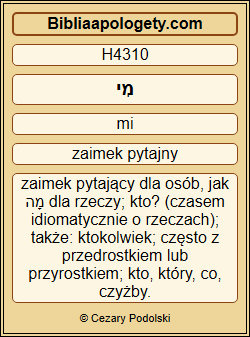 wstąpił H5927 wstąpił H5927 do niebios H8064 do niebios H8064 i zstąpił H3381 i zstąpił H3381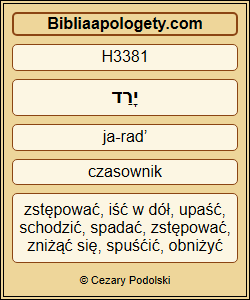 ? Kto H4310 zebrał H622 ? Kto H4310 zebrał H622 wiatr H7307 wiatr H7307 w dłoniach swoich H2651 w dłoniach swoich H2651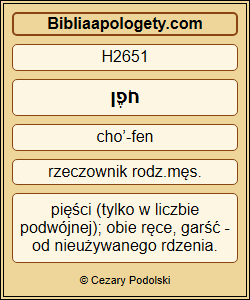 ? Kto H4310 zawinął H6887 ? Kto H4310 zawinął H6887 wody H4325 wody H4325 w szacie H8071 w szacie H8071 ? Kto H4310 ustanowił H6965 ? Kto H4310 ustanowił H6965 wszystkie H3605 wszystkie H3605 krańce H657 krańce H657 ziemi H776 ziemi H776 ? Jakie [jest H4100 ? Jakie [jest H4100 ] imię Jego H8034 ] imię Jego H8034 i jakie H4100 imię H8034 Syna Jego H1121, jeśli H3588 wiesz H3045? (Prz30_4 tłum. AI) i jakie H4100 imię H8034 Syna Jego H1121, jeśli H3588 wiesz H3045? (Prz30_4 tłum. AI) |
| L03 |
Prz30_4 |
Kto wstąpił do nieba i zstąpił? Kto zebrał wiatr w swoje garście? Kto wody owinął płaszczem? Kto krańce ziemi utworzył? Jakie jest jego imię? - A jakie syna? Wiadomo ci może? (Prz30_4 BT_4) |
| L04 |
Prz30_4 |
Kto wstąpił H5927 do nieba H8064 i zstąpił H3381? Kto zebrał H622 wiatr H7307 w swe dłonie H2651? Kto wody H4325 zawinął H6887 w płaszcz H8071? Kto ustanowił H6965 krańce H657 ziemi H776? Jakie jest Jego imię H8034 i imię H8034 Jego Syna H1121 – jeśli wiesz H3045? (Prz30_4 BT_4) |
| L05 |
Prz30_4 |
mi |
'a•lah- |
sza•<Ma>•jim |
wai•je•<Rad> |
mi |
'a•saf- |
<Ru>•ach |
be•cha•fe•<Naw> |
mi |
ca•rar- |
<Ma>•jim |
bas•sim•<La>, |
mi |
he•<Kim> |
kol- |
'af•se- |
'<A>•rec; |
mah- |
sze•<Mo> |
u•mah- |
szem- |
be•<No>, |
ki |
te•<Da>'. |
| L06 |
Prz30_4 |
מִ֤י |
עָלָֽה־ |
שָׁמַ֨יִם ׀ |
וַיֵּרַ֡ד |
מִ֤י |
אָֽסַף־ |
ר֨וּחַ ׀ |
בְּחָפְנָ֡יו |
מִ֤י |
צָֽרַר־ |
מַ֨יִם ׀ |
בַּשִּׂמְלָ֗ה |
מִ֭י |
הֵקִ֣ים |
כָּל־ |
אַפְסֵי־ |
אָ֑רֶץ |
מַה־ |
שְּׁמ֥וֹ |
וּמַֽה־ |
שֶּׁם־ |
בְּ֝נ֗וֹ |
כִּ֣י |
תֵדָֽע׃ |
| L07 |
Prz30_4 |
Kto |
wstąpił |
do niebios |
i zstąpił? |
Kto |
zebrał |
wiatr |
w dłoniach swoich? |
Kto |
zawinął |
wody |
w szacie? |
Kto |
ustanowił |
wszystkie |
krańce |
ziemi? |
Jakie [jest] |
imię Jego |
i jakie |
imię |
Syna Jego, |
jeśli |
wiesz? |
| L08 |
Prz30_4 |
מִ֤י |
עָלָֽה־ |
שָׁמַ֨יִם ׀ |
וַ/יֵּרַ֡ד |
מִ֤י |
אָֽסַף־ |
ר֨וּחַ ׀ |
בְּ/חָפְנָ֡י/ו |
מִ֤י |
צָֽרַר־ |
מַ֨יִם ׀ |
בַּ/שִּׂמְלָ֗ה |
מִ֭י |
הֵקִ֣ים |
כָּל־ |
אַפְסֵי־ |
אָ֑רֶץ |
מַה־ |
שְּׁמ֥/וֹ |
וּ/מַֽה־ |
שֶּׁם־ |
בְּ֝נ֗/וֹ |
כִּ֣י |
תֵדָֽע׃ |
| L09 |
Prz30_4 |
HTiPartykuła pytajna |
HVqp3msCzas. qal, perfectum, 3 os., m., lp. |
HNcmpaRzecz. posp., m., lm., stan absolutny |
HC/Vqw3msSpój. + Czas. qal, imperf. konsekutywne, 3 os., m., lp. |
HTiPartykuła pytajna |
HVqp3msCzas. qal, perfectum, 3 os., m., lp. |
HNcbsaRzecz. posp., r. wspólny, lp., stan absolutny |
HR/Ncmdc/Sp3msPrzyim. + Rzecz. posp., m., podw., stan konstrukcyjny + Sufiks zaimkowy, 3 os., m., lp. |
HTiPartykuła pytajna |
HVqp3msCzas. qal, perfectum, 3 os., m., lp. |
HNcmpaRzecz. posp., m., lm., stan absolutny |
HRd/NcfsaPrzyim. z rodzajnikiem + Rzecz. posp., ż., lp., stan absolutny |
HTiPartykuła pytajna |
HVhp3msCzas. hifil, perfectum, 3 os., m., lp. |
HNcmscRzecz. posp., m., lp., stan konstrukcyjny |
HNcmpcRzecz. posp., m., lm., stan konstrukcyjny |
HNcbsaRzecz. posp., r. wspólny, lp., stan absolutny |
HTiPartykuła pytajna |
HNcmsc/Sp3msRzecz. posp., m., lp., stan konstrukcyjny + Sufiks zaimkowy, 3 os., m., lp. |
HC/TiSpój. + Partykuła pytajna |
HNcmscRzecz. posp., m., lp., stan konstrukcyjny |
HNcmsc/Sp3msRzecz. posp., m., lp., stan konstrukcyjny + Sufiks zaimkowy, 3 os., m., lp. |
HCSpój. |
HVqi2msCzas. qal, imperfektum, 2 os., m., lp. |
| L10 |
Prz30_4 |
mî |
`älâ|- |
šämaºyim |
wayyërad |
mî |
´ä|sap- |
rûªH |
BüHopnäyw |
mî |
cä|rar- |
maºyim |
BaSSimlâ |
mî |
hëqîm |
Kol- |
´apsê- |
´äºrec |
mà- |
ššümô |
ûmà|- |
ššem- |
Bünô |
Kî |
tëdä` |
| L11 |
Prz30_4 |
H4310 |
H5927 |
H8064 |
H3381 |
H4310 |
H0622 |
H7307 |
H2651 |
H4310 |
H6887 |
H4325 |
H8071 |
H4310 |
H6965 |
H3605 |
H0657 |
H0776 |
H4100 |
H8034 |
H4100 |
H8034 |
H1121 |
H3588 |
H3045 |
| L12 |
Prz30_4 |
Who |
Who hath ascended up |
into heaven |
or descended |
Who |
? who hath gathered |
the wind |
fists |
Who |
has wrapped |
the waters |
apparel |
Who |
has established |
all |
all the ends |
common |
how long |
name |
how long |
is his name |
and what [is] his son's |
for |
if thou canst tell |
| L13 |
Prz30_4 |
mi |
a·lah- |
sha·Ma·yim |
vai·ye·Rad |
mi |
a·saf- |
Ru·ach |
be·cha·fe·Nav |
mi |
tza·rar- |
Ma·yim |
bas·sim·Lah, |
mi |
he·Kim |
kol- |
af·sei- |
'A·retz; |
mah- |
she·Mo |
u·mah- |
shem- |
be·No, |
ki |
te·Da'. |
| L14 |
Prz30_4 |
מִי |
עָלָה |
שָׁמַיִם |
יָרַד |
מִי |
אָסַף |
רוּחַ |
חֹפֶן |
מִי |
צָרַר |
מַיִם |
שִׂמְלָה |
מִי |
קוּם |
כֹּל |
אֶפֶס |
אֶרֶץ |
מָה |
שֵׁם |
מָה |
שֵׁם |
בֵּן |
כִּי |
יָדַע |
| L15 |
Prz30_4 |
(Mi) |
'a·(La) |
sza·(Ma)·jim |
ja·(Rad) |
(Mi) |
'a·(Saf) |
(Ru)·ach |
(Cho)·fen |
(Mi) |
ca·(Rar) |
(Ma)·jim |
sim·(La) |
(Mi) |
(Kum) |
(Kol) |
'(E)·fes |
'(E)·rec |
(Ma) |
(Szem) |
(Ma) |
(Szem) |
(Ben) |
(Ki) |
ja·(Da)' |
| L16 |
Prz30_4 |
mî |
‘ālā(h) |
šāmájim |
jāraḏ |
mî |
’āsap̱ |
rûᵃḥ |
ḥṓp̱en |
mî |
ṣārar |
májim |
śimlā(h) |
mî |
qûm |
kōl |
’ép̱es |
’éreṣ |
mā(h) |
šēm |
mā(h) |
šēm |
bēn |
kî |
jāḏa‘ |
| L17 |
Prz30_4 |
mî |
‘ālāh |
šāmajim |
jārad |
mî |
’āsap |
rûaḥ |
ḥōpen |
mî |
ṣārar |
majim |
śimlāh |
mî |
qûm |
kōl |
’epes |
’ereṣ |
māh |
šēm |
māh |
šēm |
bēn |
kî |
jāda‘ |
| L18 |
Prz30_4 |
Who hath ascended up into heaven, or descended? who hath gathered the wind in his fists? who hath bound the waters in a garment? who hath established all the ends of the earth? what [is] his name, and what [is] his son's name, if thou canst tell? (Prz30_4 KJV) |
| L19 |
Prz30_4 |
4 Who hath ascended up <05927> (08804) into heaven <08064>, or descended <03381> (08799)? who hath gathered <0622> (08804) the wind <07307> in his fists <02651>? who hath bound <06887> (08804) the waters <04325> in a garment <08071>? who hath established <06965> (08689) all the ends <0657> of the earth <0776>? what is his name <08034>, and what is his son's <01121> name <08034>, if thou canst tell <03045> (08799)? (Prz30_4 KJV) |
| L20 |
Prz30_4 |
278/422 |
682/883 |
307/421 |
286/378 |
279/422 |
139/202 |
194/377 |
3/6 |
280/422 |
42/52 |
412/579 |
23/27 |
281/422 |
492/627 |
3989/5415 |
22/44 |
1651/2502 |
532/744 |
673/864 |
533/744 |
674/864 |
4285/4921 |
3071/4478 |
596/934 |
| L21 |
Prz30_4 |
Prz30_4_1 |
Prz30_4_2 |
Prz30_4_3 |
Prz30_4_4 |
Prz30_4_5 |
Prz30_4_6 |
Prz30_4_7 |
Prz30_4_8 |
Prz30_4_9 |
Prz30_4_10 |
Prz30_4_11 |
Prz30_4_12 |
Prz30_4_13 |
Prz30_4_14 |
Prz30_4_15 |
Prz30_4_16 |
Prz30_4_17 |
Prz30_4_18 |
Prz30_4_19 |
Prz30_4_20 |
Prz30_4_21 |
Prz30_4_22 |
Prz30_4_23 |
Prz30_4_24 |
| |
| L01 |
Prz30_5 |
Każde słowo Boga [jest] wypróbowane; tarczą [jest] On dla chroniących się w Nim. (Prz30_5 tłum. AI) |
| L02 |
Prz30_5 |
Każde H3605 słowo H565 Boga H433 Boga H433 [jest] wypróbowane H6884 [jest] wypróbowane H6884 ; tarczą [jest H4043 ; tarczą [jest H4043 ] On H1931 ] On H1931 dla chroniących się H2620 dla chroniących się H2620 w Nim. (Prz30_5 tłum. AI) w Nim. (Prz30_5 tłum. AI) |
| L03 |
Prz30_5 |
Każde słowo Boga w ogniu wypróbowane, tarczą jest dla tych, co Doń się uciekają. (Prz30_5 BT_4) |
| L04 |
Prz30_5 |
Każde słowo H565 Boga H433 jest czyste H6884, On tarczą H4043 dla tych, którzy się do Niego uciekają H2620. (Prz30_5 BT_4) |
| L05 |
Prz30_5 |
kol- |
'im•<Rat> |
e•<Lo>•a |
ce•ru•<Fa>; |
ma•<Gen> |
<Hu>, |
la•cho•<Sim> |
bo. |
| L06 |
Prz30_5 |
כָּל־ |
אִמְרַ֣ת |
אֱל֣וֹהַּ |
צְרוּפָ֑ה |
מָגֵ֥ן |
ה֝֗וּא |
לַֽחֹסִ֥ים |
בּֽוֹ׃ |
| L07 |
Prz30_5 |
Każde |
słowo |
Boga |
[jest] wypróbowane; |
tarczą [jest] |
On |
dla chroniących się |
w Nim. |
| L08 |
Prz30_5 |
כָּל־ |
אִמְרַ֣ת |
אֱל֣וֹהַּ |
צְרוּפָ֑ה |
מָגֵ֥ן |
ה֝֗וּא |
לַֽ/חֹסִ֥ים |
בּֽ/וֹ׃ |
| L09 |
Prz30_5 |
HNcmscRzecz. posp., m., lp., stan konstrukcyjny |
HNcfscRzecz. posp., ż., lp., stan konstrukcyjny |
HNcmsaRzecz. posp., m., lp., stan absolutny |
HVqsfsaCzas. qal, imiesłów bierny, ż., lp., stan absolutny |
HNcbsaRzecz. posp., r. wspólny, lp., stan absolutny |
HPp3msZaimek osobowy, 3 os., m., lp. |
HRd/VqrmpaPrzyim. z rodzajnikiem + Czas. qal, imiesłów czynny, m., lm., stan absolutny |
HR/Sp3msPrzyim. + Sufiks zaimkowy, 3 os., m., lp. |
| L10 |
Prz30_5 |
Kol- |
´imrat |
´élôªh |
cürûpâ |
mägën |
hû´ |
la|Hösîm |
Bô |
| L11 |
Prz30_5 |
H3605 |
H0565 |
H0433 |
H6884 |
H4043 |
H1931 |
H2620 |
H0000 |
| L12 |
Prz30_5 |
Every |
Every word |
of God |
[is] pure |
he [is] a shield |
who |
unto them that put their trust |
|
| L13 |
Prz30_5 |
kol- |
'im·Rat |
e·Lo·ah |
tze·ru·Fah; |
ma·Gen |
Hu, |
la·cho·Sim |
bo. |
| L14 |
Prz30_5 |
כֹּל |
אִמְרָה |
אֱלוֹהַּ |
צָרַף |
מָגֵן |
הוּא |
חָסָה |
|
| L15 |
Prz30_5 |
(Kol) |
'im·(Ra) |
e·(Lo)·a |
ca·(Raf) |
ma·(Gen) |
(Hu) |
cha·(Sa) |
|
| L16 |
Prz30_5 |
kōl |
’imrā(h) |
’ᵉ̆lôᵃh |
ṣārap̱ |
māg̱ēn |
hû(’) |
ḥāsā(h) |
|
| L17 |
Prz30_5 |
kōl |
’imrāh |
’ĕlôah |
ṣārap |
māgēn |
hû’ |
ḥāsāh |
|
| L18 |
Prz30_5 |
Every word of God [is] pure: he [is] a shield unto them that put their trust in him. (Prz30_5 KJV) |
| L19 |
Prz30_5 |
5 Every word <0565> of God <0433> is pure <06884> (08803): he is a shield <04043> unto them that put their trust <02620> (08802) in him. (Prz30_5 KJV) |
| L20 |
Prz30_5 |
3990/5415 |
31/37 |
53/59 |
14/32 |
50/63 |
1409/1867 |
32/37 |
4892/6521 |
| L21 |
Prz30_5 |
Prz30_5_1 |
Prz30_5_2 |
Prz30_5_3 |
Prz30_5_4 |
Prz30_5_5 |
Prz30_5_6 |
Prz30_5_7 |
Prz30_5_8 |
| |
| L01 |
Prz30_6 |
Nie dodawaj do słów Jego, aby nie zganił ciebie i [abyś] okazał się kłamcą. (Prz30_6 tłum. AI) |
| L02 |
Prz30_6 |
Nie H408 dodawaj H3254 dodawaj H3254 do H5921 do H5921 słów Jego H1697, aby nie H6435 słów Jego H1697, aby nie H6435 zganił H3198 zganił H3198 ciebie i [abyś] okazał się kłamcą H3576 ciebie i [abyś] okazał się kłamcą H3576 . (Prz30_6 tłum. AI) . (Prz30_6 tłum. AI) |
| L03 |
Prz30_6 |
Do słów Jego nic nie dodawaj, by cię nie skarał: nie uznał za kłamcę. (Prz30_6 BT_4) |
| L04 |
Prz30_6 |
Do Jego słów H1697 nic nie dodawaj H3254, by cię nie zganił H3198 i nie uznał za kłamcę H3576. (Prz30_6 BT_4) |
| L05 |
Prz30_6 |
'al- |
<Tosp> |
'al- |
de•wa•<Raw>; |
pen- |
jo•<Chi>•ach |
be•<Cha> |
we•nich•<Za>•we•ta. |
<Pe> |
| L06 |
Prz30_6 |
אַל־ |
תּ֥וֹסְףְּ |
עַל־ |
דְּבָרָ֑יו |
פֶּן־ |
יוֹכִ֖יחַ |
בְּךָ֣ |
וְנִכְזָֽבְתָּ׃ |
פ |
| L07 |
Prz30_6 |
Nie |
dodawaj |
do |
słów Jego, |
aby nie |
zganił |
ciebie |
i [abyś] okazał się kłamcą. |
¶ |
| L08 |
Prz30_6 |
אַל־ |
תּ֥וֹסְףְּ |
עַל־ |
דְּבָרָ֑י/ו |
פֶּן־ |
יוֹכִ֖יחַ |
בְּ/ךָ֣ |
וְ/נִכְזָֽבְתָּ׃ |
פ |
| L09 |
Prz30_6 |
HTnPartykuła przecząca |
HVhj2msCzas. hifil, jussyw, 2 os., m., lp. |
HRPrzyim. |
HNcmpc/Sp3msRzecz. posp., m., lm., stan konstrukcyjny + Sufiks zaimkowy, 3 os., m., lp. |
HCSpój. |
HVhi3msCzas. hifil, imperfektum, 3 os., m., lp. |
HR/Sp2msPrzyim. + Sufiks zaimkowy, 2 os., m., lp. |
HC/VNq2msSpój. + Czas. nifal, perf. konsekutywne, 2 os., m., lp. |
MARK-PZnacznik podziału: petucha (akapit otwarty) |
| L10 |
Prz30_6 |
´al- |
TôsP |
`al- |
Dübäräyw |
Pen- |
yôkîªH |
Bükä |
wünikzäºbTä |
P |
| L11 |
Prz30_6 |
H0408 |
H3254 |
H5921 |
H1697 |
H6435 |
H3198 |
H0000 |
H3576 |
|
| L12 |
Prz30_6 |
not |
Add |
unto |
thou not unto his words |
Or |
lest he reprove |
|
thee and thou be found a liar |
|
| L13 |
Prz30_6 |
al- |
Tosp |
al- |
de·va·Rav; |
pen- |
yo·Chi·ach |
be·Cha |
ve·nich·Za·ve·ta. |
Peh |
| L14 |
Prz30_6 |
אַל |
יָסַף |
עַל |
דָּבָר |
פֵּן |
יָכַח |
|
כָּזַב |
|
| L15 |
Prz30_6 |
('Al) |
ja·(Saf) |
('Al) |
da·(War) |
(Pen) |
ja·(Chach) |
|
ka·(Zaw) |
|
| L16 |
Prz30_6 |
’al |
jāsap̱ |
‘al |
dāḇār |
pēn |
jāḵaḥ |
|
kāzaḇ |
|
| L17 |
Prz30_6 |
’al |
jāsap |
‘al |
dābār |
pēn |
jākaḥ |
|
kāzab |
|
| L18 |
Prz30_6 |
Add thou not unto his words, lest he reprove thee, and thou be found a liar. (Prz30_6 KJV) |
| L19 |
Prz30_6 |
6 Add <03254> (08686) thou not unto his words <01697>, lest he reprove <03198> (08686) thee, and thou be found a liar <03576> (08738). (Prz30_6 KJV) |
| L20 |
Prz30_6 |
498/725 |
165/210 |
3954/5759 |
996/1428 |
112/133 |
46/59 |
4893/6521 |
13/18 |
|
| L21 |
Prz30_6 |
Prz30_6_1 |
Prz30_6_2 |
Prz30_6_3 |
Prz30_6_4 |
Prz30_6_5 |
Prz30_6_6 |
Prz30_6_7 |
Prz30_6_8 |
Prz30_6_9 |
| |
| L01 |
Prz30_7 |
Dwie [rzeczy] prosiłem od Ciebie; nie odmawiaj mi zanim umrę. (Prz30_7 tłum. AI) |
| L02 |
Prz30_7 |
Dwie [rzeczy H8147 ] prosiłem H7592 ] prosiłem H7592 od Ciebie H853 od Ciebie H853 ; nie H408 odmawiaj H4513 ; nie H408 odmawiaj H4513 mi H4480 mi H4480 zanim H2962 zanim H2962 umrę H4191 umrę H4191 . (Prz30_7 tłum. AI) . (Prz30_7 tłum. AI) |
| L03 |
Prz30_7 |
Proszę Cię o dwie rzeczy, nie odmów mi - proszę - nim umrę: (Prz30_7 BT_4) |
| L04 |
Prz30_7 |
O dwie rzeczy H8147 proszę H7592 Cię – nie odmów H4513 mi, zanim umrę H4191. (Prz30_7 BT_4) |
| L05 |
Prz30_7 |
ta•jim |
sza•'<Al>•ti |
me•'it•<Tach>; |
'al- |
tim•<Na>' |
mi•<Men>•ni, |
be•<Te>•rem |
'a•<Mut>. |
| L06 |
Prz30_7 |
שְׁ֭תַּיִם |
שָׁאַ֣לְתִּי |
מֵאִתָּ֑ךְ |
אַל־ |
תִּמְנַ֥ע |
מִ֝מֶּ֗נִּי |
בְּטֶ֣רֶם |
אָמֽוּת׃ |
| L07 |
Prz30_7 |
Dwie [rzeczy] |
prosiłem |
od Ciebie; |
nie |
odmawiaj |
mi |
zanim |
umrę. |
| L08 |
Prz30_7 |
שְׁ֭תַּיִם |
שָׁאַ֣לְתִּי |
מֵ/אִתָּ֑/ךְ |
אַל־ |
תִּמְנַ֥ע |
מִ֝מֶּ֗/נִּי |
בְּ/טֶ֣רֶם |
אָמֽוּת׃ |
| L09 |
Prz30_7 |
HAcfdaPrzym. liczebnik główny, ż., podw., stan absolutny |
HVqp1csCzas. qal, perfectum, 1 os., r. wspólny, lp. |
HR/R/Sp2fsPrzyim. + Przyim. + Sufiks zaimkowy, 2 os., ż., lp. |
HTnPartykuła przecząca |
HVqj2msCzas. qal, jussyw, 2 os., m., lp. |
HR/Sp1csPrzyim. + Sufiks zaimkowy, 1 os., r. wspólny, lp. |
HR/DPrzyim. + Przysł. |
HVqi1csCzas. qal, imperfektum, 1 os., r. wspólny, lp. |
| L10 |
Prz30_7 |
šTaºyim |
šä´aºlTî |
më´iTTäk |
´al- |
Timna` |
mimmeºnnî |
Bü†eºrem |
´ämût |
| L11 |
Prz30_7 |
H8147 |
H7592 |
H0853 |
H0408 |
H4513 |
H4480 |
H2962 |
H4191 |
| L12 |
Prz30_7 |
Two |
[things] have I required |
|
not |
of thee deny |
at |
before |
me [them] not before I die |
| L13 |
Prz30_7 |
ta·yim |
sha·'Al·ti |
me·'it·Tach; |
al- |
tim·Na' |
mi·Men·ni, |
be·Te·rem |
'a·Mut. |
| L14 |
Prz30_7 |
שְׁנַיִם |
שָׁאַל |
אֵת |
אַל |
מָנַע |
מִן |
טֶרֶם |
מוּת |
| L15 |
Prz30_7 |
sze·(Na)·jim |
sza·'(Al) |
('Et) |
('Al) |
ma·(Na)' |
(Min) |
(Te)·rem |
(Mut) |
| L16 |
Prz30_7 |
šᵉnájim |
šā’al |
’ēṯ |
’al |
māna‘ |
min |
ṭérem |
mûṯ |
| L17 |
Prz30_7 |
šenajim |
šā’al |
’ēt |
’al |
māna‘ |
min |
ṭerem |
mût |
| L18 |
Prz30_7 |
Two [things] have I required of thee; deny me [them] not before I die: (Prz30_7 KJV) |
| L19 |
Prz30_7 |
7 Two <08147> things have I required <07592> (08804) of thee; deny <04513> (08799) me them not before I die <04191> (08799): (Prz30_7 KJV) |
| L20 |
Prz30_7 |
674/768 |
143/170 |
8841/11047 |
499/725 |
19/29 |
947/1215 |
36/56 |
701/836 |
| L21 |
Prz30_7 |
Prz30_7_1 |
Prz30_7_2 |
Prz30_7_3 |
Prz30_7_4 |
Prz30_7_5 |
Prz30_7_6 |
Prz30_7_7 |
Prz30_7_8 |
| |
| L01 |
Prz30_8 |
0 i słowo kłamstwa oddal ode mnie; ubóstwa ani bogactwa nie dawaj mi; karm mnie chlebem wyznaczonym mi, (Prz30_8 tłum. AI) |
| L02 |
Prz30_8 |
0 H7723 i słowo H1697 kłamstwa H3577 i słowo H1697 kłamstwa H3577 oddal H7368 oddal H7368 ode mnie H4480; ubóstwa H7389 ode mnie H4480; ubóstwa H7389 ani bogactwa H6239 ani bogactwa H6239 nie H408 dawaj H5414 nie H408 dawaj H5414 mi; karm mnie H2963 mi; karm mnie H2963 chlebem H3899 chlebem H3899 wyznaczonym mi H2706 wyznaczonym mi H2706 , (Prz30_8 tłum. AI) , (Prz30_8 tłum. AI) |
| L03 |
Prz30_8 |
Kłamstwo i fałsz oddalaj ode mnie, nie dawaj mi bogactwa ni nędzy, żyw mnie chlebem niezbędnym, (Prz30_8 BT_4) |
| L04 |
Prz30_8 |
Oddal H7368 ode mnie fałsz H7723 i kłamstwo H3577, nie dawaj H5414 mi ani ubóstwa H7389, ani bogactwa H6239, żyw H2963 mnie chlebem H3899 niezbędnym H2706, (Prz30_8 BT_4) |
| L05 |
Prz30_8 |
szaw |
u•de•war- |
ka•<Zaw> |
har•<Chek> |
mi•<Men>•ni, |
resz |
<wa>•'o•szer |
'al- |
tit•ten- |
<Li>; |
hat•ri•<Fe>•ni, |
<Le>•chem |
chuk•<Ki>. |
| L06 |
Prz30_8 |
שָׁ֤וְא ׀ |
וּֽדְבַר־ |
כָּזָ֡ב |
הַרְחֵ֬ק |
מִמֶּ֗נִּי |
רֵ֣אשׁ |
וָ֭עֹשֶׁר |
אַל־ |
תִּֽתֶּן־ |
לִ֑י |
הַ֝טְרִיפֵ֗נִי |
לֶ֣חֶם |
חֻקִּֽי׃ |
| L07 |
Prz30_8 |
0 |
i słowo |
kłamstwa |
oddal |
ode mnie; |
ubóstwa |
ani bogactwa |
nie |
dawaj |
mi; |
karm mnie |
chlebem |
wyznaczonym mi, |
| L08 |
Prz30_8 |
שָׁ֤וְא ׀ |
וּֽ/דְבַר־ |
כָּזָ֡ב |
הַרְחֵ֬ק |
מִמֶּ֗/נִּי |
רֵ֣אשׁ |
וָ֭/עֹשֶׁר |
אַל־ |
תִּֽתֶּן־ |
לִ֑/י |
הַ֝טְרִיפֵ֗/נִי |
לֶ֣חֶם |
חֻקִּֽ/י׃ |
| L09 |
Prz30_8 |
HNcmsaRzecz. posp., m., lp., stan absolutny |
HC/NcmscSpój. + Rzecz. posp., m., lp., stan konstrukcyjny |
HNcmsaRzecz. posp., m., lp., stan absolutny |
HVhv2msCzas. hifil, imperatyw, 2 os., m., lp. |
HR/Sp1csPrzyim. + Sufiks zaimkowy, 1 os., r. wspólny, lp. |
HNcmsaRzecz. posp., m., lp., stan absolutny |
HC/NcmsaSpój. + Rzecz. posp., m., lp., stan absolutny |
HTnPartykuła przecząca |
HVqj2msCzas. qal, jussyw, 2 os., m., lp. |
HR/Sp1csPrzyim. + Sufiks zaimkowy, 1 os., r. wspólny, lp. |
HVhv2ms/Sp1csCzas. hifil, imperatyw, 2 os., m., lp. + Sufiks zaimkowy, 1 os., r. wspólny, lp. |
HNcbscRzecz. posp., r. wspólny, lp., stan konstrukcyjny |
HNcmsc/Sp1csRzecz. posp., m., lp., stan konstrukcyjny + Sufiks zaimkowy, 1 os., r. wspólny, lp. |
| L10 |
Prz30_8 |
šäºw´ |
û|dübar- |
Käzäb |
harHëq |
mimmeºnnî |
rë´š |
wä`öšer |
´al- |
Ti|TTen- |
lî |
ha†rîpëºnî |
leºHem |
Huqqî |
| L11 |
Prz30_8 |
H7723 |
H1697 |
H3577 |
H7368 |
H4480 |
H7389 |
H6239 |
H0408 |
H5414 |
H0000 |
H2963 |
H3899 |
H2706 |
| L12 |
Prz30_8 |
from me vanity |
act |
and lies |
Remove far |
at |
me neither poverty |
nor riches |
neither |
give |
|
feed |
me with food |
convenient |
| L13 |
Prz30_8 |
shav |
u·de·var- |
ka·Zav |
har·Chek |
mi·Men·ni, |
resh |
Va·'o·sher |
al- |
tit·ten- |
Li; |
hat·ri·Fe·ni, |
Le·chem |
chuk·Ki. |
| L14 |
Prz30_8 |
שָׁוְא |
דָּבָר |
כָּזָב |
רָחַק |
מִן |
רֵישׁ |
עֹשֶׁר |
אַל |
נָתַן |
|
טָרַף |
לֶחֶם |
חֹק |
| L15 |
Prz30_8 |
(Szaw) |
da·(War) |
ka·(Zaw) |
ra·(Chak) |
(Min) |
(Resz) |
'(O)·szer |
('Al) |
na·(Tan) |
|
ta·(Raf) |
(Le)·chem |
(Chok) |
| L16 |
Prz30_8 |
šāw(’) |
dāḇār |
kāzāḇ |
rāḥaq |
min |
rêš |
‘ṓšer |
’al |
nāṯan |
|
ṭārap̱ |
léḥem |
ḥōq |
| L17 |
Prz30_8 |
šāwe’ |
dābār |
kāzāb |
rāḥaq |
min |
rêš |
‘ōšer |
’al |
nātan |
|
ṭārap |
leḥem |
ḥōq |
| L18 |
Prz30_8 |
Remove far from me vanity and lies: give me neither poverty nor riches; feed me with food convenient for me: (Prz30_8 KJV) |
| L19 |
Prz30_8 |
8 Remove far <07368> (08685) from me vanity <07723> and lies <01697> <03577>: give <05414> (08799) me neither poverty <07389> nor riches <06239>; feed <02963> (08685) me with food <03899> convenient <02706> for me: (Prz30_8 KJV) |
| L20 |
Prz30_8 |
27/51 |
997/1428 |
15/29 |
37/57 |
948/1215 |
6/7 |
27/37 |
500/725 |
1485/2007 |
4894/6521 |
15/25 |
228/295 |
107/125 |
| L21 |
Prz30_8 |
Prz30_8_1 |
Prz30_8_2 |
Prz30_8_3 |
Prz30_8_4 |
Prz30_8_5 |
Prz30_8_6 |
Prz30_8_7 |
Prz30_8_8 |
Prz30_8_9 |
Prz30_8_10 |
Prz30_8_11 |
Prz30_8_12 |
Prz30_8_13 |
| |
| L01 |
Prz30_9 |
abym nie nasycił się i zaparł się [Ciebie], i powiedział: „Kim [jest] Jahwe?”, ani abym nie zubożał i ukradł, i znieważył imię Boga mego. (Prz30_9 tłum. AI) |
| L02 |
Prz30_9 |
abym nie H6435 nasycił się H7646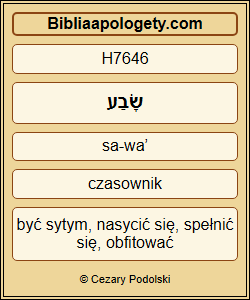 i zaparł się [Ciebie H3584 i zaparł się [Ciebie H3584 ], i powiedział H559 ], i powiedział H559 : „Kim [jest H4310] Jahwe H3069 : „Kim [jest H4310] Jahwe H3069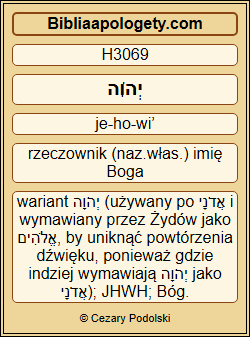 ?”, ani abym nie H6435 zubożał H3423 ?”, ani abym nie H6435 zubożał H3423 i ukradł H1589 i ukradł H1589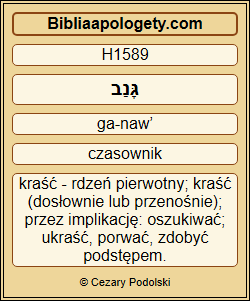 , i znieważył H8610 , i znieważył H8610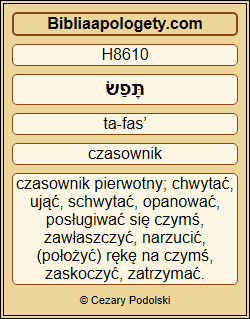 imię H8034 Boga mego H430 imię H8034 Boga mego H430 . (Prz30_9 tłum. AI) . (Prz30_9 tłum. AI) |
| L03 |
Prz30_9 |
bym syty nie stał się niewiernym, nie rzekł: A któż jest Pan? lub z biedy nie począł kraść i imię mego Boga znieważać. (Prz30_9 BT_4) |
| L04 |
Prz30_9 |
bym syty H7646 nie zaparł H3584 się Ciebie i nie rzekł H559: „Któż jest Pan H3068 ?”, albo z nędzy H3423 nie zaczął kraść H1589 i nie znieważył H8610 imienia H8034 Boga H430 mego. (Prz30_9 BT_4) ?”, albo z nędzy H3423 nie zaczął kraść H1589 i nie znieważył H8610 imienia H8034 Boga H430 mego. (Prz30_9 BT_4) |
| L05 |
Prz30_9 |
pen |
'es•<Ba>' |
we•chi•chasz•<Ti> |
we•'a•<Mar>•ti, |
mi |
<jah>•weQere (czytaj): A·do·(Naj) |
u•fen- |
'iw•wa•<Resz> |
we•ga•<Naw>•ti; |
we•ta•<Fas>•ti, |
szem |
'e•lo•<Hai>. |
<Pe> |
| L06 |
Prz30_9 |
פֶּ֥ן |
אֶשְׂבַּ֨ע ׀ |
וְכִחַשְׁתִּי֮ |
וְאָמַ֗רְתִּי |
מִ֥י |
יְה֫וָ֥ה |
וּפֶֽן־ |
אִוָּרֵ֥שׁ |
וְגָנַ֑בְתִּי |
וְ֝תָפַ֗שְׂתִּי |
שֵׁ֣ם |
אֱלֹהָֽי׃ |
פ |
| L07 |
Prz30_9 |
abym nie |
nasycił się |
i zaparł się [Ciebie], |
i powiedział: |
„Kim [jest] |
Jahwe?”, |
ani abym nie |
zubożał |
i ukradł, |
i znieważył |
imię |
Boga mego. |
¶ |
| L08 |
Prz30_9 |
פֶּ֥ן |
אֶשְׂבַּ֨ע ׀ |
וְ/כִחַשְׁתִּי֮ |
וְ/אָמַ֗רְתִּי |
מִ֥י |
יְה֫וָ֥ה |
וּ/פֶֽן־ |
אִוָּרֵ֥שׁ |
וְ/גָנַ֑בְתִּי |
וְ֝/תָפַ֗שְׂתִּי |
שֵׁ֣ם |
אֱלֹהָֽ/י׃ |
פ |
| L09 |
Prz30_9 |
HCSpój. |
HVqi1csCzas. qal, imperfektum, 1 os., r. wspólny, lp. |
HC/Vpq1csSpój. + Czas. piel, perf. konsekutywne, 1 os., r. wspólny, lp. |
HC/Vqq1csSpój. + Czas. qal, perf. konsekutywne, 1 os., r. wspólny, lp. |
HTiPartykuła pytajna |
HNpRzecz. własny |
HC/CSpój. + Spój. |
HVNi1csCzas. nifal, imperfektum, 1 os., r. wspólny, lp. |
HC/Vqq1csSpój. + Czas. qal, perf. konsekutywne, 1 os., r. wspólny, lp. |
HC/Vqq1csSpój. + Czas. qal, perf. konsekutywne, 1 os., r. wspólny, lp. |
HNcmscRzecz. posp., m., lp., stan konstrukcyjny |
HNcmpc/Sp1csRzecz. posp., m., lm., stan konstrukcyjny + Sufiks zaimkowy, 1 os., r. wspólny, lp. |
MARK-PZnacznik podziału: petucha (akapit otwarty) |
| L10 |
Prz30_9 |
Pen |
´eSBa` |
wükiHašTî |
wü´ämaºrTî |
mî |
yhwh(´ädönäy) |
ûpe|n- |
´iwwärëš |
wügänaºbTî |
wütäpaºSTî |
šëm |
´élöhäy |
P |
| L11 |
Prz30_9 |
H6435 |
H7646 |
H3584 |
H0559 |
H4310 |
H3069 |
H6435 |
H3423 |
H1589 |
H8610 |
H8034 |
H0430 |
|
| L12 |
Prz30_9 |
I |
Lest I be full |
and deny |
[thee] and say |
Who |
God |
lest |
cast out |
and steal |
and take |
the name |
of my God |
|
| L13 |
Prz30_9 |
pen |
'es·Ba' |
ve·chi·chash·Ti |
ve·'a·Mar·ti, |
mi |
Yah·weh |
u·fen- |
'iv·va·Resh |
ve·ga·Nav·ti; |
ve·ta·Fas·ti, |
shem |
'e·lo·Hai. |
Peh |
| L14 |
Prz30_9 |
פֵּן |
שָׂבַע |
כָּחַשׁ |
אָמַר |
מִי |
יְהֹוִה |
פֵּן |
יָרַשׁ |
גָּנַב |
תָּפַשׂ |
שֵׁם |
אֱלֹהִים |
|
| L15 |
Prz30_9 |
(Pen) |
sa·(Wa') |
ka·(Chasz) |
'a·(Mar) |
(Mi) |
(Jah)·we |
(Pen) |
ja·(Rasz) |
ga·(Naw) |
ta·(Fas) |
(Szem) |
E·lo·(Him) |
|
| L16 |
Prz30_9 |
pēn |
śāḇa‘ |
kāḥaš |
’āmar |
mî |
JHWH |
pēn |
jāraš |
gānaḇ |
tāp̱aś |
šēm |
’ᵉ̆lōhîm |
|
| L17 |
Prz30_9 |
pēn |
śāba‘ |
kāḥaš |
’āmar |
mî |
jhwh |
pēn |
jāraš |
gānab |
tāpaś |
šēm |
’ĕlōhîm |
|
| L18 |
Prz30_9 |
Lest I be full, and deny [thee], and say, Who [is] the LORD? or lest I be poor, and steal, and take the name of my God [in vain]. (Prz30_9 KJV) |
| L19 |
Prz30_9 |
9 Lest I be full <07646> (08799), and deny <03584> (08765) thee, and say, <0559> (08804), Who is the LORD <03068>? or lest I be poor <03423> (08735), and steal <01589> (08804), and take <08610> (08804) the name <08034> of my God <0430> in vain. (Prz30_9 KJV) |
| L20 |
Prz30_9 |
113/133 |
61/99 |
16/22 |
3856/5298 |
282/422 |
226/608 |
114/133 |
196/230 |
35/40 |
30/65 |
675/864 |
2152/2597 |
|
| L21 |
Prz30_9 |
Prz30_9_1 |
Prz30_9_2 |
Prz30_9_3 |
Prz30_9_4 |
Prz30_9_5 |
Prz30_9_6 |
Prz30_9_7 |
Prz30_9_8 |
Prz30_9_9 |
Prz30_9_10 |
Prz30_9_11 |
Prz30_9_12 |
Prz30_9_13 |
| |
| L01 |
Prz30_10 |
Nie oskarżaj sługi przed panami jego aby nie przeklął cię i [abyś] nie stał się winny. (Prz30_10 tłum. AI) |
| L02 |
Prz30_10 |
Nie H408 oskarżaj H3960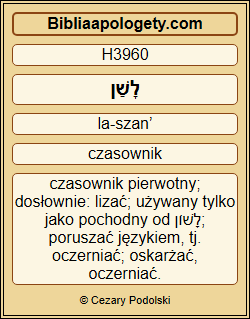 sługi H5650 sługi H5650 przed H413 przed H413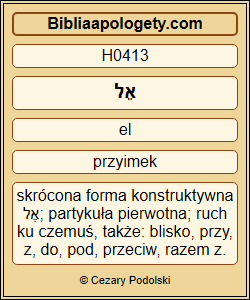 panami jego aby nie H6435 przeklął cię H7043 panami jego aby nie H6435 przeklął cię H7043 i [abyś] nie stał się winny H816 i [abyś] nie stał się winny H816 . (Prz30_10 tłum. AI) . (Prz30_10 tłum. AI) |
| L03 |
Prz30_10 |
Nie oczerniaj sługi przed panem, by cię nie przeklął, byś nie poniósł kary. (Prz30_10 BT_4) |
| L04 |
Prz30_10 |
Nie oskarżaj H3960 sługi H5650 przed jego panem H113 , by cię nie przeklął H7043 i nie poniósł H816 winy. (Prz30_10 BT_4) , by cię nie przeklął H7043 i nie poniósł H816 winy. (Prz30_10 BT_4) |
| L05 |
Prz30_10 |
'al- |
tal•<szen> |
'<E>•wed |
'el- |
['a•do•now |
ch] |
('a•do•<Naw>; |
k) |
pen- |
je•kal•lel•<Cha> |
we•'a•<sza>•me•ta. |
| L06 |
Prz30_10 |
אַל־ |
תַּלְשֵׁ֣ן |
עֶ֭בֶד |
אֶל־ |
[אֲדֹנֹו |
כ] |
(אֲדֹנָ֑יו |
ק) |
פֶּֽן־ |
יְקַלֶּלְךָ֥ |
וְאָשָֽׁמְתָּ׃ |
| L07 |
Prz30_10 |
Nie |
oskarżaj |
sługi |
przed |
[panem jego |
כ] |
(panami jego |
ק) |
aby nie |
przeklął cię |
i [abyś] nie stał się winny. |
| L08 |
Prz30_10 |
אַל־ |
תַּלְשֵׁ֣ן |
עֶ֭בֶד |
אֶל־ |
אדנ/ו |
|
אֲדֹנָ֑י/ו |
|
פֶּֽן־ |
יְקַלֶּלְ/ךָ֥ |
וְ/אָשָֽׁמְתָּ׃ |
| L09 |
Prz30_10 |
HTnPartykuła przecząca |
HVhj2msCzas. hifil, jussyw, 2 os., m., lp. |
HNcmsaRzecz. posp., m., lp., stan absolutny |
HRPrzyim. |
HNcmpc/Sp3msRzecz. posp., m., lm., stan konstrukcyjny + Sufiks zaimkowy, 3 os., m., lp. |
MARK-KZnacznik wariantu: ketiv (forma zapisana) |
HNcmpc/Sp3msRzecz. posp., m., lm., stan konstrukcyjny + Sufiks zaimkowy, 3 os., m., lp. |
MARK-QZnacznik wariantu: qere (forma czytana) |
HCSpój. |
HVpi3ms/Sp2msCzas. piel, imperfektum, 3 os., m., lp. + Sufiks zaimkowy, 2 os., m., lp. |
HC/Vqq2msSpój. + Czas. qal, perf. konsekutywne, 2 os., m., lp. |
| L10 |
Prz30_10 |
´al- |
Talšën |
`ebed |
´el- |
(´ádönô) |
|
[´ádönäyw] |
|
Pe|n- |
yüqallelkä |
wü´äšäºmTä |
| L11 |
Prz30_10 |
H0408 |
H3960 |
H5650 |
H0413 |
|
|
|
|
H6435 |
H7043 |
H0816 |
| L12 |
Prz30_10 |
not |
Accuse |
not a servant |
about |
|
|
your lord |
|
Or |
lest he curse |
thee and thou be found guilty |
| L13 |
Prz30_10 |
al- |
tal·Shen |
'E·ved |
el- |
['a·do·nov |
ch] |
('a·do·Nav; |
k) |
pen- |
ye·kal·lel·Cha |
ve·'a·Sha·me·ta. |
| L14 |
Prz30_10 |
אַל |
לָשַׁן |
עֶבֶד |
אֵל |
|
|
|
|
פֵּן |
קָלַל |
אָשַׁם |
| L15 |
Prz30_10 |
('Al) |
la·(Szan) |
'(E)·wed |
('El) |
|
|
|
|
(Pen) |
ka·(Lal) |
'a·(Szam) |
| L16 |
Prz30_10 |
’al |
lāšan |
‘éḇeḏ |
’ēl |
|
|
|
|
pēn |
qālal |
’āšam |
| L17 |
Prz30_10 |
’al |
lāšan |
‘ebed |
’ēl |
|
|
|
|
pēn |
qālal |
’āšam |
| L18 |
Prz30_10 |
Accuse not a servant unto his master, lest he curse thee, and thou be found guilty. (Prz30_10 KJV) |
| L19 |
Prz30_10 |
10 Accuse <03960> (08686) not a servant <05650> unto his master <0113>, lest he curse <07043> (08762) thee,, and thou be found guilty <0816> (08804). (Prz30_10 KJV) |
| L20 |
Prz30_10 |
501/725 |
1/1 |
696/797 |
4008/5500 |
|
|
1/1 |
|
115/133 |
59/82 |
20/35 |
| L21 |
Prz30_10 |
Prz30_10_1 |
Prz30_10_2 |
Prz30_10_3 |
Prz30_10_4 |
Prz30_10_5 |
Prz30_10_6 |
Prz30_10_7 |
Prz30_10_8 |
Prz30_10_9 |
Prz30_10_10 |
Prz30_10_11 |
| |
| L01 |
Prz30_11 |
Pokolenie ojcu swemu złorzeczy i — matki swojej nie błogosławi. (Prz30_11 tłum. AI) |
| L02 |
Prz30_11 |
Pokolenie H1755 ojcu swemu H1 ojcu swemu H1 złorzeczy H7043 i H853 — matki swojej H517 złorzeczy H7043 i H853 — matki swojej H517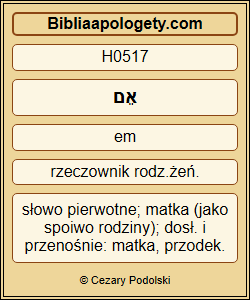 nie H3808 błogosławi H1288 nie H3808 błogosławi H1288 . (Prz30_11 tłum. AI) . (Prz30_11 tłum. AI) |
| L03 |
Prz30_11 |
Jest plemię, co ojcu złorzeczy i matce nie chce błogosławić. (Prz30_11 BT_4) |
| L04 |
Prz30_11 |
Jest pokolenie H1755, które złorzeczy H7043 ojcu H1 swemu i nie błogosławi H1288 matce H517. (Prz30_11 BT_4) |
| L05 |
Prz30_11 |
<Dor> |
'a•<wiw> |
je•kal•<Lel>; |
we•'<Et> |
im•<Mo>, |
lo |
je•wa•<Rech>. |
| L06 |
Prz30_11 |
דּ֭וֹר |
אָבִ֣יו |
יְקַלֵּ֑ל |
וְאֶת־ |
אִ֝מּ֗וֹ |
לֹ֣א |
יְבָרֵֽךְ׃ |
| L07 |
Prz30_11 |
Pokolenie |
ojcu swemu |
złorzeczy |
i — |
matki swojej |
nie |
błogosławi. |
| L08 |
Prz30_11 |
דּ֭וֹר |
אָבִ֣י/ו |
יְקַלֵּ֑ל |
וְ/אֶת־ |
אִ֝מּ֗/וֹ |
לֹ֣א |
יְבָרֵֽךְ׃ |
| L09 |
Prz30_11 |
HNcmsaRzecz. posp., m., lp., stan absolutny |
HNcmsc/Sp3msRzecz. posp., m., lp., stan konstrukcyjny + Sufiks zaimkowy, 3 os., m., lp. |
HVpi3msCzas. piel, imperfektum, 3 os., m., lp. |
HC/ToSpój. + Partykuła znacznik dopełnienia bliższego |
HNcfsc/Sp3msRzecz. posp., ż., lp., stan konstrukcyjny + Sufiks zaimkowy, 3 os., m., lp. |
HTnPartykuła przecząca |
HVpi3msCzas. piel, imperfektum, 3 os., m., lp. |
| L10 |
Prz30_11 |
Dôr |
´äbîw |
yüqallël |
wü´et- |
´immô |
lö´ |
yübärëk |
| L11 |
Prz30_11 |
H1755 |
H0001 |
H7043 |
H0853 |
H0517 |
H3808 |
H1288 |
| L12 |
Prz30_11 |
[There is] a generation |
their father |
[that] curseth |
|
their mother |
and does not |
and doth not bless |
| L13 |
Prz30_11 |
Dor |
'a·Viv |
ye·kal·Lel; |
ve·'Et |
im·Mo, |
lo |
ye·va·Rech. |
| L14 |
Prz30_11 |
דּוֹר |
אָב |
קָלַל |
אֵת |
אֵם |
לֹא |
בָּרַךְ |
| L15 |
Prz30_11 |
(Dor) |
'(Aw) |
ka·(Lal) |
('Et) |
('Em) |
(Lo) |
ba·(Rach) |
| L16 |
Prz30_11 |
dôr |
’āḇ |
qālal |
’ēṯ |
’ēm |
lō(’) |
bāraḵ |
| L17 |
Prz30_11 |
dôr |
’āb |
qālal |
’ēt |
’ēm |
lō’ |
bārak |
| L18 |
Prz30_11 |
[There is] a generation [that] curseth their father, and doth not bless their mother. (Prz30_11 KJV) |
| L19 |
Prz30_11 |
11 There is a generation <01755> that curseth <07043> (08762) their father <01>, and doth not bless <01288> (08762) their mother <0517>. (Prz30_11 KJV) |
| L20 |
Prz30_11 |
132/166 |
1071/1212 |
60/82 |
8842/11047 |
176/220 |
3365/5164 |
315/330 |
| L21 |
Prz30_11 |
Prz30_11_1 |
Prz30_11_2 |
Prz30_11_3 |
Prz30_11_4 |
Prz30_11_5 |
Prz30_11_6 |
Prz30_11_7 |
| |
| L01 |
Prz30_12 |
Pokolenie czyste [jest] w oczach swoich, lecz z brudu swego nie zostało obmyte. (Prz30_12 tłum. AI) |
| L02 |
Prz30_12 |
Pokolenie H1755 czyste [jest H2889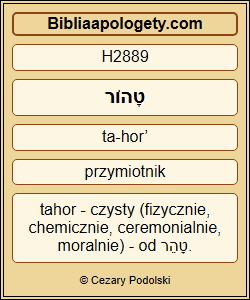 ] w oczach swoich H5869 ] w oczach swoich H5869 , lecz z brudu swego H6675 , lecz z brudu swego H6675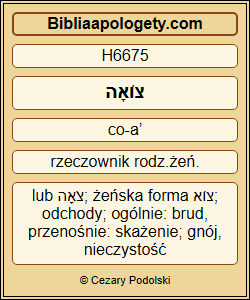 nie H3808 zostało obmyte H7364 nie H3808 zostało obmyte H7364 . (Prz30_12 tłum. AI) . (Prz30_12 tłum. AI) |
| L03 |
Prz30_12 |
Jest plemię w swych oczach niewinne, a nie jest obmyte z brudów. (Prz30_12 BT_4) |
| L04 |
Prz30_12 |
Pokolenie H1755, które w swoich oczach H5869 jest czyste H2889, a z plugastwa H6675 nie zostało obmyte H7364. (Prz30_12 BT_4) |
| L05 |
Prz30_12 |
<Dor> |
ta•<Hor> |
be•'e•<Naw>; |
u•mic•co•'a•<To>, |
lo |
ru•<Chac>. |
| L06 |
Prz30_12 |
דּ֭וֹר |
טָה֣וֹר |
בְּעֵינָ֑יו |
וּ֝מִצֹּאָת֗וֹ |
לֹ֣א |
רֻחָֽץ׃ |
| L07 |
Prz30_12 |
Pokolenie |
czyste [jest] |
w oczach swoich, |
lecz z brudu swego |
nie |
zostało obmyte. |
| L08 |
Prz30_12 |
דּ֭וֹר |
טָה֣וֹר |
בְּ/עֵינָ֑י/ו |
וּ֝/מִ/צֹּאָת֗/וֹ |
לֹ֣א |
רֻחָֽץ׃ |
| L09 |
Prz30_12 |
HNcmsaRzecz. posp., m., lp., stan absolutny |
HAamsaPrzym. zwykły, m., lp., stan absolutny |
HR/Ncbdc/Sp3msPrzyim. + Rzecz. posp., r. wspólny, podw., stan konstrukcyjny + Sufiks zaimkowy, 3 os., m., lp. |
HC/R/Ncfsc/Sp3msSpój. + Przyim. + Rzecz. posp., ż., lp., stan konstrukcyjny + Sufiks zaimkowy, 3 os., m., lp. |
HTnPartykuła przecząca |
HVPp3msCzas. pual, perfectum, 3 os., m., lp. |
| L10 |
Prz30_12 |
Dôr |
†ähôr |
Bü`ênäyw |
ûmiccö´ätô |
lö´ |
ruHäc |
| L11 |
Prz30_12 |
H1755 |
H2889 |
H5869 |
H6675 |
H3808 |
H7364 |
| L12 |
Prz30_12 |
[There is] a generation |
[that are] pure |
in their own eyes |
from their filthiness |
not |
and [yet] is not washed |
| L13 |
Prz30_12 |
Dor |
ta·Hor |
be·'ei·Nav; |
u·mitz·tzo·'a·To, |
lo |
ru·Chatz. |
| L14 |
Prz30_12 |
דּוֹר |
טָהוֹר |
עַיִן |
צוֹאָה |
לֹא |
רָחַץ |
| L15 |
Prz30_12 |
(Dor) |
ta·(Hor) |
'(A)·jin |
co·('A) |
(Lo) |
ra·(Chac) |
| L16 |
Prz30_12 |
dôr |
ṭāhôr |
‘ájin |
ṣô’ā(h) |
lō(’) |
rāḥaṣ |
| L17 |
Prz30_12 |
dôr |
ṭāhôr |
‘ajin |
ṣô’āh |
lō’ |
rāḥaṣ |
| L18 |
Prz30_12 |
[There is] a generation [that are] pure in their own eyes, and [yet] is not washed from their filthiness. (Prz30_12 KJV) |
| L19 |
Prz30_12 |
12 There is a generation <01755> that are pure <02889> in their own eyes <05869>, and yet is not washed <07364> (08795) from their filthiness <06675>. (Prz30_12 KJV) |
| L20 |
Prz30_12 |
133/166 |
84/92 |
644/878 |
1/3 |
3366/5164 |
65/72 |
| L21 |
Prz30_12 |
Prz30_12_1 |
Prz30_12_2 |
Prz30_12_3 |
Prz30_12_4 |
Prz30_12_5 |
Prz30_12_6 |
| |
| L01 |
Prz30_13 |
Pokolenie — jakże wyniosłe [są] oczy jego, a powieki jego podniesione! (Prz30_13 tłum. AI) |
| L02 |
Prz30_13 |
Pokolenie H1755 — jakże H4100 wyniosłe [są H7311 ] oczy jego H5869, a powieki jego H6079 ] oczy jego H5869, a powieki jego H6079 podniesione H5375 podniesione H5375 ! (Prz30_13 tłum. AI) ! (Prz30_13 tłum. AI) |
| L03 |
Prz30_13 |
Jest plemię o wzroku wyniosłym, powieki ma w górę wzniesione. (Prz30_13 BT_4) |
| L04 |
Prz30_13 |
Pokolenie H1755 – o jak wyniosłe H7311 ma oczy H5869, powieki H6079 podniesione! (Prz30_13 BT_4) |
| L05 |
Prz30_13 |
<Dor> |
mah- |
ra•<Mu> |
'e•<Naw>; |
we•'af•'ap•<Paw>, |
jin•na•<Se>•'u. |
| L06 |
Prz30_13 |
דּ֭וֹר |
מָה־ |
רָמ֣וּ |
עֵינָ֑יו |
וְ֝עַפְעַפָּ֗יו |
יִנָּשֵֽׂאוּ׃ |
| L07 |
Prz30_13 |
Pokolenie — |
jakże |
wyniosłe [są] |
oczy jego, |
a powieki jego |
podniesione! |
| L08 |
Prz30_13 |
דּ֭וֹר |
מָה־ |
רָמ֣וּ |
עֵינָ֑י/ו |
וְ֝/עַפְעַפָּ֗י/ו |
יִנָּשֵֽׂאוּ׃ |
| L09 |
Prz30_13 |
HNcmsaRzecz. posp., m., lp., stan absolutny |
HTiPartykuła pytajna |
HVqp3cpCzas. qal, perfectum, 3 os., r. wspólny, lm. |
HNcbdc/Sp3msRzecz. posp., r. wspólny, podw., stan konstrukcyjny + Sufiks zaimkowy, 3 os., m., lp. |
HC/Ncmdc/Sp3msSpój. + Rzecz. posp., m., podw., stan konstrukcyjny + Sufiks zaimkowy, 3 os., m., lp. |
HVNi3mpCzas. nifal, imperfektum, 3 os., m., lm. |
| L10 |
Prz30_13 |
Dôr |
mâ- |
rämû |
`ênäyw |
wü`ap`aPPäyw |
yinnäS뺴û |
| L11 |
Prz30_13 |
H1755 |
H4100 |
H7311 |
H5869 |
H6079 |
H5375 |
| L12 |
Prz30_13 |
[There is] a generation |
how long |
O how lofty |
are their eyes |
and their eyelids |
are lifted up |
| L13 |
Prz30_13 |
Dor |
mah- |
ra·Mu |
'ei·Nav; |
ve·'af·'ap·Pav, |
yin·na·Se·'u. |
| L14 |
Prz30_13 |
דּוֹר |
מָה |
רוּם |
עַיִן |
עַפְעַף |
נָשָׂא |
| L15 |
Prz30_13 |
(Dor) |
(Ma) |
(Rum) |
'(A)·jin |
'af·('Af) |
na·(Sa) |
| L16 |
Prz30_13 |
dôr |
mā(h) |
rûm |
‘ájin |
‘ap̱‘ap̱ |
nāśā(’) |
| L17 |
Prz30_13 |
dôr |
māh |
rûm |
‘ajin |
‘ap‘ap |
nāśā’ |
| L18 |
Prz30_13 |
[There is] a generation, O how lofty are their eyes! and their eyelids are lifted up. (Prz30_13 KJV) |
| L19 |
Prz30_13 |
13 There is a generation <01755>, O how lofty <07311> (08804) are their eyes <05869>! and their eyelids <06079> are lifted up <05375> (08735). (Prz30_13 KJV) |
| L20 |
Prz30_13 |
134/166 |
534/744 |
137/185 |
645/878 |
9/10 |
435/650 |
| L21 |
Prz30_13 |
Prz30_13_1 |
Prz30_13_2 |
Prz30_13_3 |
Prz30_13_4 |
Prz30_13_5 |
Prz30_13_6 |
| |
| L01 |
Prz30_14 |
Pokolenie, miecze [to] zęby jego, a noże [to] trzonowce jego, aby pożerać ubogich z ziemi i nędzarzy spośród ludzi. (Prz30_14 tłum. AI) |
| L02 |
Prz30_14 |
Pokolenie H1755, miecze [to H2719 ] zęby jego H8127 ] zęby jego H8127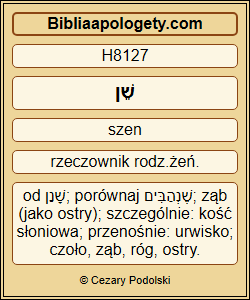 , a noże [to H3979 , a noże [to H3979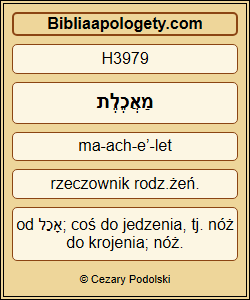 ] trzonowce jego H4973 ] trzonowce jego H4973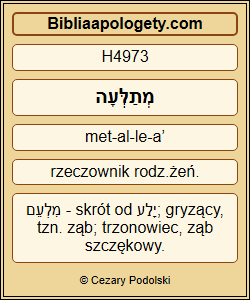 , aby pożerać H398 , aby pożerać H398 ubogich H6041 ubogich H6041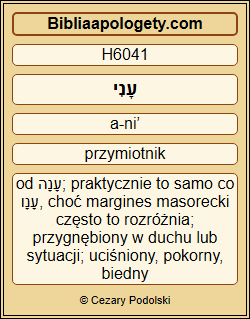 z ziemi H776 i nędzarzy H34 z ziemi H776 i nędzarzy H34 spośród ludzi H120. (Prz30_14 tłum. AI) spośród ludzi H120. (Prz30_14 tłum. AI) |
| L03 |
Prz30_14 |
Jest plemię o zębach jak miecze, o zębach trzonowych jak noże, by wygryźć uciemiężonych z kraju, a spośród ludzi nędzarzy. (Prz30_14 BT_4) |
| L04 |
Prz30_14 |
Pokolenie H1755, którego zęby H8127 są jak miecze H2719, a trzonowce H4973 jak noże H3979, by pożerać H398 ubogich H6041 z ziemi H776 i nędzarzy H34 spośród ludzi H120. (Prz30_14 BT_4) |
| L05 |
Prz30_14 |
<Dor> |
cha•ra•<wot> |
szin•<Naw> |
u•ma•'a•cha•<Lot> |
me•tal•le•'<O>•<Taw> |
le•'e•<Chol> |
'a•ni•<jim> |
me•'<E>•rec; |
we•'ew•jo•<Nim>, |
me•'a•<Dam>. |
<Pe> |
| L06 |
Prz30_14 |
דּ֤וֹר ׀ |
חֲרָב֣וֹת |
שִׁנָּיו֮ |
וּֽמַאֲכָל֪וֹת |
מְֽתַלְּעֹ֫תָ֥יו |
לֶאֱכֹ֣ל |
עֲנִיִּ֣ים |
מֵאֶ֑רֶץ |
וְ֝אֶבְיוֹנִ֗ים |
מֵאָדָֽם׃ |
פ |
| L07 |
Prz30_14 |
Pokolenie, |
miecze [to] |
zęby jego, |
a noże [to] |
trzonowce jego, |
aby pożerać |
ubogich |
z ziemi |
i nędzarzy |
spośród ludzi. |
¶ |
| L08 |
Prz30_14 |
דּ֤וֹר ׀ |
חֲרָב֣וֹת |
שִׁנָּי/ו֮ |
וּֽ/מַאֲכָל֪וֹת |
מְֽתַלְּעֹ֫תָ֥י/ו |
לֶ/אֱכֹ֣ל |
עֲנִיִּ֣ים |
מֵ/אֶ֑רֶץ |
וְ֝/אֶבְיוֹנִ֗ים |
מֵ/אָדָֽם׃ |
פ |
| L09 |
Prz30_14 |
HNcmsaRzecz. posp., m., lp., stan absolutny |
HNcfpaRzecz. posp., ż., lm., stan absolutny |
HNcbdc/Sp3msRzecz. posp., r. wspólny, podw., stan konstrukcyjny + Sufiks zaimkowy, 3 os., m., lp. |
HC/NcfpaSpój. + Rzecz. posp., ż., lm., stan absolutny |
HNcfpc/Sp3msRzecz. posp., ż., lm., stan konstrukcyjny + Sufiks zaimkowy, 3 os., m., lp. |
HR/VqcPrzyim. + Czas. qal, bezok. konstrukcyjny |
HAampaPrzym. zwykły, m., lm., stan absolutny |
HR/NcbsaPrzyim. + Rzecz. posp., r. wspólny, lp., stan absolutny |
HC/AampaSpój. + Przym. zwykły, m., lm., stan absolutny |
HR/NcmsaPrzyim. + Rzecz. posp., m., lp., stan absolutny |
MARK-PZnacznik podziału: petucha (akapit otwarty) |
| L10 |
Prz30_14 |
Dôr |
Háräbôt |
šinnäyw |
û|ma´ákälôt |
mü|tallü`ötäyw |
le´éköl |
`ániyyîm |
më´eºrec |
wü´ebyônîm |
më´ädäm |
P |
| L11 |
Prz30_14 |
H1755 |
H2719 |
H8127 |
H3979 |
H4973 |
H0398 |
H6041 |
H0776 |
H0034 |
H0120 |
|
| L12 |
Prz30_14 |
[There is] a generation |
[are as] swords |
whose teeth |
[as] knives |
and their jaw teeth |
to devour |
the poor |
from off the earth |
and the needy |
from [among] men |
|
| L13 |
Prz30_14 |
Dor |
cha·ra·Vot |
shin·Nav |
u·ma·'a·cha·Lot |
me·tal·le·'O·Tav |
le·'e·Chol |
'a·ni·Yim |
me·'E·retz; |
ve·'ev·yo·Nim, |
me·'a·Dam. |
Peh |
| L14 |
Prz30_14 |
דּוֹר |
חֶרֶב |
שֵׁן |
מַאֲכֶלֶת |
מְתַלְּעָה |
אָכַל |
עָנִי |
אֶרֶץ |
אֶבְיוֹן |
אָדָם |
|
| L15 |
Prz30_14 |
(Dor) |
(Che)·rew |
(Szen) |
ma·'a·(Che)·let |
me·tal·le·('A) |
a·(Chal) |
'a·(Ni) |
'(E)·rec |
ew·(Jon) |
'a·(Dam) |
|
| L16 |
Prz30_14 |
dôr |
ḥéreḇ |
šēn |
ma’ᵃ̆ḵéleṯ |
mᵉṯallᵉ‘ā(h) |
’āḵal |
‘ānî |
’éreṣ |
’eḇjôn |
’āḏām |
|
| L17 |
Prz30_14 |
dôr |
ḥereb |
šēn |
ma’ăkelet |
metalle‘āh |
’ākal |
‘ānî |
’ereṣ |
’ebjôn |
’ādām |
|
| L18 |
Prz30_14 |
[There is] a generation, whose teeth [are as] swords, and their jaw teeth [as] knives, to devour the poor from off the earth, and the needy from [among] men. (Prz30_14 KJV) |
| L19 |
Prz30_14 |
14 There is a generation <01755>, whose teeth <08127> are as swords <02719>, and their jaw teeth <04973> as knives <03979>, to devour <0398> (08800) the poor <06041> from off the earth <0776>, and the needy <034> from among men <0120>. (Prz30_14 KJV) |
| L20 |
Prz30_14 |
135/166 |
195/412 |
37/55 |
4/4 |
2/3 |
562/806 |
45/72 |
1652/2502 |
42/61 |
280/552 |
|
| L21 |
Prz30_14 |
Prz30_14_1 |
Prz30_14_2 |
Prz30_14_3 |
Prz30_14_4 |
Prz30_14_5 |
Prz30_14_6 |
Prz30_14_7 |
Prz30_14_8 |
Prz30_14_9 |
Prz30_14_10 |
Prz30_14_11 |
| |
| L01 |
Prz30_15 |
Pijawka [ma] dwie córki: „Daj! Daj!” Trzy [są] one, nie nasycą się; cztery nie powiedziały: „Dość!” (Prz30_15 tłum. AI) |
| L02 |
Prz30_15 |
Pijawka [ma H5936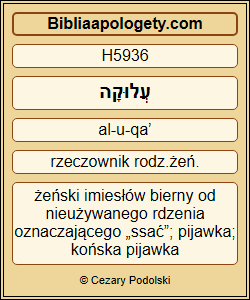 ] dwie H8147 córki H1323 ] dwie H8147 córki H1323 : „Daj H3051 : „Daj H3051 ! Daj H3051!” Trzy [są H7969 ! Daj H3051!” Trzy [są H7969 ] one H2007 ] one H2007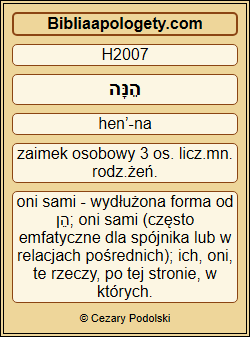 , nie H3808 nasycą się H7646; cztery H702 , nie H3808 nasycą się H7646; cztery H702 nie H3808 powiedziały H559: „Dość H1952 nie H3808 powiedziały H559: „Dość H1952 !” (Prz30_15 tłum. AI) !” (Prz30_15 tłum. AI) |
| L03 |
Prz30_15 |
Pijawka ma dwie córki: Przynieś! Przynieś! Trzy rzeczy są nigdy nie syte, cztery nie mówią: Dość: (Prz30_15 BT_4) |
| L04 |
Prz30_15 |
Pijawka H5936 ma dwie H8147 córki H1323: „Daj! Daj! H3051”. Trzy rzeczy H7969 są nienasycone H7646, cztery H702 nigdy nie mówią H559: „Dość H1952”. (Prz30_15 BT_4) |
| L05 |
Prz30_15 |
la•'a•lu•<Ka> |
sze•<Te> |
wa•nOt |
haw |
haw |
sza•<Losz> |
<Hen>•na |
lo |
tis•<Ba>'•na; |
'ar•<Ba>', |
lo- |
'<A>•me•ru |
<Hon>. |
| L06 |
Prz30_15 |
לַֽעֲלוּקָ֨ה ׀ |
שְׁתֵּ֥י |
בָנוֹת֮ |
הַ֤ב ׀ |
הַ֥ב |
שָׁל֣וֹשׁ |
הֵ֭נָּה |
לֹ֣א |
תִשְׂבַּ֑עְנָה |
אַ֝רְבַּ֗ע |
לֹא־ |
אָ֥מְרוּ |
הֽוֹן׃ |
| L07 |
Prz30_15 |
Pijawka [ma] |
dwie |
córki: |
„Daj! |
Daj!” |
Trzy [są] |
one, |
nie |
nasycą się; |
cztery |
nie |
powiedziały: |
„Dość!” |
| L08 |
Prz30_15 |
לַֽ/עֲלוּקָ֨ה ׀ |
שְׁתֵּ֥י |
בָנוֹת֮ |
הַ֤ב ׀ |
הַ֥ב |
שָׁל֣וֹשׁ |
הֵ֭נָּה |
לֹ֣א |
תִשְׂבַּ֑עְנָה |
אַ֝רְבַּ֗ע |
לֹא־ |
אָ֥מְרוּ |
הֽוֹן׃ |
| L09 |
Prz30_15 |
HR/NcfsaPrzyim. + Rzecz. posp., ż., lp., stan absolutny |
HAcfdcPrzym. liczebnik główny, ż., podw., stan konstrukcyjny |
HNcfpaRzecz. posp., ż., lm., stan absolutny |
HVqv2msCzas. qal, imperatyw, 2 os., m., lp. |
HVqv2msCzas. qal, imperatyw, 2 os., m., lp. |
HAcfsaPrzym. liczebnik główny, ż., lp., stan absolutny |
HPp3fpZaimek osobowy, 3 os., ż., lm. |
HTnPartykuła przecząca |
HVqi3fpCzas. qal, imperfektum, 3 os., ż., lm. |
HAcfsaPrzym. liczebnik główny, ż., lp., stan absolutny |
HTnPartykuła przecząca |
HVqp3cpCzas. qal, perfectum, 3 os., r. wspólny, lm. |
HNcmsaRzecz. posp., m., lp., stan absolutny |
| L10 |
Prz30_15 |
la|`álûqâ |
šTê |
bänôt |
hab |
hab |
šälôš |
hënnâ |
lö´ |
tiSBaº`nâ |
´arBa` |
lö´- |
´äºmrû |
hôn |
| L11 |
Prz30_15 |
H5936 |
H8147 |
H1323 |
H3051 |
H3051 |
H7969 |
H2007 |
H3808 |
H7646 |
H0702 |
H3808 |
H0559 |
H1952 |
| L12 |
Prz30_15 |
The horseleach |
hath two |
daughters |
[crying] Give |
give |
There are three |
in |
not |
[things that] are never satisfied |
[yea] four |
not |
[things] say |
not [It is] enough |
| L13 |
Prz30_15 |
la·'a·lu·Kah |
she·Tei |
va·nOt |
hav |
hav |
sha·Loosh |
Hen·nah |
lo |
tis·Ba'·nah; |
'ar·Ba', |
lo- |
'A·me·ru |
Hon. |
| L14 |
Prz30_15 |
עֲלוּקָה |
שְׁנַיִם |
בַּת |
יָהַב |
יָהַב |
שָׁלוֹשׁ |
הֵנָּה |
לֹא |
שָׂבַע |
אַרְבַּע |
לֹא |
אָמַר |
הוֹן |
| L15 |
Prz30_15 |
'a·lu·(Ka) |
sze·(Na)·jim |
(Bat) |
ja·(Haw) |
ja·(Haw) |
sza·(Losz) |
(Hen)·na |
(Lo) |
sa·(Wa') |
'ar·(Ba)' |
(Lo) |
'a·(Mar) |
(Hon) |
| L16 |
Prz30_15 |
‘ᵃ̆lûqā(h) |
šᵉnájim |
baṯ |
jāhaḇ |
jāhaḇ |
šālôš |
hḗnnā(h) |
lō(’) |
śāḇa‘ |
’arba‘ |
lō(’) |
’āmar |
hôn |
| L17 |
Prz30_15 |
‘ălûqāh |
šenajim |
bat |
jāhab |
jāhab |
šālôš |
hēnnāh |
lō’ |
śāba‘ |
’arba‘ |
lō’ |
’āmar |
hôn |
| L18 |
Prz30_15 |
The horseleach hath two daughters, [crying], Give, give. There are three [things that] are never satisfied, [yea], four [things] say not, [It is] enough: (Prz30_15 KJV) |
| L19 |
Prz30_15 |
15 The horseleach <05936> hath two <08147> daughters <01323>, crying, Give <03051> (08798), give <03051> (08798). There are three <07969> things that are never satisfied <07646> (08799), yea, four <0702> things say <0559> (08804) not, It is enough <01952>: (Prz30_15 KJV) |
| L20 |
Prz30_15 |
1/1 |
675/768 |
424/588 |
31/33 |
32/33 |
371/429 |
27/48 |
3367/5164 |
62/99 |
226/316 |
3368/5164 |
3857/5298 |
20/26 |
| L21 |
Prz30_15 |
Prz30_15_1 |
Prz30_15_2 |
Prz30_15_3 |
Prz30_15_4 |
Prz30_15_5 |
Prz30_15_6 |
Prz30_15_7 |
Prz30_15_8 |
Prz30_15_9 |
Prz30_15_10 |
Prz30_15_11 |
Prz30_15_12 |
Prz30_15_13 |
| |
| L01 |
Prz30_16 |
Szeol i zamknięte łono, ziemia nie nasycona wodą i ogień, który nie powiedział: „Dość!” (Prz30_16 tłum. AI) |
| L02 |
Prz30_16 |
Szeol H7585 i zamknięte H6115 i zamknięte H6115 łono H7356 łono H7356 , ziemia H776 nie H3808 nasycona H7646 wodą H4325 i ogień H784 , ziemia H776 nie H3808 nasycona H7646 wodą H4325 i ogień H784 , który nie H3808 powiedział H559: „Dość H1952!” (Prz30_16 tłum. AI) , który nie H3808 powiedział H559: „Dość H1952!” (Prz30_16 tłum. AI) |
| L03 |
Prz30_16 |
Szeol, niepłodne łono, ziemia wody niesyta, ogień, co nie mówi: Dość. (Prz30_16 BT_4) |
| L04 |
Prz30_16 |
Szeol H7585, łono H7358 niepłodne H6115, ziemia H776 nienasycona H7646 wodą H4325, ogień H784, który nie mówi H559: „Dość H1952”. (Prz30_16 BT_4) niepłodne H6115, ziemia H776 nienasycona H7646 wodą H4325, ogień H784, który nie mówi H559: „Dość H1952”. (Prz30_16 BT_4) |
| L05 |
Prz30_16 |
sze•'<Ol> |
we•'<O>•<cer> |
<Ra>•cham |
'<E>•rec |
lo- |
<Sa>•we•'a |
<Ma>•jim; |
we•'<Esz>, |
lo- |
'<A>•me•ra |
<Hon>. |
| L06 |
Prz30_16 |
שְׁאוֹל֮ |
וְעֹ֪צֶ֫ר |
רָ֥חַם |
אֶ֭רֶץ |
לֹא־ |
שָׂ֣בְעָה |
מַּ֑יִם |
וְ֝אֵ֗שׁ |
לֹא־ |
אָ֥מְרָה |
הֽוֹן׃ |
| L07 |
Prz30_16 |
Szeol |
i zamknięte |
łono, |
ziemia |
nie |
nasycona |
wodą |
i ogień, |
który nie |
powiedział: |
„Dość!” |
| L08 |
Prz30_16 |
שְׁאוֹל֮ |
וְ/עֹ֪צֶ֫ר |
רָ֥חַם |
אֶ֭רֶץ |
לֹא־ |
שָׂ֣בְעָה |
מַּ֑יִם |
וְ֝/אֵ֗שׁ |
לֹא־ |
אָ֥מְרָה |
הֽוֹן׃ |
| L09 |
Prz30_16 |
HNpRzecz. własny |
HC/NcmscSpój. + Rzecz. posp., m., lp., stan konstrukcyjny |
HNcbsaRzecz. posp., r. wspólny, lp., stan absolutny |
HNcbsaRzecz. posp., r. wspólny, lp., stan absolutny |
HTnPartykuła przecząca |
HVqp3fsCzas. qal, perfectum, 3 os., ż., lp. |
HNcmpaRzecz. posp., m., lm., stan absolutny |
HC/NcbsaSpój. + Rzecz. posp., r. wspólny, lp., stan absolutny |
HTnPartykuła przecząca |
HVqp3fsCzas. qal, perfectum, 3 os., ż., lp. |
HNcmsaRzecz. posp., m., lp., stan absolutny |
| L10 |
Prz30_16 |
šü´ôl |
wü`öºcer |
räºHam |
´erec |
lö´- |
Säºb`â |
mmaºyim |
wü´ëš |
lö´- |
´äºmrâ |
hôn |
| L11 |
Prz30_16 |
H7585 |
H6115 |
H7356 |
H0776 |
H3808 |
H7646 |
H4325 |
H0784 |
H3808 |
H0559 |
H1952 |
| L12 |
Prz30_16 |
The grave |
and the barren |
womb |
the earth |
is never |
[that] is not filled |
with water |
and the fire |
never |
[that] saith |
not [It is] enough |
| L13 |
Prz30_16 |
she·'Ol |
ve·'O·Tzer |
Ra·cham |
'E·retz |
lo- |
Sa·ve·'ah |
Ma·yim; |
ve·'Esh, |
lo- |
'A·me·rah |
Hon. |
| L14 |
Prz30_16 |
שְׁאוֹל |
עֹצֶר |
רַחַם |
אֶרֶץ |
לֹא |
שָׂבַע |
מַיִם |
אֵשׁ |
לֹא |
אָמַר |
הוֹן |
| L15 |
Prz30_16 |
sze·('Ol) |
('O)·cer |
(Ra)·cham |
'(E)·rec |
(Lo) |
sa·(Wa') |
(Ma)·jim |
('Esz) |
(Lo) |
'a·(Mar) |
(Hon) |
| L16 |
Prz30_16 |
šᵉ(’)ôl |
‘ṓṣer |
ráḥam |
’éreṣ |
lō(’) |
śāḇa‘ |
májim |
’ēš |
lō(’) |
’āmar |
hôn |
| L17 |
Prz30_16 |
še’ôl |
‘ōṣer |
raḥam |
’ereṣ |
lō’ |
śāba‘ |
majim |
’ēš |
lō’ |
’āmar |
hôn |
| L18 |
Prz30_16 |
The grave; and the barren womb; the earth [that] is not filled with water; and the fire [that] saith not, [It is] enough. (Prz30_16 KJV) |
| L19 |
Prz30_16 |
16 The grave <07585>; and the barren <06115> womb <07356>; the earth <0776> that is not filled <07646> (08804) with water <04325>; and the fire <0784> that saith <0559> (08804) not, It is enough <01952>. (Prz30_16 KJV) |
| L20 |
Prz30_16 |
44/66 |
2/3 |
27/43 |
1653/2502 |
3369/5164 |
63/99 |
413/579 |
218/377 |
3370/5164 |
3858/5298 |
21/26 |
| L21 |
Prz30_16 |
Prz30_16_1 |
Prz30_16_2 |
Prz30_16_3 |
Prz30_16_4 |
Prz30_16_5 |
Prz30_16_6 |
Prz30_16_7 |
Prz30_16_8 |
Prz30_16_9 |
Prz30_16_10 |
Prz30_16_11 |
| |
| L01 |
Prz30_17 |
Oko, które szydzi z ojca i gardzi posłuszeństwem matce, wydziobią je kruki potoku, i pożrą je synowie orła. (Prz30_17 tłum. AI) |
| L02 |
Prz30_17 |
Oko H5869, które szydzi H3932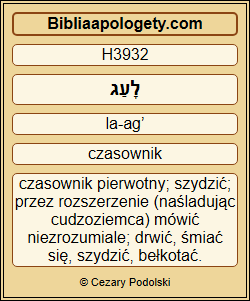 z ojca H1 i gardzi H936 z ojca H1 i gardzi H936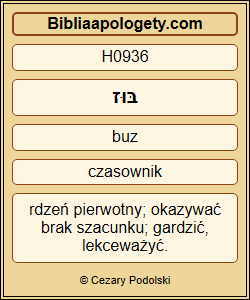 posłuszeństwem H3349 posłuszeństwem H3349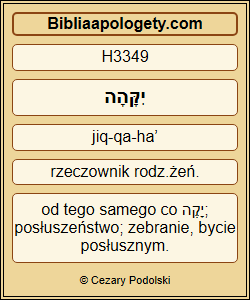 matce H517, wydziobią je H5365 matce H517, wydziobią je H5365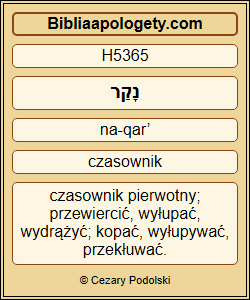 kruki H6158 kruki H6158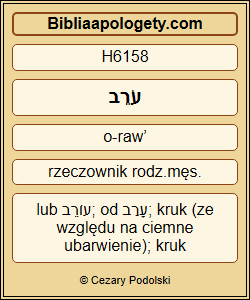 potoku H5158 potoku H5158 , i pożrą je H398 synowie H1121 orła H5404 , i pożrą je H398 synowie H1121 orła H5404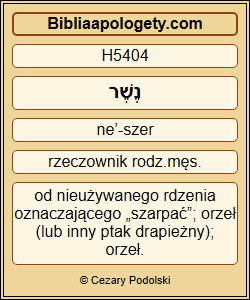 . (Prz30_17 tłum. AI) . (Prz30_17 tłum. AI) |
| L03 |
Prz30_17 |
Oko, co ojca wyśmiewa, gardzi posłuchem dla matki - niech kruki nad rzeką wydziobią lub niech je zjedzą orlęta! (Prz30_17 BT_4) |
| L04 |
Prz30_17 |
Oko H5869, które szydzi H3932 z ojca H1 i gardzi H936 posłuszeństwem H3349 wobec matki H517 – wydziobią H5365 je kruki H6158 znad strumieni H5158, a pożrą H398 orlęta H1121 H5404. (Prz30_17 BT_4) |
| L05 |
Prz30_17 |
'<A>•jin |
til•'<Ag> |
le•'<Aw> |
we•ta•<wuz> |
lik•ka•<Hat>- |
'em |
jik•ke•<Ru>•ha |
'o•re•we- |
<Na>•chal; |
we•jo•che•<Lu>•ha |
we•ne- |
<Na>•szer. |
<Pe> |
| L06 |
Prz30_17 |
עַ֤יִן ׀ |
תִּֽלְעַ֣ג |
לְאָב֮ |
וְתָב֪וּז |
לִֽיקֲּהַ֫ת־ |
אֵ֥ם |
יִקְּר֥וּהָ |
עֹרְבֵי־ |
נַ֑חַל |
וְֽיֹאכְל֥וּהָ |
בְנֵי־ |
נָֽשֶׁר׃ |
פ |
| L07 |
Prz30_17 |
Oko, |
które szydzi |
z ojca |
i gardzi |
posłuszeństwem |
matce, |
wydziobią je |
kruki |
potoku, |
i pożrą je |
synowie |
orła. |
¶ |
| L08 |
Prz30_17 |
עַ֤יִן ׀ |
תִּֽלְעַ֣ג |
לְ/אָב֮ |
וְ/תָב֪וּז |
לִֽ/יקֲּהַ֫ת־ |
אֵ֥ם |
יִקְּר֥וּ/הָ |
עֹרְבֵי־ |
נַ֑חַל |
וְֽ/יֹאכְל֥וּ/הָ |
בְנֵי־ |
נָֽשֶׁר׃ |
פ |
| L09 |
Prz30_17 |
HNcbsaRzecz. posp., r. wspólny, lp., stan absolutny |
HVqi3fsCzas. qal, imperfektum, 3 os., ż., lp. |
HR/NcmsaPrzyim. + Rzecz. posp., m., lp., stan absolutny |
HC/Vqi3fsSpój. + Czas. qal, imperfektum, 3 os., ż., lp. |
HR/NcfscPrzyim. + Rzecz. posp., ż., lp., stan konstrukcyjny |
HNcfsaRzecz. posp., ż., lp., stan absolutny |
HVqi3mp/Sp3fsCzas. qal, imperfektum, 3 os., m., lm. + Sufiks zaimkowy, 3 os., ż., lp. |
HNcmpcRzecz. posp., m., lm., stan konstrukcyjny |
HNcmsaRzecz. posp., m., lp., stan absolutny |
HC/Vqi3mp/Sp3fsSpój. + Czas. qal, imperfektum, 3 os., m., lm. + Sufiks zaimkowy, 3 os., ż., lp. |
HNcmpcRzecz. posp., m., lm., stan konstrukcyjny |
HNcmsaRzecz. posp., m., lp., stan absolutny |
MARK-PZnacznik podziału: petucha (akapit otwarty) |
| L10 |
Prz30_17 |
`aºyin |
Ti|l`ag |
lü´äb |
wütäbûz |
lî|qqáhat- |
´ëm |
yiqqürûºhä |
`örbê- |
naºHal |
wü|yö´külûºhä |
bünê- |
n亚er |
P |
| L11 |
Prz30_17 |
H5869 |
H3932 |
H0001 |
H0936 |
H3349 |
H0517 |
H5365 |
H6158 |
H5158 |
H0398 |
H1121 |
H5404 |
|
| L12 |
Prz30_17 |
The eye |
[that] mocketh |
at [his] father |
and despiseth |
to obey |
[his] mother |
shall pick it out |
the ravens |
of the valley |
shall eat |
and the young |
eagles |
|
| L13 |
Prz30_17 |
'A·yin |
til·'Ag |
le·'Av |
ve·ta·Vuz |
lik·ka·Hat- |
'em |
yik·ke·Ru·ha |
o·re·vei- |
Na·chal; |
ve·yo·che·Lu·ha |
ve·nei- |
Na·sher. |
Peh |
| L14 |
Prz30_17 |
עַיִן |
לָעַג |
אָב |
בּוּז |
יִקָּהָה |
אֵם |
נָקַר |
עֹרֵב |
נַחַל |
אָכַל |
בֵּן |
נֶשֶׁר |
|
| L15 |
Prz30_17 |
'(A)·jin |
la·('Ag) |
'(Aw) |
(Buz) |
jik·ka·(Ha) |
('Em) |
na·(Kar) |
'o·(Rew) |
(Na)·chal |
a·(Chal) |
(Ben) |
(Ne)·szer |
|
| L16 |
Prz30_17 |
‘ájin |
lā‘ag̱ |
’āḇ |
bûz |
jiqqāhā(h) |
’ēm |
nāqar |
‘ōrēḇ |
náḥal |
’āḵal |
bēn |
néšer |
|
| L17 |
Prz30_17 |
‘ajin |
lā‘ag |
’āb |
bûz |
jiqqāhāh |
’ēm |
nāqar |
‘ōrēb |
naḥal |
’ākal |
bēn |
nešer |
|
| L18 |
Prz30_17 |
The eye [that] mocketh at [his] father, and despiseth to obey [his] mother, the ravens of the valley shall pick it out, and the young eagles shall eat it. (Prz30_17 KJV) |
| L19 |
Prz30_17 |
17 The eye <05869> that mocketh <03932> (08799) at his father <01>, and despiseth <0936> (08799) to obey <03349> his mother <0517>, the ravens <06158> of the valley <05158> shall pick it out <05365> (08799), and the young <01121> eagles <05404> shall eat <0398> (08799) it. (Prz30_17 KJV) |
| L20 |
Prz30_17 |
646/878 |
15/19 |
1072/1212 |
8/11 |
2/2 |
177/220 |
5/6 |
8/10 |
110/141 |
563/806 |
4286/4921 |
11/26 |
|
| L21 |
Prz30_17 |
Prz30_17_1 |
Prz30_17_2 |
Prz30_17_3 |
Prz30_17_4 |
Prz30_17_5 |
Prz30_17_6 |
Prz30_17_7 |
Prz30_17_8 |
Prz30_17_9 |
Prz30_17_10 |
Prz30_17_11 |
Prz30_17_12 |
Prz30_17_13 |
| |
| L01 |
Prz30_18 |
Trzy [rzeczy] one [są] zbyt cudowne dla mnie, a cztery nie znam ich: (Prz30_18 tłum. AI) |
| L02 |
Prz30_18 |
Trzy [rzeczy H7969] one [są H1992 ] zbyt cudowne H6381 ] zbyt cudowne H6381 dla mnie H4480, a cztery nie H3808 znam ich H3045: (Prz30_18 tłum. AI) dla mnie H4480, a cztery nie H3808 znam ich H3045: (Prz30_18 tłum. AI) |
| L03 |
Prz30_18 |
Trzech rzeczy pojąć nie mogę, a czterech nie znam: (Prz30_18 BT_4) |
| L04 |
Prz30_18 |
Trzy H7969 rzeczy są dla mnie zbyt cudowne H6381, a czterech H702 nie rozumiem H3045: (Prz30_18 BT_4) |
| L05 |
Prz30_18 |
sze•lo•<sza> |
<Hem>•ma |
nif•le•'<U> |
mi•<Men>•ni; |
[we•'ar•ba' |
ch] |
(we•'ar•ba•'<Ah>, |
k) |
lo |
je•da'•<Tim>. |
| L06 |
Prz30_18 |
שְׁלֹשָׁ֣ה |
הֵ֭מָּה |
נִפְלְא֣וּ |
מִמֶּ֑נִּי |
[וְאַרְבָּע |
כ] |
(וְ֝אַרְבָּעָ֗ה |
ק) |
לֹ֣א |
יְדַעְתִּֽים׃ |
| L07 |
Prz30_18 |
Trzy [rzeczy] |
one [są] |
zbyt cudowne |
dla mnie, |
[a cztery |
כ] |
(a cztery |
ק) |
nie |
znam ich: |
| L08 |
Prz30_18 |
שְׁלֹשָׁ֣ה |
הֵ֭מָּה |
נִפְלְא֣וּ |
מִמֶּ֑/נִּי |
ו/ארבע |
|
וְ֝/אַרְבָּעָ֗ה |
|
לֹ֣א |
יְדַעְתִּֽי/ם׃ |
| L09 |
Prz30_18 |
HAcmsaPrzym. liczebnik główny, m., lp., stan absolutny |
HPp3mpZaimek osobowy, 3 os., m., lm. |
HVNp3cpCzas. nifal, perfectum, 3 os., r. wspólny, lm. |
HR/Sp1csPrzyim. + Sufiks zaimkowy, 1 os., r. wspólny, lp. |
HC/AcfsaSpój. + Przym. liczebnik główny, ż., lp., stan absolutny |
MARK-KZnacznik wariantu: ketiv (forma zapisana) |
HC/AcmsaSpój. + Przym. liczebnik główny, m., lp., stan absolutny |
MARK-QZnacznik wariantu: qere (forma czytana) |
HTnPartykuła przecząca |
HVqp1cs/Sp3mpCzas. qal, perfectum, 1 os., r. wspólny, lp. + Sufiks zaimkowy, 3 os., m., lm. |
| L10 |
Prz30_18 |
šülöšâ |
hëmmâ |
niplü´û |
mimmeºnnî |
(wü´arBä`) |
|
[wü´arBä`â] |
|
lö´ |
yüda`Tîm |
| L11 |
Prz30_18 |
H7969 |
H1992 |
H6381 |
H4480 |
|
|
|
|
H3808 |
H3045 |
| L12 |
Prz30_18 |
There be three |
There |
[things which] are too wonderful |
are too |
|
|
four |
|
not |
which I know |
| L13 |
Prz30_18 |
she·lo·Shah |
Hem·mah |
nif·le·'U |
mi·Men·ni; |
[ve·'ar·ba' |
ch] |
(ve·'ar·ba·'Ah, |
k) |
lo |
ye·da'·Tim. |
| L14 |
Prz30_18 |
שָׁלוֹשׁ |
הֵם |
פָּלָא |
מִן |
|
|
|
|
לֹא |
יָדַע |
| L15 |
Prz30_18 |
sza·(Losz) |
(Hem) |
pa·(La) |
(Min) |
|
|
|
|
(Lo) |
ja·(Da)' |
| L16 |
Prz30_18 |
šālôš |
hēm |
pālā(’) |
min |
|
|
|
|
lō(’) |
jāḏa‘ |
| L17 |
Prz30_18 |
šālôš |
hēm |
pālā’ |
min |
|
|
|
|
lō’ |
jāda‘ |
| L18 |
Prz30_18 |
There be three [things which] are too wonderful for me, yea, four which I know not: (Prz30_18 KJV) |
| L19 |
Prz30_18 |
18 There be three <07969> things which are too wonderful <06381> (08738) for me, yea, four <0702> which I know <03045> (08804) not: (Prz30_18 KJV) |
| L20 |
Prz30_18 |
372/429 |
522/820 |
59/71 |
949/1215 |
|
|
1/2 |
|
3371/5164 |
597/934 |
| L21 |
Prz30_18 |
Prz30_18_1 |
Prz30_18_2 |
Prz30_18_3 |
Prz30_18_4 |
Prz30_18_5 |
Prz30_18_6 |
Prz30_18_7 |
Prz30_18_8 |
Prz30_18_9 |
Prz30_18_10 |
| |
| L01 |
Prz30_19 |
Droga orła na niebie, droga węża po skale, droga statku w sercu morza i droga mężczyzny z młodą kobietą. (Prz30_19 tłum. AI) |
| L02 |
Prz30_19 |
Droga H1870 orła H5404 na niebie H8064, droga H1870 węża H5175 orła H5404 na niebie H8064, droga H1870 węża H5175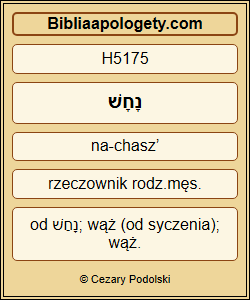 po H5921 skale H6697 po H5921 skale H6697 , droga H1870 statku H591 , droga H1870 statku H591 w sercu H3820 w sercu H3820 morza H3220 morza H3220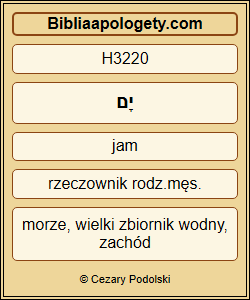 i droga H1870 mężczyzny H1397 z młodą kobietą H5959 i droga H1870 mężczyzny H1397 z młodą kobietą H5959 . (Prz30_19 tłum. AI) . (Prz30_19 tłum. AI) |
| L03 |
Prz30_19 |
drogi orła po niebie, drogi węża po skale, drogi okrętu po morzu, drogi mężczyzny u młodej kobiety. (Prz30_19 BT_4) |
| L04 |
Prz30_19 |
Drogi H1870 orła H5404 po niebie H8064, drogi H1870 węża H5175 po skale H6697, drogi H1870 statku H591 po morzu H3220 i drogi H1870 mężczyzny H1397 do młodej kobiety H5959. (Prz30_19 BT_4) |
| L05 |
Prz30_19 |
<De>•rech |
han•<Ne>•szer |
basz•sza•ma•<jim> |
<De>•rech |
na•<Chasz>, |
'a•<Le> |
cur |
de•rech- |
'o•ni•<ja> |
we•lew- |
<jam>; |
we•<De>•rech |
<Ge>•wer |
be•'al•<Ma>. |
| L06 |
Prz30_19 |
דֶּ֤רֶךְ |
הַנֶּ֨שֶׁר ׀ |
בַּשָּׁמַיִם֮ |
דֶּ֥רֶךְ |
נָחָ֗שׁ |
עֲלֵ֫י |
צ֥וּר |
דֶּֽרֶךְ־ |
אֳנִיָּ֥ה |
בְלֶב־ |
יָ֑ם |
וְדֶ֖רֶךְ |
גֶּ֣בֶר |
בְּעַלְמָֽה׃ |
| L07 |
Prz30_19 |
Droga |
orła |
na niebie, |
droga |
węża |
po |
skale, |
droga |
statku |
w sercu |
morza |
i droga |
mężczyzny |
z młodą kobietą. |
| L08 |
Prz30_19 |
דֶּ֤רֶךְ |
הַ/נֶּ֨שֶׁר ׀ |
בַּ/שָּׁמַיִם֮ |
דֶּ֥רֶךְ |
נָחָ֗שׁ |
עֲלֵ֫י |
צ֥וּר |
דֶּֽרֶךְ־ |
אֳנִיָּ֥ה |
בְ/לֶב־ |
יָ֑ם |
וְ/דֶ֖רֶךְ |
גֶּ֣בֶר |
בְּ/עַלְמָֽה׃ |
| L09 |
Prz30_19 |
HNcbscRzecz. posp., r. wspólny, lp., stan konstrukcyjny |
HTd/NcmsaPartykuła rodzajnik określony + Rzecz. posp., m., lp., stan absolutny |
HRd/NcmpaPrzyim. z rodzajnikiem + Rzecz. posp., m., lm., stan absolutny |
HNcbscRzecz. posp., r. wspólny, lp., stan konstrukcyjny |
HNcmsaRzecz. posp., m., lp., stan absolutny |
HRPrzyim. |
HNcmsaRzecz. posp., m., lp., stan absolutny |
HNcbscRzecz. posp., r. wspólny, lp., stan konstrukcyjny |
HNcfsaRzecz. posp., ż., lp., stan absolutny |
HR/NcmscPrzyim. + Rzecz. posp., m., lp., stan konstrukcyjny |
HNcmsaRzecz. posp., m., lp., stan absolutny |
HC/NcbscSpój. + Rzecz. posp., r. wspólny, lp., stan konstrukcyjny |
HNcmsaRzecz. posp., m., lp., stan absolutny |
HR/NcfsaPrzyim. + Rzecz. posp., ż., lp., stan absolutny |
| L10 |
Prz30_19 |
Deºrek |
hanneºšer |
Baššämayìm |
Deºrek |
näHäš |
`álê |
cûr |
De|rek- |
´óniyyâ |
büleb- |
yäm |
wüdeºrek |
Geºber |
Bü`almâ |
| L11 |
Prz30_19 |
H1870 |
H5404 |
H8064 |
H1870 |
H5175 |
H5921 |
H6697 |
H1870 |
H0591 |
H3820 |
H3220 |
H1870 |
H1397 |
H5959 |
| L12 |
Prz30_19 |
The way |
of an eagle |
in the air |
the way |
of a serpent |
on |
upon a rock |
the way |
of a ship |
in the midst |
of the sea |
and the way |
of a man |
with a maid |
| L13 |
Prz30_19 |
De·rech |
han·Ne·sher |
bash·sha·ma·Yim |
De·rech |
na·Chash, |
'a·Lei |
tzur |
de·rech- |
'o·ni·Yah |
ve·lev- |
Yam; |
ve·De·rech |
Ge·ver |
be·'al·Mah. |
| L14 |
Prz30_19 |
דֶּרֶךְ |
נֶשֶׁר |
שָׁמַיִם |
דֶּרֶךְ |
נָחָשׁ |
עַל |
צוּר |
דֶּרֶךְ |
אֳנִיָּה |
לֵב |
יָם |
דֶּרֶךְ |
גֶּבֶר |
עַלְמָה |
| L15 |
Prz30_19 |
(De)·rech |
(Ne)·szer |
sza·(Ma)·jim |
(De)·rech |
na·(Chasz) |
('Al) |
(Cur) |
(De)·rech |
'o·ni·(Ja) |
(Lew) |
(Jam) |
(De)·rech |
(Ge)·wer |
'al·(Ma) |
| L16 |
Prz30_19 |
déreḵ |
néšer |
šāmájim |
déreḵ |
nāḥāš |
‘al |
ṣûr |
déreḵ |
’ᵒ̆nijjā(h) |
lēḇ |
jām |
déreḵ |
géḇer |
‘almā(h) |
| L17 |
Prz30_19 |
derek |
nešer |
šāmajim |
derek |
nāḥāš |
‘al |
ṣûr |
derek |
’ŏnijjāh |
lēb |
jām |
derek |
geber |
‘almāh |
| L18 |
Prz30_19 |
The way of an eagle in the air; the way of a serpent upon a rock; the way of a ship in the midst of the sea; and the way of a man with a maid. (Prz30_19 KJV) |
| L19 |
Prz30_19 |
19 The way <01870> of an eagle <05404> in the air <08064>; the way <01870> of a serpent <05175> upon a rock <06697>; the way <01870> of a ship <0591> in the midst <03820> of the sea <03220>; and the way <01870> of a man <01397> with a maid <05959>. (Prz30_19 KJV) |
| L20 |
Prz30_19 |
450/700 |
12/26 |
308/421 |
451/700 |
20/31 |
3955/5759 |
61/77 |
452/700 |
17/30 |
385/592 |
238/396 |
453/700 |
46/65 |
4/7 |
| L21 |
Prz30_19 |
Prz30_19_1 |
Prz30_19_2 |
Prz30_19_3 |
Prz30_19_4 |
Prz30_19_5 |
Prz30_19_6 |
Prz30_19_7 |
Prz30_19_8 |
Prz30_19_9 |
Prz30_19_10 |
Prz30_19_11 |
Prz30_19_12 |
Prz30_19_13 |
Prz30_19_14 |
| |
| L01 |
Prz30_20 |
Taka [jest] droga kobiety cudzołożnej: zjada, i ociera usta swoje, i mówi: „Nie uczyniłam nieprawości”. (Prz30_20 tłum. AI) |
| L02 |
Prz30_20 |
Taka [jest H3651 ] droga H1870 kobiety H802 ] droga H1870 kobiety H802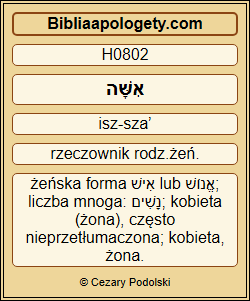 cudzołożnej H5003 cudzołożnej H5003 : zjada H398, i ociera H4229 : zjada H398, i ociera H4229 usta swoje H6310 usta swoje H6310 , i mówi H559: „Nie H3808 uczyniłam H6466 , i mówi H559: „Nie H3808 uczyniłam H6466 nieprawości H205 nieprawości H205 ”. (Prz30_20 tłum. AI) ”. (Prz30_20 tłum. AI) |
| L03 |
Prz30_20 |
Tak postępuje cudzołożnica: zjadła, obtarła swe usta i rzekła: źle nie zrobiłam. (Prz30_20 BT_4) |
| L04 |
Prz30_20 |
Tak postępuje cudzołożnica H802 H5003: zje H398, obetrze H4229 usta H6310 i powie H559: „Nie zrobiłam H6466 nic złego H205.” (Prz30_20 BT_4) |
| L05 |
Prz30_20 |
ken |
<De>•rech |
'isz•<sza>, |
me•<Na>•'<A>•fet |
'<A>•che•la |
u•<Ma>•cha•ta |
<Fi>•ha; |
we•'a•me•<Ra>, |
lo- |
fa•'<Al>•ti |
'<A>•wen. |
<Pe> |
| L06 |
Prz30_20 |
כֵּ֤ן ׀ |
דֶּ֥רֶךְ |
אִשָּׁ֗ה |
מְנָ֫אָ֥פֶת |
אָ֭כְלָה |
וּמָ֣חֲתָה |
פִ֑יהָ |
וְ֝אָמְרָ֗ה |
לֹֽא־ |
פָעַ֥לְתִּי |
אָֽוֶן׃ |
פ |
| L07 |
Prz30_20 |
Taka [jest] |
droga |
kobiety |
cudzołożnej: |
zjada, |
i ociera |
usta swoje, |
i mówi: |
„Nie |
uczyniłam |
nieprawości”. |
¶ |
| L08 |
Prz30_20 |
כֵּ֤ן ׀ |
דֶּ֥רֶךְ |
אִשָּׁ֗ה |
מְנָ֫אָ֥פֶת |
אָ֭כְלָה |
וּ/מָ֣חֲתָה |
פִ֑י/הָ |
וְ֝/אָמְרָ֗ה |
לֹֽא־ |
פָעַ֥לְתִּי |
אָֽוֶן׃ |
פ |
| L09 |
Prz30_20 |
HTmPartykuła wskazująca |
HNcbscRzecz. posp., r. wspólny, lp., stan konstrukcyjny |
HNcfsaRzecz. posp., ż., lp., stan absolutny |
HVprfsaCzas. piel, imiesłów czynny, ż., lp., stan absolutny |
HVqp3fsCzas. qal, perfectum, 3 os., ż., lp. |
HC/Vqq3fsSpój. + Czas. qal, perf. konsekutywne, 3 os., ż., lp. |
HNcmsc/Sp3fsRzecz. posp., m., lp., stan konstrukcyjny + Sufiks zaimkowy, 3 os., ż., lp. |
HC/Vqq3fsSpój. + Czas. qal, perf. konsekutywne, 3 os., ż., lp. |
HTnPartykuła przecząca |
HVqp1csCzas. qal, perfectum, 1 os., r. wspólny, lp. |
HNcmsaRzecz. posp., m., lp., stan absolutny |
MARK-PZnacznik podziału: petucha (akapit otwarty) |
| L10 |
Prz30_20 |
Kën |
Deºrek |
´iššâ |
münä´äºpet |
´äklâ |
ûmäºHátâ |
pîºhä |
wü´ämrâ |
lö|´- |
pä`aºlTî |
´äºwen |
P |
| L11 |
Prz30_20 |
H3651 |
H1870 |
H0802 |
H5003 |
H0398 |
H4229 |
H6310 |
H0559 |
H3808 |
H6466 |
H0205 |
|
| L12 |
Prz30_20 |
This |
Such [is] the way |
woman |
of an adulterous |
she eateth |
and wipeth |
her mouth |
and saith |
no |
I have done |
no wickedness |
|
| L13 |
Prz30_20 |
ken |
De·rech |
'ish·Shah, |
me·Na·'A·fet |
'A·che·lah |
u·Ma·cha·tah |
Fi·ha; |
ve·'a·me·Rah, |
lo- |
fa·'Al·ti |
'A·ven. |
Peh |
| L14 |
Prz30_20 |
כֵּן |
דֶּרֶךְ |
אִשָּׁה |
נָאַף |
אָכַל |
מָחָה |
פֶּה |
אָמַר |
לֹא |
פָּעַל |
אָוֶן |
|
| L15 |
Prz30_20 |
(Ken) |
(De)·rech |
'isz·(Sza) |
na·('Af) |
a·(Chal) |
ma·(Cha) |
(Pe) |
'a·(Mar) |
(Lo) |
pa·('Al.) |
'(A)·wen |
|
| L16 |
Prz30_20 |
kēn |
déreḵ |
’iššā(h) |
nā’ap̱ |
’āḵal |
māḥā(h) |
pe(h) |
’āmar |
lō(’) |
pā‘al |
’ā́wen |
|
| L17 |
Prz30_20 |
kēn |
derek |
’iššāh |
nā’ap |
’ākal |
māḥāh |
peh |
’āmar |
lō’ |
pā‘al |
’āwen |
|
| L18 |
Prz30_20 |
Such [is] the way of an adulterous woman; she eateth, and wipeth her mouth, and saith, I have done no wickedness. (Prz30_20 KJV) |
| L19 |
Prz30_20 |
20 Such is the way <01870> of an adulterous <05003> (08764) woman <0802>; she eateth <0398> (08804), and wipeth <04229> (08804) her mouth <06310>, and saith <0559> (08804), I have done <06466> (08804) no wickedness <0205>. (Prz30_20 KJV) |
| L20 |
Prz30_20 |
438/767 |
454/700 |
676/781 |
10/31 |
564/806 |
29/36 |
382/497 |
3859/5298 |
3372/5164 |
44/56 |
54/78 |
|
| L21 |
Prz30_20 |
Prz30_20_1 |
Prz30_20_2 |
Prz30_20_3 |
Prz30_20_4 |
Prz30_20_5 |
Prz30_20_6 |
Prz30_20_7 |
Prz30_20_8 |
Prz30_20_9 |
Prz30_20_10 |
Prz30_20_11 |
Prz30_20_12 |
| |
| L01 |
Prz30_21 |
Pod trzema [rzeczami] drży ziemia, a pod czterema nie może wytrzymać: (Prz30_21 tłum. AI) |
| L02 |
Prz30_21 |
Pod H8478 trzema [rzeczami H7969] drży H7264 trzema [rzeczami H7969] drży H7264 ziemia H776, a pod H8478 czterema H702 nie H3808 może H3201 ziemia H776, a pod H8478 czterema H702 nie H3808 może H3201 wytrzymać H5375: (Prz30_21 tłum. AI) wytrzymać H5375: (Prz30_21 tłum. AI) |
| L03 |
Prz30_21 |
Pod trzema rzeczami drży ziemia i czterech znieść nie może: (Prz30_21 BT_4) |
| L04 |
Prz30_21 |
Pod trzema H7969 rzeczami drży H7264 ziemia H776 i czterech H702 znieść nie może H3201: (Prz30_21 BT_4) |
| L05 |
Prz30_21 |
<Ta>•chat |
losz |
<Ra>•ge•za |
'<E>•rec; |
we•<Ta>•chat |
'ar•<Ba>', |
lo- |
tu•<Chal> |
se•'<Et>. |
| L06 |
Prz30_21 |
תַּ֣חַת |
שָׁ֭לוֹשׁ |
רָ֣גְזָה |
אֶ֑רֶץ |
וְתַ֥חַת |
אַ֝רְבַּ֗ע |
לֹא־ |
תוּכַ֥ל |
שְׂאֵֽת׃ |
| L07 |
Prz30_21 |
Pod |
trzema [rzeczami] |
drży |
ziemia, |
a pod |
czterema |
nie |
może |
wytrzymać: |
| L08 |
Prz30_21 |
תַּ֣חַת |
שָׁ֭לוֹשׁ |
רָ֣גְזָה |
אֶ֑רֶץ |
וְ/תַ֥חַת |
אַ֝רְבַּ֗ע |
לֹא־ |
תוּכַ֥ל |
שְׂאֵֽת׃ |
| L09 |
Prz30_21 |
HRPrzyim. |
HAcfsaPrzym. liczebnik główny, ż., lp., stan absolutny |
HVqp3fsCzas. qal, perfectum, 3 os., ż., lp. |
HNcbsaRzecz. posp., r. wspólny, lp., stan absolutny |
HC/RSpój. + Przyim. |
HAcfsaPrzym. liczebnik główny, ż., lp., stan absolutny |
HTnPartykuła przecząca |
HVqi3fsCzas. qal, imperfektum, 3 os., ż., lp. |
HVqcCzas. qal, bezok. konstrukcyjny |
| L10 |
Prz30_21 |
TaºHat |
šälôš |
räºgzâ |
´eºrec |
wütaºHat |
´arBa` |
lö´- |
tûkal |
Sü´ët |
| L11 |
Prz30_21 |
H8478 |
H7969 |
H7264 |
H0776 |
H8478 |
H0702 |
H3808 |
H3201 |
H5375 |
| L12 |
Prz30_21 |
Under |
For three |
is disquieted |
[things] the earth |
and under |
and for four |
it |
[which] it cannot |
bear |
| L13 |
Prz30_21 |
Ta·chat |
loosh |
Ra·ge·zah |
'E·retz; |
ve·Ta·chat |
'ar·Ba', |
lo- |
tu·Chal |
se·'Et. |
| L14 |
Prz30_21 |
תַּחַת |
שָׁלוֹשׁ |
רָגַז |
אֶרֶץ |
תַּחַת |
אַרְבַּע |
לֹא |
יָכֹל |
נָשָׂא |
| L15 |
Prz30_21 |
(Ta)·chat |
sza·(Losz) |
ra·(Gaz) |
'(E)·rec |
(Ta)·chat |
'ar·(Ba)' |
(Lo) |
ja·(Chol) |
na·(Sa) |
| L16 |
Prz30_21 |
táḥaṯ |
šālôš |
rāg̱az |
’éreṣ |
táḥaṯ |
’arba‘ |
lō(’) |
jāḵōl |
nāśā(’) |
| L17 |
Prz30_21 |
taḥat |
šālôš |
rāgaz |
’ereṣ |
taḥat |
’arba‘ |
lō’ |
jākōl |
nāśā’ |
| L18 |
Prz30_21 |
For three [things] the earth is disquieted, and for four [which] it cannot bear: (Prz30_21 KJV) |
| L19 |
Prz30_21 |
21 For three <07969> things the earth <0776> is disquieted <07264> (08804), and for four <0702> which it cannot <03201> (08799) bear <05375> (08800): (Prz30_21 KJV) |
| L20 |
Prz30_21 |
364/498 |
373/429 |
20/41 |
1654/2502 |
365/498 |
227/316 |
3373/5164 |
136/191 |
436/650 |
| L21 |
Prz30_21 |
Prz30_21_1 |
Prz30_21_2 |
Prz30_21_3 |
Prz30_21_4 |
Prz30_21_5 |
Prz30_21_6 |
Prz30_21_7 |
Prz30_21_8 |
Prz30_21_9 |
| |
| L01 |
Prz30_22 |
pod sługą, gdy króluje, i głupcem, gdy nasyci się chlebem; (Prz30_22 tłum. AI) |
| L02 |
Prz30_22 |
pod H8478 sługą H5650, gdy H3588 króluje H4427 , i głupcem H5036 , i głupcem H5036 , gdy H3588 nasyci się H7646 chlebem H3899; (Prz30_22 tłum. AI) , gdy H3588 nasyci się H7646 chlebem H3899; (Prz30_22 tłum. AI) |
| L03 |
Prz30_22 |
pod niewolnikiem, gdy królem zostanie; pod głupcem, gdy je do syta; (Prz30_22 BT_4) |
| L04 |
Prz30_22 |
Pod sługą H5650, który zostaje królem H4427, pod głupcem H5036, który się nasyci H7646 chlebem H3899, (Prz30_22 BT_4) |
| L05 |
Prz30_22 |
ta•chat- |
'<E>•wed |
ki |
jim•<Loch>; |
we•na•<wal>, |
ki |
jis•ba'- |
<La>•chem. |
| L06 |
Prz30_22 |
תַּֽחַת־ |
עֶ֭בֶד |
כִּ֣י |
יִמְל֑וֹךְ |
וְ֝נָבָ֗ל |
כִּ֣י |
יִֽשְׂבַּֽע־ |
לָֽחֶם׃ |
| L07 |
Prz30_22 |
pod |
sługą, |
gdy |
króluje, |
i głupcem, |
gdy |
nasyci się |
chlebem; |
| L08 |
Prz30_22 |
תַּֽחַת־ |
עֶ֭בֶד |
כִּ֣י |
יִמְל֑וֹךְ |
וְ֝/נָבָ֗ל |
כִּ֣י |
יִֽשְׂבַּֽע־ |
לָֽחֶם׃ |
| L09 |
Prz30_22 |
HRPrzyim. |
HNcmsaRzecz. posp., m., lp., stan absolutny |
HCSpój. |
HVqi3msCzas. qal, imperfektum, 3 os., m., lp. |
HC/AamsaSpój. + Przym. zwykły, m., lp., stan absolutny |
HCSpój. |
HVqi3msCzas. qal, imperfektum, 3 os., m., lp. |
HNcbsaRzecz. posp., r. wspólny, lp., stan absolutny |
| L10 |
Prz30_22 |
Ta|Hat- |
`ebed |
Kî |
yimlôk |
wünäbäl |
Kî |
yi|SBa|`- |
läºHem |
| L11 |
Prz30_22 |
H8478 |
H5650 |
H3588 |
H4427 |
H5036 |
H3588 |
H7646 |
H3899 |
| L12 |
Prz30_22 |
Under |
For a servant |
when |
when he reigneth |
and a fool |
when |
when he is filled |
with meat |
| L13 |
Prz30_22 |
ta·chat- |
'E·ved |
ki |
yim·Loch; |
ve·na·Val, |
ki |
yis·ba'- |
La·chem. |
| L14 |
Prz30_22 |
תַּחַת |
עֶבֶד |
כִּי |
מָלַךְ |
נָבָל |
כִּי |
שָׂבַע |
לֶחֶם |
| L15 |
Prz30_22 |
(Ta)·chat |
'(E)·wed |
(Ki) |
ma·(Lach) |
na·(Wal) |
(Ki) |
sa·(Wa') |
(Le)·chem |
| L16 |
Prz30_22 |
táḥaṯ |
‘éḇeḏ |
kî |
mālaḵ |
nāḇāl |
kî |
śāḇa‘ |
léḥem |
| L17 |
Prz30_22 |
taḥat |
‘ebed |
kî |
mālak |
nābāl |
kî |
śāba‘ |
leḥem |
| L18 |
Prz30_22 |
For a servant when he reigneth; and a fool when he is filled with meat; (Prz30_22 KJV) |
| L19 |
Prz30_22 |
22 For a servant <05650> when he reigneth <04427> (08799); and a fool <05036> when he is filled <07646> (08799) with meat <03899>; (Prz30_22 KJV) |
| L20 |
Prz30_22 |
366/498 |
697/797 |
3072/4478 |
322/345 |
14/18 |
3073/4478 |
64/99 |
229/295 |
| L21 |
Prz30_22 |
Prz30_22_1 |
Prz30_22_2 |
Prz30_22_3 |
Prz30_22_4 |
Prz30_22_5 |
Prz30_22_6 |
Prz30_22_7 |
Prz30_22_8 |
| |
| L01 |
Prz30_23 |
pod znienawidzoną [kobietą], gdy wyjdzie za mąż, i służącą, gdy dziedziczy po pani swojej. (Prz30_23 tłum. AI) |
| L02 |
Prz30_23 |
pod H8478 znienawidzoną [kobietą H8130 ], gdy H3588 wyjdzie za mąż H1166 ], gdy H3588 wyjdzie za mąż H1166 , i służącą H8198 , i służącą H8198 , gdy H3588 dziedziczy H3423 po pani swojej H1404 , gdy H3588 dziedziczy H3423 po pani swojej H1404 . (Prz30_23 tłum. AI) . (Prz30_23 tłum. AI) |
| L03 |
Prz30_23 |
pod pogardzaną, gdy żoną i panią zostanie; pod sługą - dziedziczką po pani. (Prz30_23 BT_4) |
| L04 |
Prz30_23 |
pod odtrąconą H8130 kobietą, która wychodzi za mąż H1166, i pod służącą H8198, która wypiera H3423 swoją panią H1404. (Prz30_23 BT_4) |
| L05 |
Prz30_23 |
<Ta>•chat |
nu•'a |
ki |
tib•ba•'<El>; |
we•szif•<Cha>, |
ki- |
ti•<Rasz> |
ge•wir•<Ta>. |
<Pe> |
| L06 |
Prz30_23 |
תַּ֣חַת |
שְׂ֭נוּאָה |
כִּ֣י |
תִבָּעֵ֑ל |
וְ֝שִׁפְחָ֗ה |
כִּֽי־ |
תִירַ֥שׁ |
גְּבִרְתָּֽהּ׃ |
פ |
| L07 |
Prz30_23 |
pod |
znienawidzoną [kobietą], |
gdy |
wyjdzie za mąż, |
i służącą, |
gdy |
dziedziczy |
po pani swojej. |
¶ |
| L08 |
Prz30_23 |
תַּ֣חַת |
שְׂ֭נוּאָה |
כִּ֣י |
תִבָּעֵ֑ל |
וְ֝/שִׁפְחָ֗ה |
כִּֽי־ |
תִירַ֥שׁ |
גְּבִרְתָּֽ/הּ׃ |
פ |
| L09 |
Prz30_23 |
HRPrzyim. |
HVqsfsaCzas. qal, imiesłów bierny, ż., lp., stan absolutny |
HCSpój. |
HVNi3fsCzas. nifal, imperfektum, 3 os., ż., lp. |
HC/NcfsaSpój. + Rzecz. posp., ż., lp., stan absolutny |
HCSpój. |
HVqi3fsCzas. qal, imperfektum, 3 os., ż., lp. |
HNcfsc/Sp3fsRzecz. posp., ż., lp., stan konstrukcyjny + Sufiks zaimkowy, 3 os., ż., lp. |
MARK-PZnacznik podziału: petucha (akapit otwarty) |
| L10 |
Prz30_23 |
TaºHat |
Sünû´â |
Kî |
tiBBä`ël |
wüšipHâ |
Kî|- |
tîraš |
GübirTäh |
P |
| L11 |
Prz30_23 |
H8478 |
H8130 |
H3588 |
H1166 |
H8198 |
H3588 |
H3423 |
H1404 |
|
| L12 |
Prz30_23 |
Under |
For an odious |
when |
[woman] when she is married |
and an handmaid |
when |
that is heir |
to her mistress |
|
| L13 |
Prz30_23 |
Ta·chat |
nu·'ah |
ki |
tib·ba·'El; |
ve·shif·Chah, |
ki- |
ti·Rash |
ge·vir·Tah. |
Peh |
| L14 |
Prz30_23 |
תַּחַת |
שָׂנֵא |
כִּי |
בָּעַל |
שִׁפְחָה |
כִּי |
יָרַשׁ |
גְּבֶרֶת |
|
| L15 |
Prz30_23 |
(Ta)·chat |
sa·(Ne) |
(Ki) |
ba·('Al) |
szif·(Cha) |
(Ki) |
ja·(Rasz) |
ge·(We)·ret |
|
| L16 |
Prz30_23 |
táḥaṯ |
śānē(’) |
kî |
bā‘al |
šip̱ḥā(h) |
kî |
jāraš |
gᵉḇéreṯ |
|
| L17 |
Prz30_23 |
taḥat |
śānē’ |
kî |
bā‘al |
šipḥāh |
kî |
jāraš |
geberet |
|
| L18 |
Prz30_23 |
For an odious [woman] when she is married; and an handmaid that is heir to her mistress. (Prz30_23 KJV) |
| L19 |
Prz30_23 |
23 For an odious <08130> (08803) woman when she is married <01166> (08735); and an handmaid <08198> that is heir <03423> (08799) to her mistress <01404>. (Prz30_23 KJV) |
| L20 |
Prz30_23 |
367/498 |
123/145 |
3074/4478 |
5/15 |
53/63 |
3075/4478 |
197/230 |
6/9 |
|
| L21 |
Prz30_23 |
Prz30_23_1 |
Prz30_23_2 |
Prz30_23_3 |
Prz30_23_4 |
Prz30_23_5 |
Prz30_23_6 |
Prz30_23_7 |
Prz30_23_8 |
Prz30_23_9 |
| |
| L01 |
Prz30_24 |
Cztery [rzeczy] one [są] najmniejsze na ziemi, a one [mimo to są] mądre, bardzo mądre: (Prz30_24 tłum. AI) |
| L02 |
Prz30_24 |
Cztery [rzeczy H702] one [są H1992] najmniejsze na H6996 ziemi H776, a one H1992 [mimo to są] mądre H2450 ziemi H776, a one H1992 [mimo to są] mądre H2450 , bardzo mądre H2449 , bardzo mądre H2449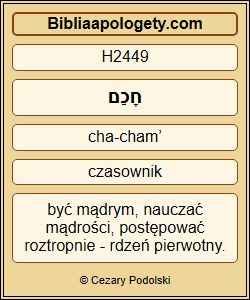 : (Prz30_24 tłum. AI) : (Prz30_24 tłum. AI) |
| L03 |
Prz30_24 |
Są na ziemi cztery istoty małe, lecz najrozumniejsze z mądrych: (Prz30_24 BT_4) |
| L04 |
Prz30_24 |
Cztery H702 rzeczy są najmniejsze H6996 na ziemi H776, a jednak bardzo mądre H2450 H2449: (Prz30_24 BT_4) |
| L05 |
Prz30_24 |
'ar•<Ba>•'a |
hem |
ke•tan•ne- |
'<A>•rec; |
we•<Hem>•ma, |
cha•cha•<Mim> |
me•chuk•ka•<Mim>. |
| L06 |
Prz30_24 |
אַרְבָּ֣עָה |
הֵ֭ם |
קְטַנֵּי־ |
אָ֑רֶץ |
וְ֝הֵ֗מָּה |
חֲכָמִ֥ים |
מְחֻכָּמִֽים׃ |
| L07 |
Prz30_24 |
Cztery [rzeczy] |
one [są] |
najmniejsze na |
ziemi, |
a one |
[mimo to są] mądre, |
bardzo mądre: |
| L08 |
Prz30_24 |
אַרְבָּ֣עָה |
הֵ֭ם |
קְטַנֵּי־ |
אָ֑רֶץ |
וְ֝/הֵ֗מָּה |
חֲכָמִ֥ים |
מְחֻכָּמִֽים׃ |
| L09 |
Prz30_24 |
HAcmsaPrzym. liczebnik główny, m., lp., stan absolutny |
HPp3mpZaimek osobowy, 3 os., m., lm. |
HAampcPrzym. zwykły, m., lm., stan konstrukcyjny |
HNcbsaRzecz. posp., r. wspólny, lp., stan absolutny |
HC/Pp3mpSpój. + Zaimek osobowy, 3 os., m., lm. |
HAampaPrzym. zwykły, m., lm., stan absolutny |
HVPsmpaCzas. pual, imiesłów bierny, m., lm., stan absolutny |
| L10 |
Prz30_24 |
´arBäº`â |
hëm |
qü†annê- |
´äºrec |
wühëºmmâ |
Hákämîm |
müHuKKämîm |
| L11 |
Prz30_24 |
H0702 |
H1992 |
H6996 |
H0776 |
H1992 |
H2450 |
H2449 |
| L12 |
Prz30_24 |
There be four |
like |
[things which are] little |
upon the earth |
like |
wise |
but they [are] exceeding |
| L13 |
Prz30_24 |
'ar·Ba·'ah |
hem |
ke·tan·nei- |
'A·retz; |
ve·Hem·mah, |
cha·cha·Mim |
me·chuk·ka·Mim. |
| L14 |
Prz30_24 |
אַרְבַּע |
הֵם |
קָטָן |
אֶרֶץ |
הֵם |
חָכָם |
חָכַם |
| L15 |
Prz30_24 |
'ar·(Ba)' |
(Hem) |
ka·(Tan) |
'(E)·rec |
(Hem) |
cha·(Cham) |
cha·(Cham) |
| L16 |
Prz30_24 |
’arba‘ |
hēm |
qāṭān |
’éreṣ |
hēm |
ḥāḵām |
ḥāḵam |
| L17 |
Prz30_24 |
’arba‘ |
hēm |
qāṭān |
’ereṣ |
hēm |
ḥākām |
ḥākam |
| L18 |
Prz30_24 |
There be four [things which are] little upon the earth, but they [are] exceeding wise: (Prz30_24 KJV) |
| L19 |
Prz30_24 |
24 There be four <0702> things which are little <06996> upon the earth <0776>, but they are exceeding <02449> (08794) wise <02450>: (Prz30_24 KJV) |
| L20 |
Prz30_24 |
228/316 |
523/820 |
76/101 |
1655/2502 |
524/820 |
90/137 |
21/26 |
| L21 |
Prz30_24 |
Prz30_24_1 |
Prz30_24_2 |
Prz30_24_3 |
Prz30_24_4 |
Prz30_24_5 |
Prz30_24_6 |
Prz30_24_7 |
| |
| L01 |
Prz30_25 |
Mrówki [są] ludem nie silnym, a przygotowują latem pokarm swój. (Prz30_25 tłum. AI) |
| L02 |
Prz30_25 |
Mrówki [są H5244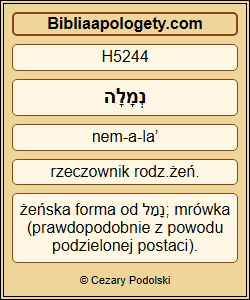 ] ludem H5971 ] ludem H5971 nie H3808 silnym H5794 nie H3808 silnym H5794 , a przygotowują H3559 , a przygotowują H3559 latem H7019 latem H7019 pokarm swój H3899. (Prz30_25 tłum. AI) pokarm swój H3899. (Prz30_25 tłum. AI) |
| L03 |
Prz30_25 |
lud mrówczy, chociaż bez siły, a w lecie nazbiera żywności; (Prz30_25 BT_4) |
| L04 |
Prz30_25 |
Mrówki H5244 – lud H5971 bez mocy H5794, ale latem H7019 gromadzą H3559 swój pokarm H3899. (Prz30_25 BT_4) |
| L05 |
Prz30_25 |
<Han>•ne•ma•lim |
'am |
lo- |
'<Az>; |
wai•ja•<Chi>•nu |
wak•<Ka>•jic |
lach•<Mam>. |
| L06 |
Prz30_25 |
הַ֭נְּמָלִים |
עַ֣ם |
לֹא־ |
עָ֑ז |
וַיָּכִ֖ינוּ |
בַקַּ֣יִץ |
לַחְמָֽם׃ |
| L07 |
Prz30_25 |
Mrówki [są] |
ludem |
nie |
silnym, |
a przygotowują |
latem |
pokarm swój. |
| L08 |
Prz30_25 |
הַ֭/נְּמָלִים |
עַ֣ם |
לֹא־ |
עָ֑ז |
וַ/יָּכִ֖ינוּ |
בַ/קַּ֣יִץ |
לַחְמָֽ/ם׃ |
| L09 |
Prz30_25 |
HTd/NcfpaPartykuła rodzajnik określony + Rzecz. posp., ż., lm., stan absolutny |
HNcmsaRzecz. posp., m., lp., stan absolutny |
HTnPartykuła przecząca |
HAamsaPrzym. zwykły, m., lp., stan absolutny |
HC/Vhw3mpSpój. + Czas. hifil, imperf. konsekutywne, 3 os., m., lm. |
HRd/NcmsaPrzyim. z rodzajnikiem + Rzecz. posp., m., lp., stan absolutny |
HNcbsc/Sp3mpRzecz. posp., r. wspólny, lp., stan konstrukcyjny + Sufiks zaimkowy, 3 os., m., lm. |
| L10 |
Prz30_25 |
hannümälîm |
`am |
lö´- |
`äz |
wayyäkîºnû |
baqqaºyic |
laHmäm |
| L11 |
Prz30_25 |
H5244 |
H5971 |
H3808 |
H5794 |
H3559 |
H7019 |
H3899 |
| L12 |
Prz30_25 |
The ants |
[are] a people |
are not |
not strong |
yet they prepare |
in the summer |
their meat |
| L13 |
Prz30_25 |
Han·ne·ma·lim |
'am |
lo- |
'Az; |
vai·ya·Chi·nu |
vak·Ka·yitz |
lach·Mam. |
| L14 |
Prz30_25 |
נְמָלָה |
עַם |
לֹא |
עַז |
כּוּן |
קַיִץ |
לֶחֶם |
| L15 |
Prz30_25 |
ne·ma·(La) |
('Am) |
(Lo) |
('Az) |
(Kun) |
(Ka)·jic |
(Le)·chem |
| L16 |
Prz30_25 |
nᵉmālā(h) |
‘am |
lō(’) |
‘az |
kûn |
qájiṣ |
léḥem |
| L17 |
Prz30_25 |
nemālāh |
‘am |
lō’ |
‘az |
kûn |
qajiṣ |
leḥem |
| L18 |
Prz30_25 |
The ants [are] a people not strong, yet they prepare their meat in the summer; (Prz30_25 KJV) |
| L19 |
Prz30_25 |
25 The ants <05244> are a people <05971> not strong <05794>, yet they prepare <03559> (08686) their meat <03899> in the summer <07019>; (Prz30_25 KJV) |
| L20 |
Prz30_25 |
2/2 |
1341/1866 |
3374/5164 |
15/24 |
183/216 |
9/20 |
230/295 |
| L21 |
Prz30_25 |
Prz30_25_1 |
Prz30_25_2 |
Prz30_25_3 |
Prz30_25_4 |
Prz30_25_5 |
Prz30_25_6 |
Prz30_25_7 |
| |
| L01 |
Prz30_26 |
Góraliki [są] ludem nie potężnym, a zakładają w skale dom swój. (Prz30_26 tłum. AI) |
| L02 |
Prz30_26 |
Góraliki [są H8227 ] ludem H5971 nie H3808 potężnym H6099 ] ludem H5971 nie H3808 potężnym H6099 , a zakładają H7760 , a zakładają H7760 w skale H5553 w skale H5553 dom swój H1004 dom swój H1004 . (Prz30_26 tłum. AI) . (Prz30_26 tłum. AI) |
| L03 |
Prz30_26 |
góraliki, lud wprawdzie niemocny, ale w skale mieszkania zakłada; (Prz30_26 BT_4) |
| L04 |
Prz30_26 |
Góraliki H8227 – lud H5971 słaby H6099, lecz zakładają H7760 swe domy H1004 w skałach H5553. (Prz30_26 BT_4) |
| L05 |
Prz30_26 |
fan•nim |
'am |
lo- |
'a•<cum>; |
wai•ja•<Si>•mu |
was•<Se>•la' |
be•<Tam>. |
| L06 |
Prz30_26 |
שְׁ֭פַנִּים |
עַ֣ם |
לֹא־ |
עָצ֑וּם |
וַיָּשִׂ֖ימוּ |
בַסֶּ֣לַע |
בֵּיתָֽם׃ |
| L07 |
Prz30_26 |
Góraliki [są] |
ludem |
nie |
potężnym, |
a zakładają |
w skale |
dom swój. |
| L08 |
Prz30_26 |
שְׁ֭פַנִּים |
עַ֣ם |
לֹא־ |
עָצ֑וּם |
וַ/יָּשִׂ֖ימוּ |
בַ/סֶּ֣לַע |
בֵּיתָֽ/ם׃ |
| L09 |
Prz30_26 |
HNcmpaRzecz. posp., m., lm., stan absolutny |
HNcmsaRzecz. posp., m., lp., stan absolutny |
HTnPartykuła przecząca |
HAamsaPrzym. zwykły, m., lp., stan absolutny |
HC/Vqw3mpSpój. + Czas. qal, imperf. konsekutywne, 3 os., m., lm. |
HRd/NcmsaPrzyim. z rodzajnikiem + Rzecz. posp., m., lp., stan absolutny |
HNcmsc/Sp3mpRzecz. posp., m., lp., stan konstrukcyjny + Sufiks zaimkowy, 3 os., m., lm. |
| L10 |
Prz30_26 |
šüpannîm |
`am |
lö´- |
`äcûm |
wayyäSîºmû |
basseºla` |
Bêtäm |
| L11 |
Prz30_26 |
H8227 |
H5971 |
H3808 |
H6099 |
H7760 |
H5553 |
H1004 |
| L12 |
Prz30_26 |
The conies |
folk |
are not |
[are but] a feeble |
yet make |
in the rocks |
they their houses |
| L13 |
Prz30_26 |
fan·nim |
'am |
lo- |
'a·Tzum; |
vai·ya·Si·mu |
vas·Se·la' |
bei·Tam. |
| L14 |
Prz30_26 |
שָׁפָן |
עַם |
לֹא |
עָצוּם |
שׂוּם |
סֶלַע |
בַּיִת |
| L15 |
Prz30_26 |
sza·(Fan) |
('Am) |
(Lo) |
'a·(Cum) |
(Sum) |
(Se)·la' |
(Ba)·jit |
| L16 |
Prz30_26 |
šāp̱ān |
‘am |
lō(’) |
‘āṣûm |
śûm |
séla‘ |
bájiṯ |
| L17 |
Prz30_26 |
šāpān |
‘am |
lō’ |
‘āṣûm |
śûm |
sela‘ |
bajit |
| L18 |
Prz30_26 |
The conies [are but] a feeble folk, yet make they their houses in the rocks; (Prz30_26 KJV) |
| L19 |
Prz30_26 |
26 The conies <08227> are but a feeble <06099> folk <05971>, yet make <07760> (08799) they their houses <01004> in the rocks <05553>; (Prz30_26 KJV) |
| L20 |
Prz30_26 |
22/34 |
1342/1866 |
3375/5164 |
18/31 |
397/581 |
38/59 |
1502/2052 |
| L21 |
Prz30_26 |
Prz30_26_1 |
Prz30_26_2 |
Prz30_26_3 |
Prz30_26_4 |
Prz30_26_5 |
Prz30_26_6 |
Prz30_26_7 |
| |
| L01 |
Prz30_27 |
Króla nie ma szarańcza, a wychodzi w szyku cała. (Prz30_27 tłum. AI) |
| L02 |
Prz30_27 |
Króla H4428 nie ma H369 nie ma H369 szarańcza H697 szarańcza H697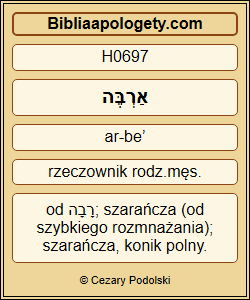 , a wychodzi H3318 , a wychodzi H3318 w szyku H2686 w szyku H2686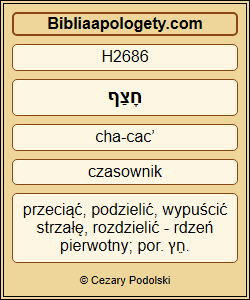 cała H3605. (Prz30_27 tłum. AI) cała H3605. (Prz30_27 tłum. AI) |
| L03 |
Prz30_27 |
szarańcza, która choć nie ma króla, cała wyrusza w porządku; (Prz30_27 BT_4) |
| L04 |
Prz30_27 |
Szarańcza H697 – nie ma króla H4428, a jednak cała H3605 wyrusza H3318 w szyku H2686. (Prz30_27 BT_4) |
| L05 |
Prz30_27 |
<Me>•lech |
'en |
la•'ar•<Be>; |
wai•je•<ce> |
cho•<cec> |
kul•<Lo>. |
| L06 |
Prz30_27 |
מֶ֭לֶךְ |
אֵ֣ין |
לָאַרְבֶּ֑ה |
וַיֵּצֵ֖א |
חֹצֵ֣ץ |
כֻּלּֽוֹ׃ |
| L07 |
Prz30_27 |
Króla |
nie ma |
szarańcza, |
a wychodzi |
w szyku |
cała. |
| L08 |
Prz30_27 |
מֶ֭לֶךְ |
אֵ֣ין |
לָ/אַרְבֶּ֑ה |
וַ/יֵּצֵ֖א |
חֹצֵ֣ץ |
כֻּלּֽ/וֹ׃ |
| L09 |
Prz30_27 |
HNcmsaRzecz. posp., m., lp., stan absolutny |
HTnPartykuła przecząca |
HRd/NcmsaPrzyim. z rodzajnikiem + Rzecz. posp., m., lp., stan absolutny |
HC/Vqw3msSpój. + Czas. qal, imperf. konsekutywne, 3 os., m., lp. |
HVqrmsaCzas. qal, imiesłów czynny, m., lp., stan absolutny |
HNcmsc/Sp3msRzecz. posp., m., lp., stan konstrukcyjny + Sufiks zaimkowy, 3 os., m., lp. |
| L10 |
Prz30_27 |
melek |
´ên |
lä´arBè |
wayyëcë´ |
Höcëc |
Kullô |
| L11 |
Prz30_27 |
H4428 |
H0369 |
H0697 |
H3318 |
H2686 |
H3605 |
| L12 |
Prz30_27 |
have no king |
have |
The locusts |
yet go they forth |
all of them by bands |
all |
| L13 |
Prz30_27 |
Me·lech |
'ein |
la·'ar·Beh; |
vai·ye·Tze |
cho·Tzetz |
kul·Lo. |
| L14 |
Prz30_27 |
מֶלֶךְ |
אַיִן |
אַרְבֶּה |
יָצָא |
חָצַץ |
כֹּל |
| L15 |
Prz30_27 |
(Me)·lech |
'(A)·jin |
'ar·(Be) |
ja·(Ca) |
cha·(Cac) |
(Kol) |
| L16 |
Prz30_27 |
méleḵ |
’ájin |
’arbe(h) |
jāṣā(’) |
ḥāṣaṣ |
kōl |
| L17 |
Prz30_27 |
melek |
’ajin |
’arbeh |
jāṣā’ |
ḥāṣaṣ |
kōl |
| L18 |
Prz30_27 |
The locusts have no king, yet go they forth all of them by bands; (Prz30_27 KJV) |
| L19 |
Prz30_27 |
27 The locusts <0697> have no king <04428>, yet go they forth <03318> (08799) all of them by bands <02686> (08802); (Prz30_27 KJV) |
| L20 |
Prz30_27 |
2008/2519 |
456/786 |
18/24 |
809/1060 |
3/3 |
3991/5415 |
| L21 |
Prz30_27 |
Prz30_27_1 |
Prz30_27_2 |
Prz30_27_3 |
Prz30_27_4 |
Prz30_27_5 |
Prz30_27_6 |
| |
| L01 |
Prz30_28 |
Jaszczurkę rękami schwycisz, a ona [jest] w pałacach króla. (Prz30_28 tłum. AI) |
| L02 |
Prz30_28 |
Jaszczurkę H8079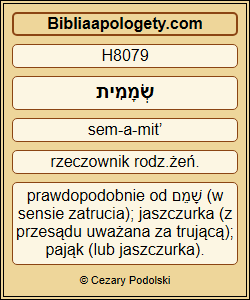 rękami H3027 rękami H3027 schwycisz H8610, a ona [jest H1931] w pałacach H1964 schwycisz H8610, a ona [jest H1931] w pałacach H1964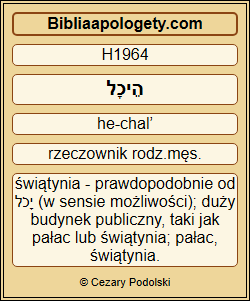 króla H4428. (Prz30_28 tłum. AI) króla H4428. (Prz30_28 tłum. AI) |
| L03 |
Prz30_28 |
jaszczurka, co nie da się schwycić rękami, a mieszka w pałacach królewskich. (Prz30_28 BT_4) |
| L04 |
Prz30_28 |
Jaszczurka H8079 – da się złapać H8610 ręką H3027, a bywa w pałacach H1964 królewskich H4428. (Prz30_28 BT_4) |
| L05 |
Prz30_28 |
ma•mit |
be•ja•<Da>•jim |
te•tap•<Pes>; |
we•<Hi>, |
be•<He>•che•le |
<Me>•lech. |
<Pe> |
| L06 |
Prz30_28 |
שְׂ֭מָמִית |
בְּיָדַ֣יִם |
תְּתַפֵּ֑שׂ |
וְ֝הִ֗יא |
בְּהֵ֣יכְלֵי |
מֶֽלֶךְ׃ |
פ |
| L07 |
Prz30_28 |
Jaszczurkę |
rękami |
schwycisz, |
a ona [jest] |
w pałacach |
króla. |
¶ |
| L08 |
Prz30_28 |
שְׂ֭מָמִית |
בְּ/יָדַ֣יִם |
תְּתַפֵּ֑שׂ |
וְ֝/הִ֗יא |
בְּ/הֵ֣יכְלֵי |
מֶֽלֶךְ׃ |
פ |
| L09 |
Prz30_28 |
HNcfsaRzecz. posp., ż., lp., stan absolutny |
HR/NcbdaPrzyim. + Rzecz. posp., r. wspólny, podw., stan absolutny |
HVpi2msCzas. piel, imperfektum, 2 os., m., lp. |
HC/Pp3fsSpój. + Zaimek osobowy, 3 os., ż., lp. |
HR/NcmpcPrzyim. + Rzecz. posp., m., lm., stan konstrukcyjny |
HNcmsaRzecz. posp., m., lp., stan absolutny |
MARK-PZnacznik podziału: petucha (akapit otwarty) |
| L10 |
Prz30_28 |
Sümämît |
Büyädaºyim |
TütaPPëS |
wühî´ |
Bühêºklê |
meºlek |
P |
| L11 |
Prz30_28 |
H8079 |
H3027 |
H8610 |
H1931 |
H1964 |
H4428 |
|
| L12 |
Prz30_28 |
The spider |
with her hands |
taketh hold |
he |
palaces |
and is in kings' |
|
| L13 |
Prz30_28 |
ma·mit |
be·ya·Da·yim |
te·tap·Pes; |
ve·Hi, |
be·Hei·che·lei |
Me·lech. |
Peh |
| L14 |
Prz30_28 |
שְׂמָמִית |
יָד |
תָּפַשׂ |
הוּא |
הֵיכָל |
מֶלֶךְ |
|
| L15 |
Prz30_28 |
se·ma·(Mit) |
(Jad) |
ta·(Fas) |
(Hu) |
he·(Chal) |
(Me)·lech |
|
| L16 |
Prz30_28 |
śᵉmāmîṯ |
jāḏ |
tāp̱aś |
hû(’) |
hêḵāl |
méleḵ |
|
| L17 |
Prz30_28 |
śemāmît |
jād |
tāpaś |
hû’ |
hêkāl |
melek |
|
| L18 |
Prz30_28 |
The spider taketh hold with her hands, and is in kings' palaces. (Prz30_28 KJV) |
| L19 |
Prz30_28 |
28 The spider <08079> taketh hold <08610> (08762) with her hands <03027>, and is in kings' <04428> palaces <01964>. (Prz30_28 KJV) |
| L20 |
Prz30_28 |
1/1 |
1190/1608 |
31/65 |
1410/1867 |
42/80 |
2009/2519 |
|
| L21 |
Prz30_28 |
Prz30_28_1 |
Prz30_28_2 |
Prz30_28_3 |
Prz30_28_4 |
Prz30_28_5 |
Prz30_28_6 |
Prz30_28_7 |
| |
| L01 |
Prz30_29 |
Trzy [rzeczy] one [są] dobrze kroczące, a cztery dobrze chodzące: (Prz30_29 tłum. AI) |
| L02 |
Prz30_29 |
Trzy [rzeczy H7969] one [są H1992] dobrze H3190 kroczące H6806 kroczące H6806 , a cztery H702 dobrze H3190 chodzące H1980 , a cztery H702 dobrze H3190 chodzące H1980 : (Prz30_29 tłum. AI) : (Prz30_29 tłum. AI) |
| L03 |
Prz30_29 |
Trzy rzeczy krok mają wspaniały, a cztery chód mają wyniosły: (Prz30_29 BT_4) |
| L04 |
Prz30_29 |
Trzy H7969 rzeczy dumnie H3190 kroczą H6806, cztery H702 dumnie H3190 stąpają H1980: (Prz30_29 BT_4) |
| L05 |
Prz30_29 |
sze•lo•<sza> |
<Hem>•ma |
me•<Ti>•we |
<ca>•'ad; |
we•'ar•ba•'<Ah>, |
me•<Ti>•we |
<La>•chet. |
| L06 |
Prz30_29 |
שְׁלֹשָׁ֣ה |
הֵ֭מָּה |
מֵיטִ֣יבֵי |
צָ֑עַד |
וְ֝אַרְבָּעָ֗ה |
מֵיטִ֥בֵי |
לָֽכֶת׃ |
| L07 |
Prz30_29 |
Trzy [rzeczy] |
one [są] |
dobrze |
kroczące, |
a cztery |
dobrze |
chodzące: |
| L08 |
Prz30_29 |
שְׁלֹשָׁ֣ה |
הֵ֭מָּה |
מֵיטִ֣יבֵי |
צָ֑עַד |
וְ֝/אַרְבָּעָ֗ה |
מֵיטִ֥בֵי |
לָֽכֶת׃ |
| L09 |
Prz30_29 |
HAcmsaPrzym. liczebnik główny, m., lp., stan absolutny |
HPp3mpZaimek osobowy, 3 os., m., lm. |
HVhrmpcCzas. hifil, imiesłów czynny, m., lm., stan konstrukcyjny |
HNcmsaRzecz. posp., m., lp., stan absolutny |
HC/AcmsaSpój. + Przym. liczebnik główny, m., lp., stan absolutny |
HVhrmpcCzas. hifil, imiesłów czynny, m., lm., stan konstrukcyjny |
HVqcCzas. qal, bezok. konstrukcyjny |
| L10 |
Prz30_29 |
šülöšâ |
hëmmâ |
mê†îºbê |
cäº`ad |
wü´arBä`â |
mê†ìºbê |
läºket |
| L11 |
Prz30_29 |
H7969 |
H1992 |
H3190 |
H6806 |
H0702 |
H3190 |
H1980 |
| L12 |
Prz30_29 |
There be three |
There |
well |
[things] which go |
yea four |
are stately |
walk |
| L13 |
Prz30_29 |
she·lo·Shah |
Hem·mah |
mei·Ti·vei |
Tza·'ad; |
ve·'ar·ba·'Ah, |
mei·Ti·vei |
La·chet. |
| L14 |
Prz30_29 |
שָׁלוֹשׁ |
הֵם |
יָטַב |
צַעַד |
אַרְבַּע |
יָטַב |
הָלַךְ |
| L15 |
Prz30_29 |
sza·(Losz) |
(Hem) |
ja·(Taw) |
(Ca)·'ad |
'ar·(Ba)' |
ja·(Taw) |
ha·(Lach) |
| L16 |
Prz30_29 |
šālôš |
hēm |
jāṭaḇ |
ṣá‘aḏ |
’arba‘ |
jāṭaḇ |
hālaḵ |
| L17 |
Prz30_29 |
šālôš |
hēm |
jāṭab |
ṣa‘ad |
’arba‘ |
jāṭab |
hālak |
| L18 |
Prz30_29 |
There be three [things] which go well, yea, four are comely in going: (Prz30_29 KJV) |
| L19 |
Prz30_29 |
29 There be three <07969> things which go <06806> well <03190> (08688), yea, four <0702> are comely <02895> (08688) in going <03212> (08800): (Prz30_29 KJV) |
| L20 |
Prz30_29 |
374/429 |
525/820 |
80/112 |
12/14 |
229/316 |
81/112 |
1174/1542 |
| L21 |
Prz30_29 |
Prz30_29_1 |
Prz30_29_2 |
Prz30_29_3 |
Prz30_29_4 |
Prz30_29_5 |
Prz30_29_6 |
Prz30_29_7 |
| |
| L01 |
Prz30_30 |
Lew, mocarz wśród zwierząt, i nie cofa się przed nikim; (Prz30_30 tłum. AI) |
| L02 |
Prz30_30 |
Lew H3918 , mocarz H1368 , mocarz H1368 wśród zwierząt H929 wśród zwierząt H929 , i nie H3808 cofa się H7725 , i nie H3808 cofa się H7725 przed H6440 przed H6440 nikim H3605; (Prz30_30 tłum. AI) nikim H3605; (Prz30_30 tłum. AI) |
| L03 |
Prz30_30 |
lew najdzielniejszy wśród zwierząt, przed niczym się nie cofa; (Prz30_30 BT_4) |
| L04 |
Prz30_30 |
Lew H3918 – najmężniejszy H1368 z bestii H929, przed nikim H3605 nie ustępuje H7725; (Prz30_30 BT_4) |
| L05 |
Prz30_30 |
<La>•jisz |
gib•<Bor> |
bab•be•he•<Ma>; |
we•lo- |
ja•<szuw>, |
mip•pe•ne- |
<Chol>. |
| L06 |
Prz30_30 |
לַ֭יִשׁ |
גִּבּ֣וֹר |
בַּבְּהֵמָ֑ה |
וְלֹא־ |
יָ֝שׁ֗וּב |
מִפְּנֵי־ |
כֹֽל׃ |
| L07 |
Prz30_30 |
Lew, |
mocarz |
wśród zwierząt, |
i nie |
cofa się |
przed |
nikim; |
| L08 |
Prz30_30 |
לַ֭יִשׁ |
גִּבּ֣וֹר |
בַּ/בְּהֵמָ֑ה |
וְ/לֹא־ |
יָ֝שׁ֗וּב |
מִ/פְּנֵי־ |
כֹֽל׃ |
| L09 |
Prz30_30 |
HNcmsaRzecz. posp., m., lp., stan absolutny |
HAamsaPrzym. zwykły, m., lp., stan absolutny |
HRd/NcfsaPrzyim. z rodzajnikiem + Rzecz. posp., ż., lp., stan absolutny |
HC/TnSpój. + Partykuła przecząca |
HVqi3msCzas. qal, imperfektum, 3 os., m., lp. |
HR/NcbpcPrzyim. + Rzecz. posp., r. wspólny, lm., stan konstrukcyjny |
HNcmsaRzecz. posp., m., lp., stan absolutny |
| L10 |
Prz30_30 |
layìš |
GiBBôr |
BaBBühëmâ |
wülö´- |
yäšûb |
miPPünê- |
köl |
| L11 |
Prz30_30 |
H3918 |
H1368 |
H0929 |
H3808 |
H7725 |
H6440 |
H3605 |
| L12 |
Prz30_30 |
A lion |
[which is] strongest |
among beasts |
and does not |
and turneth not away |
for |
any |
| L13 |
Prz30_30 |
La·yish |
gib·Bor |
bab·be·he·Mah; |
ve·lo- |
ya·Shuv, |
mip·pe·nei- |
Chol. |
| L14 |
Prz30_30 |
לַיִשׁ |
גִּבּוֹר |
בְּהֵמָה |
לֹא |
שׁוּב |
פָּנִים |
כֹּל |
| L15 |
Prz30_30 |
(La)·jisz |
gib·(Bor) |
be·he·(Ma) |
(Lo) |
(Szuw) |
pa·(Nim) |
(Kol) |
| L16 |
Prz30_30 |
lájiš |
gibbôr |
bᵉhēmā(h) |
lō(’) |
šûḇ |
pānîm |
kōl |
| L17 |
Prz30_30 |
lajiš |
gibbôr |
behēmāh |
lō’ |
šûb |
pānîm |
kōl |
| L18 |
Prz30_30 |
A lion [which is] strongest among beasts, and turneth not away for any; (Prz30_30 KJV) |
| L19 |
Prz30_30 |
30 A lion <03918> which is strongest <01368> among beasts <0929>, and turneth not away <07725> (08799) for <06440> any; (Prz30_30 KJV) |
| L20 |
Prz30_30 |
2/3 |
105/158 |
138/190 |
3376/5164 |
698/1041 |
1616/2127 |
3992/5415 |
| L21 |
Prz30_30 |
Prz30_30_1 |
Prz30_30_2 |
Prz30_30_3 |
Prz30_30_4 |
Prz30_30_5 |
Prz30_30_6 |
Prz30_30_7 |
| |
| L01 |
Prz30_31 |
kogut w biodrach, albo kozioł, i król, przeciw któremu nie ma powstania przy nim. (Prz30_31 tłum. AI) |
| L02 |
Prz30_31 |
kogut H2223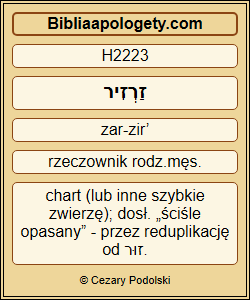 w biodrach H4975 w biodrach H4975 , albo H176 , albo H176 kozioł H8495 kozioł H8495 , i król H4428, przeciw któremu nie ma powstania H510 , i król H4428, przeciw któremu nie ma powstania H510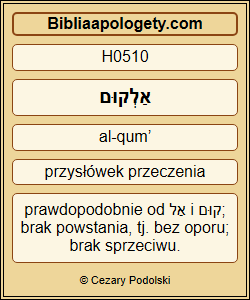 przy nim H5973 przy nim H5973 . (Prz30_31 tłum. AI) . (Prz30_31 tłum. AI) |
| L03 |
Prz30_31 |
kogut, co dumnie chodzi wśród kur; koń bojowy lub kozioł, i król, z którym jest lud [ jego]. (Prz30_31 BT_4) |
| L04 |
Prz30_31 |
Kogut H2223 H4975 wśród kur, kozioł H8495 i król H4428 z armią H5973 H510. (Prz30_31 BT_4) |
| L05 |
Prz30_31 |
zar•<Zir> |
ma•te•<Na>•jim |
'ow- |
<Ta>•jisz; |
u•<Me>•lech, |
'al•<Kum> |
im•<Mo>. |
| L06 |
Prz30_31 |
זַרְזִ֣יר |
מָתְנַ֣יִם |
אוֹ־ |
תָ֑יִשׁ |
וּ֝מֶ֗לֶךְ |
אַלְק֥וּם |
עִמּֽוֹ׃ |
| L07 |
Prz30_31 |
kogut |
w biodrach, |
albo |
kozioł, |
i król, |
przeciw któremu nie ma powstania |
przy nim. |
| L08 |
Prz30_31 |
זַרְזִ֣יר |
מָתְנַ֣יִם |
אוֹ־ |
תָ֑יִשׁ |
וּ֝/מֶ֗לֶךְ |
אַלְק֥וּם |
עִמּֽ/וֹ׃ |
| L09 |
Prz30_31 |
HNcmscRzecz. posp., m., lp., stan konstrukcyjny |
HNcmdaRzecz. posp., m., podw., stan absolutny |
HCSpój. |
HNcmsaRzecz. posp., m., lp., stan absolutny |
HC/NcmsaSpój. + Rzecz. posp., m., lp., stan absolutny |
HDPrzysł. |
HR/Sp3msPrzyim. + Sufiks zaimkowy, 3 os., m., lp. |
| L10 |
Prz30_31 |
zarzîr |
motnaºyim |
´ô- |
täºyiš |
ûmeºlek |
´alqûm |
`immô |
| L11 |
Prz30_31 |
H2223 |
H4975 |
H0176 |
H8495 |
H4428 |
H0510 |
H5973 |
| L12 |
Prz30_31 |
greyhound |
rooster |
also |
an he goat |
and a king |
against whom [there is] no rising up |
with |
| L13 |
Prz30_31 |
zar·Zir |
ma·te·Na·yim |
ov- |
Ta·yish; |
u·Me·lech, |
'al·Kum |
im·Mo. |
| L14 |
Prz30_31 |
זַרְזִיר |
מֹתֶן |
אוֹ |
תַּיִשׁ |
מֶלֶךְ |
אַלְקוּם |
עִם |
| L15 |
Prz30_31 |
zar·(Zir) |
(Mo)·ten |
(O) |
(Ta)·jisz |
(Me)·lech |
'al·(Kum) |
('Im) |
| L16 |
Prz30_31 |
zarzîr |
mṓṯen |
’ô |
tájiš |
méleḵ |
’alqûm |
‘im |
| L17 |
Prz30_31 |
zarzîr |
mōten |
’ô |
tajiš |
melek |
’alqûm |
‘im |
| L18 |
Prz30_31 |
A greyhound; an he goat also; and a king, against whom [there is] no rising up. (Prz30_31 KJV) |
| L19 |
Prz30_31 |
31 A greyhound <04975> <02223>; an he goat <08495> also <0176>; and a king <04428>, against whom there is no rising up <0510>. (Prz30_31 KJV) |
| L20 |
Prz30_31 |
1/1 |
20/47 |
299/320 |
4/4 |
2010/2519 |
1/1 |
956/1043 |
| L21 |
Prz30_31 |
Prz30_31_1 |
Prz30_31_2 |
Prz30_31_3 |
Prz30_31_4 |
Prz30_31_5 |
Prz30_31_6 |
Prz30_31_7 |
| |
| L01 |
Prz30_32 |
Jeśli postąpiłeś głupio wynosząc się albo knułeś, rękę na usta! (Prz30_32 tłum. AI) |
| L02 |
Prz30_32 |
Jeśli H518 postąpiłeś głupio H5034 postąpiłeś głupio H5034 wynosząc się H5375 albo H518 knułeś H2161 wynosząc się H5375 albo H518 knułeś H2161 , rękę H3027 na usta H6310! (Prz30_32 tłum. AI) , rękę H3027 na usta H6310! (Prz30_32 tłum. AI) |
| L03 |
Prz30_32 |
Bezmyślnie uniosłeś się dumą? Po namyśle - rękę na usta! (Prz30_32 BT_4) |
| L04 |
Prz30_32 |
Jeśli uniosłeś się H5375 głupio H5034 – połóż H3027 rękę H3027 na usta H6310. (Prz30_32 BT_4) |
| L05 |
Prz30_32 |
'im- |
na•<wal>•ta |
we•hit•nas•<Se>; |
we•'im- |
zam•<Mo>•ta, |
jad |
le•<Pe>. |
| L06 |
Prz30_32 |
אִם־ |
נָבַ֥לְתָּ |
בְהִתְנַשֵּׂ֑א |
וְאִם־ |
זַ֝מּ֗וֹתָ |
יָ֣ד |
לְפֶֽה׃ |
| L07 |
Prz30_32 |
Jeśli |
postąpiłeś głupio |
wynosząc się |
albo |
knułeś, |
rękę |
na usta! |
| L08 |
Prz30_32 |
אִם־ |
נָבַ֥לְתָּ |
בְ/הִתְנַשֵּׂ֑א |
וְ/אִם־ |
זַ֝מּ֗וֹתָ |
יָ֣ד |
לְ/פֶֽה׃ |
| L09 |
Prz30_32 |
HCSpój. |
HVqp2msCzas. qal, perfectum, 2 os., m., lp. |
HR/VtcPrzyim. + Czas. hitpael, bezok. konstrukcyjny |
HC/CSpój. + Spój. |
HVqp2msCzas. qal, perfectum, 2 os., m., lp. |
HNcbsaRzecz. posp., r. wspólny, lp., stan absolutny |
HR/NcmsaPrzyim. + Rzecz. posp., m., lp., stan absolutny |
| L10 |
Prz30_32 |
´im- |
näbaºlTä |
bühitnaSSë´ |
wü´im- |
zammôºtä |
yäd |
lüpè |
| L11 |
Prz30_32 |
H0518 |
H5034 |
H5375 |
H0518 |
H2161 |
H3027 |
H6310 |
| L12 |
Prz30_32 |
If |
If thou hast done foolishly |
in lifting up |
if |
thyself or if thou hast thought evil |
[lay] thine hand |
upon thy mouth |
| L13 |
Prz30_32 |
im- |
na·Val·ta |
ve·hit·nas·Se; |
ve·'im- |
zam·Mo·ta, |
yad |
le·Peh. |
| L14 |
Prz30_32 |
אִם |
נָבֵל |
נָשָׂא |
אִם |
זָמַם |
יָד |
פֶּה |
| L15 |
Prz30_32 |
'(Im) |
na·(Wel) |
na·(Sa) |
'(Im) |
za·(Mam) |
(Jad) |
(Pe) |
| L16 |
Prz30_32 |
’im |
nāḇēl |
nāśā(’) |
’im |
zāmam |
jāḏ |
pe(h) |
| L17 |
Prz30_32 |
’im |
nābēl |
nāśā’ |
’im |
zāmam |
jād |
peh |
| L18 |
Prz30_32 |
If thou hast done foolishly in lifting up thyself, or if thou hast thought evil, [lay] thine hand upon thy mouth. (Prz30_32 KJV) |
| L19 |
Prz30_32 |
32 If thou hast done foolishly <05034> (08804) in lifting up <05375> (08692) thyself, or if thou hast thought evil <02161> (08804), lay thine hand <03027> upon thy mouth <06310>. (Prz30_32 KJV) |
| L20 |
Prz30_32 |
813/1068 |
9/25 |
437/650 |
814/1068 |
6/13 |
1191/1608 |
383/497 |
| L21 |
Prz30_32 |
Prz30_32_1 |
Prz30_32_2 |
Prz30_32_3 |
Prz30_32_4 |
Prz30_32_5 |
Prz30_32_6 |
Prz30_32_7 |
| |
| L01 |
Prz30_33 |
Bo wyciskanie mleka wydaje masło, a wyciskanie nosa wydaje krew, a wyciskanie gniewu wydaje spór. (Prz30_33 tłum. AI) |
| L02 |
Prz30_33 |
Bo H3588 wyciskanie H4330 mleka H2461 mleka H2461 wydaje H3318 masło H2529 wydaje H3318 masło H2529 , a wyciskanie H4330 nosa H639 , a wyciskanie H4330 nosa H639 wydaje H3318 krew H1818 wydaje H3318 krew H1818 , a wyciskanie H4330 gniewu H639 wydaje H3318 spór H7379 , a wyciskanie H4330 gniewu H639 wydaje H3318 spór H7379 . (Prz30_33 tłum. AI) . (Prz30_33 tłum. AI) |
| L03 |
Prz30_33 |
Bo uciskanie mleka daje masło, uciskanie nosa wywoła krew, uciskanie gniewu - wywoła kłótnie. (Prz30_33 BT_4) |
| L04 |
Prz30_33 |
Bo uciskanie H4330 mleka H2461 daje masło H2529, uciskanie nosa H639 wywołuje krew H1818, a uciskanie gniewu H639 wywołuje kłótnię H7379. (Prz30_33 BT_4) |
| L05 |
Prz30_33 |
ki |
mic |
cha•<Law> |
jo•<ci> |
chem•'<Ah>, |
u•mic- |
'af |
<jo>•ci |
<Dam>; |
u•<Mic> |
'ap•<Pa>•jim, |
<jo>•ci |
<Riw>. |
<Pe> |
| L06 |
Prz30_33 |
כִּ֤י |
מִ֪יץ |
חָלָ֡ב |
י֘וֹצִ֤יא |
חֶמְאָ֗ה |
וּֽמִיץ־ |
אַ֭ף |
י֣וֹצִיא |
דָ֑ם |
וּמִ֥יץ |
אַ֝פַּ֗יִם |
י֣וֹצִיא |
רִֽיב׃ |
פ |
| L07 |
Prz30_33 |
Bo |
wyciskanie |
mleka |
wydaje |
masło, |
a wyciskanie |
nosa |
wydaje |
krew, |
a wyciskanie |
gniewu |
wydaje |
spór. |
¶ |
| L08 |
Prz30_33 |
כִּ֤י |
מִ֪יץ |
חָלָ֡ב |
י֘וֹצִ֤יא |
חֶמְאָ֗ה |
וּֽ/מִיץ־ |
אַ֭ף |
י֣וֹצִיא |
דָ֑ם |
וּ/מִ֥יץ |
אַ֝פַּ֗יִם |
י֣וֹצִיא |
רִֽיב׃ |
פ |
| L09 |
Prz30_33 |
HCSpój. |
HNcmscRzecz. posp., m., lp., stan konstrukcyjny |
HNcmsaRzecz. posp., m., lp., stan absolutny |
HVhi3msCzas. hifil, imperfektum, 3 os., m., lp. |
HNcfsaRzecz. posp., ż., lp., stan absolutny |
HC/NcmscSpój. + Rzecz. posp., m., lp., stan konstrukcyjny |
HTaPartykuła twierdząca |
HVhi3msCzas. hifil, imperfektum, 3 os., m., lp. |
HNcmsaRzecz. posp., m., lp., stan absolutny |
HC/NcmsaSpój. + Rzecz. posp., m., lp., stan absolutny |
HNcmdaRzecz. posp., m., podw., stan absolutny |
HVhi3msCzas. hifil, imperfektum, 3 os., m., lp. |
HNcbsaRzecz. posp., r. wspólny, lp., stan absolutny |
MARK-PZnacznik podziału: petucha (akapit otwarty) |
| L10 |
Prz30_33 |
Kî |
mîc |
Häläb |
yôcî´ |
Hem´â |
û|mîc- |
´ap |
yôºcî´ |
däm |
ûmîc |
´aPPaºyim |
yôºcî´ |
rîb |
P |
| L11 |
Prz30_33 |
H3588 |
H4330 |
H2461 |
H3318 |
H2529 |
H4330 |
H0639 |
H3318 |
H1818 |
H4330 |
H0639 |
H3318 |
H7379 |
|
| L12 |
Prz30_33 |
For |
Surely the churning |
of milk |
bringeth forth |
butter |
and the wringing |
of the nose |
bringeth forth |
blood |
so the forcing |
of wrath |
bringeth forth |
strife |
|
| L13 |
Prz30_33 |
ki |
mitz |
cha·Lav |
yo·Tzi |
chem·'Ah, |
u·mitz- |
'af |
Yo·tzi |
Dam; |
u·Mitz |
'ap·Pa·yim, |
Yo·tzi |
Riv. |
Peh |
| L14 |
Prz30_33 |
כִּי |
מִיץ |
חָלָב |
יָצָא |
חֶמְאָה |
מִיץ |
אַף |
יָצָא |
דָּם |
מִיץ |
אַף |
יָצָא |
רִיב |
|
| L15 |
Prz30_33 |
(Ki) |
(Mic) |
cha·(Law) |
ja·(Ca) |
chem·('A) |
(Mic) |
('Af) |
ja·(Ca) |
(Dam) |
(Mic) |
('Af) |
ja·(Ca) |
(Riw) |
|
| L16 |
Prz30_33 |
kî |
mîṣ |
ḥālāḇ |
jāṣā(’) |
ḥem’ā(h) |
mîṣ |
’ap̱ |
jāṣā(’) |
dām |
mîṣ |
’ap̱ |
jāṣā(’) |
rîḇ |
|
| L17 |
Prz30_33 |
kî |
mîṣ |
ḥālāb |
jāṣā’ |
ḥem’āh |
mîṣ |
’ap |
jāṣā’ |
dām |
mîṣ |
’ap |
jāṣā’ |
rîb |
|
| L18 |
Prz30_33 |
Surely the churning of milk bringeth forth butter, and the wringing of the nose bringeth forth blood: so the forcing of wrath bringeth forth strife. (Prz30_33 KJV) |
| L19 |
Prz30_33 |
33 Surely the churning <04330> of milk <02461> bringeth forth <03318> (08686) butter <02529>, and the wringing <04330> of the nose <0639> bringeth forth <03318> (08686) blood <01818>: so the forcing <04330> of wrath <0639> bringeth forth <03318> (08686) strife <07379>. (Prz30_33 KJV) |
| L20 |
Prz30_33 |
3076/4478 |
1/3 |
30/44 |
810/1060 |
7/10 |
2/3 |
175/276 |
811/1060 |
259/359 |
3/3 |
176/276 |
812/1060 |
40/60 |
|
| L21 |
Prz30_33 |
Prz30_33_1 |
Prz30_33_2 |
Prz30_33_3 |
Prz30_33_4 |
Prz30_33_5 |
Prz30_33_6 |
Prz30_33_7 |
Prz30_33_8 |
Prz30_33_9 |
Prz30_33_10 |
Prz30_33_11 |
Prz30_33_12 |
Prz30_33_13 |
Prz30_33_14 |
| |